ApiClay
Discover APIs or publish data sources as documented paid endpoints
Gallery
About ApiClay
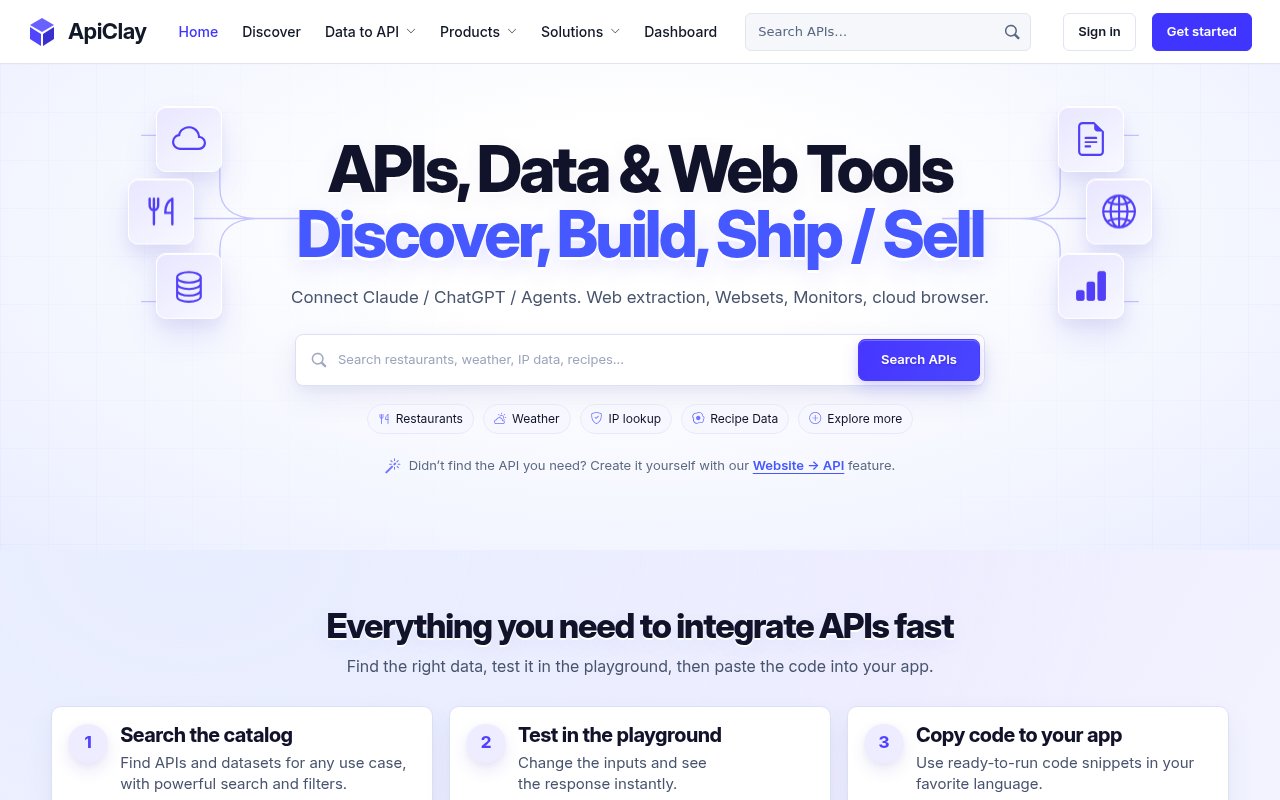
ApiClay is an API marketplace and publishing platform for turning existing data or services into documented endpoints. One side of the product helps developers discover an API, inspect its contract, test it in a playground, and copy integration code. The other side lets a publisher connect a database, spreadsheet, file, live website, OpenAPI service, or custom HTTP source and expose selected data through ApiClay with access rules, usage limits, trials, plans, and per-call pricing.
For buyers, the catalog is meant to reduce the work between finding a data provider and making a reliable request. Each API can carry reference documentation, a playground, and its own pricing information. Buyers use an ApiClay key, while upstream credentials stay on the server. Search and schema inspection are free. A live call follows the chosen listing's trial, plan, and usage rules, and a wallet ledger records paid execution and applicable infrastructure costs. Ready-to-run examples cover common client languages, helping a developer move from an inspected playground response to a server-side request without translating the route contract from scratch.
For publishers, ApiClay can wrap sources that aren't already polished public APIs. It supports MySQL, PostgreSQL, MongoDB, Airtable, Google Sheets, Excel and CSV files, existing HTTP endpoints, and OpenAPI imports. A publisher defines routes, chooses which fields are exposed, maps a source response into a stable public shape, and sets access and pricing. Publisher Studio adds live testing, response mapping, encrypted drafts, and an optional AI assistant. Credentials are kept in server-side fields rather than placed in buyer clients. The source remains under the publisher's control, while a public route can expose only selected columns or fields. That lets a team offer a narrow data product without giving buyers direct access to the underlying database or provider account.
The website workflow goes beyond a basic HTML scraper. Live URL import can inspect background XHR and GraphQL traffic, create editable route drafts, and use static fetching, JavaScript rendering, or an automatic mode. Configured browser actions can navigate, fill inputs, click, wait, scroll, and capture structured responses. A separate extraction API returns page content as JSON, Markdown, text, or links. Monitoring can schedule checks against an API or webpage, track selected field changes, and send signed webhooks when something relevant changes. Publishers still need permission to retrieve and productize a source, and mappings must be retested when an upstream page or response changes. ApiClay manages the execution layer, but it can't make an unstable external layout maintenance-free.
ApiClay also exposes a hosted Model Context Protocol server for agents. An MCP-compatible client can search the marketplace, inspect an API schema and price, then call an approved route through one endpoint. Discovery tools are free, while execution uses the listing's billing rules. The same buyer key works for MCP and REST requests. This is useful when an agent needs current structured data but shouldn't receive a publisher's database password, proxy credential, or upstream API token. The client retains control over tool approval, so connecting the server doesn't grant the model unrestricted authority to spend credits. An agent can inspect the listing first, then the user or application can approve execution under the selected route's rules.
The platform fits several groups. Developers can add live data without building a separate proxy for every vendor. Startup teams can stand up an MVP backend from a sheet or database. Business teams can enrich uploaded lists and export the results with spending caps. Data owners can package a controlled subset of an internal source as a product. Agent builders can give a model a searchable tool catalog while preserving client-side approval over consequential calls. The broad surface is useful, though a team may need time to understand which source, browser, monitor, or marketplace workflow matches its task. It is strongest when a stable contract, controlled access, documentation, and metering matter as much as retrieving the data itself.
Access is freemium in practice. Browsing, search, documentation, and schema discovery are free, and individual listings may include a trial. Paid calls draw from a credit balance according to the provider's price, with possible extra charges for browser rendering, verified CAPTCHA handling, or proxy use. Publishers choose their own plans, per-call price, and limits. This flexibility is central to the marketplace model, but it also means there isn't one simple platform price to compare. Buyers should inspect the live Pricing tab for every route before moving a workload into production. A prototype that stays inside discovery can be inexpensive, while a browser-heavy integration may have a more complex cost profile.
Key Features
- Searchable API marketplace
- Database and spreadsheet publishing
- Live website API creation
- Hosted MCP agent access
- Playgrounds and generated documentation
- Usage metering and billing
Pros & Cons
What we like
- Combines API discovery and publishing
- Keeps upstream credentials server-side
- Supports many common data sources
- Lets agents inspect pricing before calls
Room for improvement
- Pricing varies by individual listing
- Browser and proxy work can add charges
- Website mappings depend on upstream layouts
- Broad feature set needs careful configuration
Frequently Asked Questions
What is ApiClay?
Is ApiClay free?
Can ApiClay turn a website into an API?
How do AI agents use ApiClay?
Best For
Featured in
Alternatives to ApiClay
View all
Kevin Gabeci
Solo developer building web apps, cozy browser games, and AI creator toolkits.

SoloDevStack
A solo developer blog built on head-to-head tool comparisons, 580+ posts deep.

Codedex
A gamified, story-driven platform that teaches Python, web dev, and more like an RPG quest

Vibe Built
Building real apps with agentic AI. What worked, what broke, what shipped.
Reviews (0)
Badge builder
Add ApiClay to your website
Choose a badge style and size, preview it here, then copy the generated HTML. Badge images are self-contained SVGs and do not require an external script.

<a href="https://toolindex.net/tools/apiclay?ref=badge" target="_blank" rel="noopener">
  <img src="https://toolindex.net/badge/apiclay/medium.svg" alt="ApiClay - Listed on Tool Index" width="180" height="50" />
</a>How to use the badge
- 1. Pick the style, size, and theme that fit your layout.
- 2. Copy the generated HTML from the code block.
- 3. Paste it into your footer, homepage, or press page.
Standard badge available
The standard listing badge is available now. Score and circle badges are limited to tools currently ranked in the top 10 of a category.
Badge clicks return visitors to this profile with a referral tag so the source remains identifiable.
Related Tools
Kevin Gabeci
Solo developer building web apps, cozy browser games, and AI creator toolkits.

Coolify
Self-hostable, open source alternative to Heroku and Netlify

Warp
The modern terminal reimagined with AI and collaboration

Bolt.new
Prompt-to-deployed full-stack app inside the browser
Work on ApiClay? Request listing access or correction