
APIgen
AI-powered code generator that turns data models into full REST APIs and Angular dashboards
Gallery
About APIgen
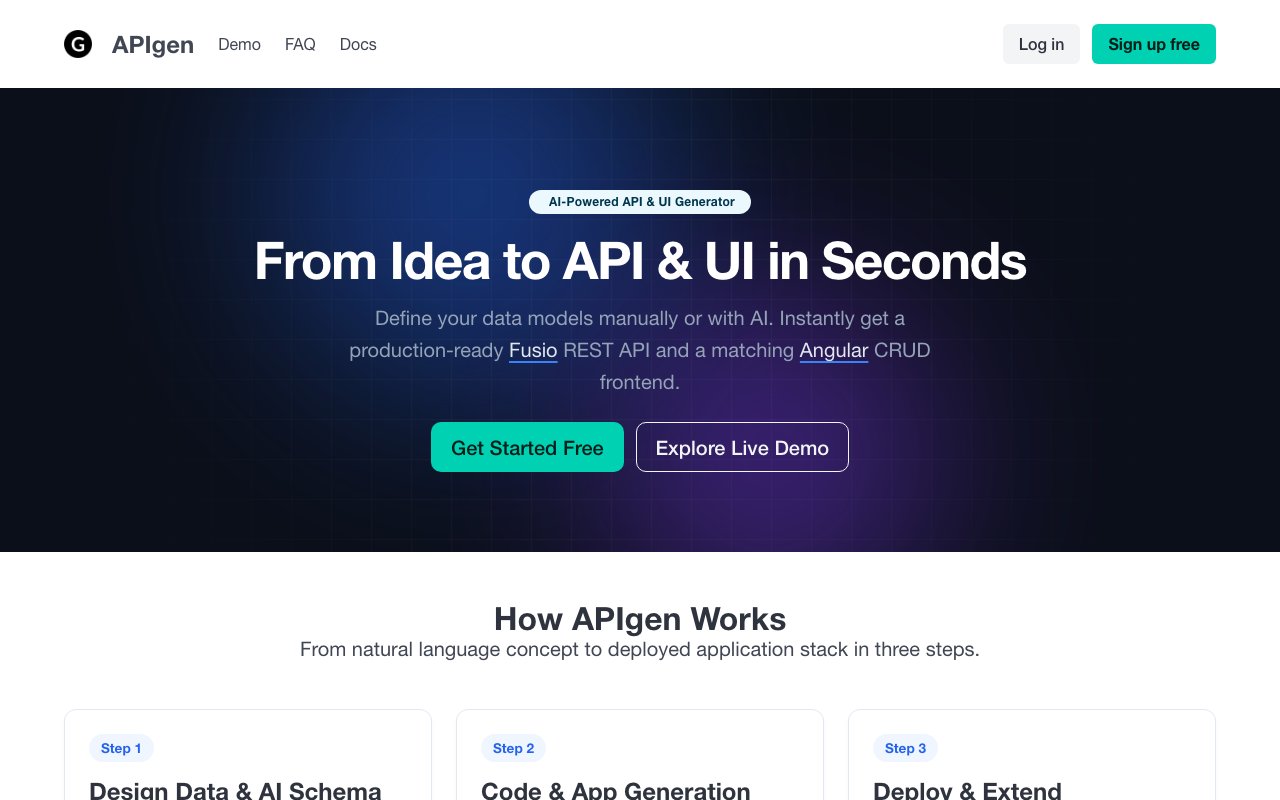
APIgen is a code generation platform that turns data model definitions into complete, production-ready application stacks. You define your entities and relationships, and the tool produces a working REST API with full CRUD operations plus a matching web dashboard. The output isn't proprietary glue code that locks you into a platform or forces you to pay a runtime fee every time your API handles a request. It's standard, readable code built on open-source frameworks that you own and can extend however you want. For developers who need to spin up backends quickly without sacrificing long-term maintainability, that's the core value proposition. You get speed now and flexibility later.
The workflow starts with schema definition. You can build your data model manually through the interface, specifying entities, fields, types, and relationships between them. If you have an existing mental model of your application, this is straightforward. Alternatively, the built-in "AI Architect" lets you describe what you need in plain language and generates structured type definitions from your description. You might say something like "I need a project management app with users, teams, projects, tasks, and comments" and get back a schema with the right entities and relationships mapped out. This is useful when you have a rough idea of what you're building but haven't mapped out every field and foreign key yet. The AI handles the translation from fuzzy concept to concrete schema, and you refine from there.
Once your schema is set, code synthesis happens automatically. APIgen produces backend code for a REST API with all the standard operations: create, read, update, delete, list, and any relationship endpoints your schema implies. It also generates a frontend dashboard built on Angular and Bootstrap, giving you an admin interface out of the box. This isn't a toy dashboard; it's functional enough to manage your data immediately after generation. The backend uses Fusio, an open-source API management framework with its own community and documentation, so what you get isn't a black box maintained by one company. It's code you can read, debug, modify, and deploy wherever you host applications.
The emphasis on open-source foundations matters for teams thinking beyond the prototype stage. Plenty of code generators produce output that works initially but becomes a liability when you need to customize, integrate with other systems, or debug production issues at three in the morning. Proprietary output means proprietary problems. APIgen's bet is that by generating standard code on established frameworks, the output stays maintainable even as your requirements grow. You're not learning a proprietary system unique to this platform; you're working with tools that have documentation, communities, Stack Overflow answers, and known patterns. When something breaks, you can find help outside the APIgen ecosystem.
Deployment options are flexible. You can take the generated code and deploy it wherever you normally host applications, whether that's your own servers, a cloud provider, or a containerized environment. You can also deploy directly from the platform if you prefer a managed experience. Either way, you walk away with source code you control. There's no runtime dependency on APIgen after generation, which means no surprise charges based on API calls, no service interruptions if your relationship with the platform changes, and no negotiating with a vendor if you outgrow their pricing tiers. The code is yours, full stop.
The target audience is developers and small teams who need to move fast without writing boilerplate. If you're building an internal tool, prototyping a product idea, standing up a backend for a mobile app, or just tired of writing the same CRUD endpoints for the hundredth time, APIgen handles the repetitive parts so you can focus on business logic. It's particularly useful early in a project when you're still figuring out what you're building. Getting a working API and admin panel in minutes lets you test ideas against real data instead of mocking everything up.
The tool is less suited for complex applications with unusual data patterns, custom authentication schemes, or teams that prefer to hand-craft every layer of their stack. If you need something that APIgen doesn't generate, you'll need to add it yourself after the fact. That's fine for most projects, but it means the platform is better positioned as an accelerator than a complete solution. The generated code is a starting point, not a finished product.
Pricing follows a freemium model. You can create a free account and generate projects without paying, which makes it easy to test whether the output meets your standards before committing. Paid tiers likely unlock additional features or higher usage limits, though the specifics aren't prominent on the marketing site. For a tool that hands you working code you own forever, the free tier alone is worth exploring to see how well it fits your workflow.
Key Features
- AI Architect for natural language to schema
- Full REST API generation with Fusio
- Angular dashboard with Bootstrap styling
- Open-source code output without lock-in
- Three-step design to deploy workflow
- TypeSchema and TypeAPI standards support
Pros & Cons
What we like
- Generates clean, maintainable code you fully own
- Produces both backend API and frontend dashboard in one pass
- Built on widely adopted open-source frameworks
- Free to start with a live demo available
Room for improvement
- Output assumes familiarity with Fusio and Angular
- Less flexible if you prefer a different frontend framework
- Smaller community compared to established low-code platforms
- Best suited for REST APIs, not every architecture style
Frequently Asked Questions
What is APIgen?
Is APIgen free?
Who is APIgen for?
Can I use my own frontend framework instead of Angular?
Best For
Featured in
Alternatives to APIgen

Kevin Gabeci
Solo developer building web apps, cozy browser games, and AI creator toolkits.

SoloDevStack
A solo developer blog built on head-to-head tool comparisons, 580+ posts deep.

Codedex
A gamified, story-driven platform that teaches Python, web dev, and more like an RPG quest

Vibe Built
Building real apps with agentic AI. What worked, what broke, what shipped.
Reviews (0)
Badge builder
Add APIgen to your website
Choose a badge style and size, preview it here, then copy the generated HTML. Badge images are self-contained SVGs and do not require an external script.

<a href="https://toolindex.net/tools/apigen?ref=badge" target="_blank" rel="noopener">
  <img src="https://toolindex.net/badge/apigen/medium.svg" alt="APIgen - Listed on Tool Index" width="180" height="50" />
</a>How to use the badge
- 1. Pick the style, size, and theme that fit your layout.
- 2. Copy the generated HTML from the code block.
- 3. Paste it into your footer, homepage, or press page.
Standard badge available
The standard listing badge is available now. Score and circle badges are limited to tools currently ranked in the top 10 of a category.
Badge clicks return visitors to this profile with a referral tag so the source remains identifiable.
Related Tools
Kevin Gabeci
Solo developer building web apps, cozy browser games, and AI creator toolkits.

Coolify
Self-hostable, open source alternative to Heroku and Netlify

Warp
The modern terminal reimagined with AI and collaboration

Bolt.new
Prompt-to-deployed full-stack app inside the browser
Work on APIgen? Request listing access or correction