
API Context Marketplace by APIMatic
Open-source Context Plugins that ground AI coding agents in an API's real SDK contract
Gallery
About API Context Marketplace by APIMatic
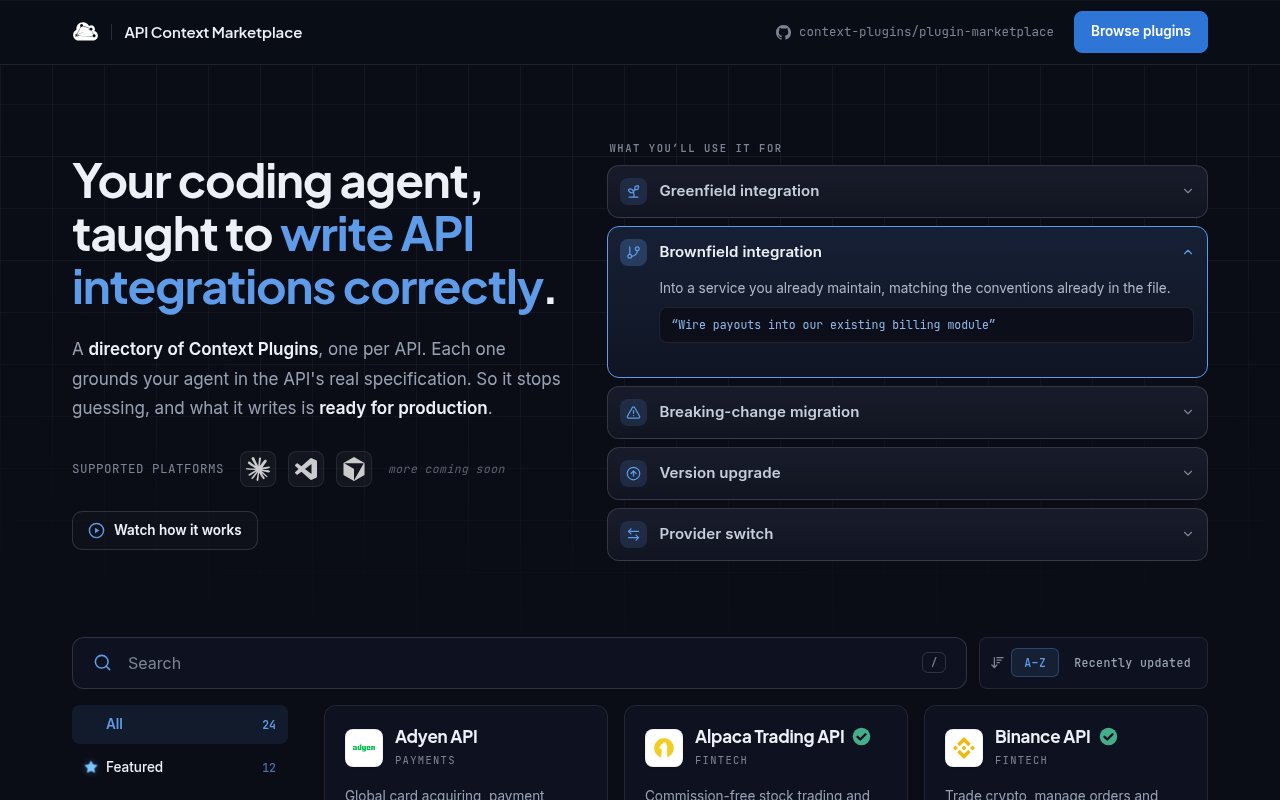
API Context Marketplace is a directory of Context Plugins, one per API, that teach an AI coding agent how a specific API actually works before it writes any integration code. Each plugin grounds the agent in the API's real specification and SDK contract rather than whatever the model remembers from training, so the code it produces calls endpoints that exist, with the right parameters and the current version's behaviour. It's built by APIMatic, the company behind an OpenAPI SDK generation platform whose customers include PayPal, Verizon and Shell.
The problem is familiar to anyone who has asked an assistant to wire up Stripe or Slack. The agent writes plausible code from memory, mixes API versions, invents a parameter or two, and you spend the afternoon debugging what looked finished. The marketplace's answer is to hand the agent version-aware, authoritative context for the API it's integrating, and APIMatic's own figures claim 91 percent fewer errors and 65 percent fewer tokens when a plugin is in play. Those are vendor numbers, but the mechanism behind them is sound.
Installing one takes a single command. With Node.js 18 or later you run npx context-plugins install followed by the API name, paypal for instance, and the plugin lands in your IDE and assistant. Claude Code users can also add plugins through its plugin marketplace directly. From there you prompt the assistant to build the integration as usual, and it reads the plugin's context instead of guessing. The marketplace also publishes machine-readable entry points at /llms.txt, /catalog.json and /.well-known/api-catalog so an agent can discover the catalog on its own. Inside each plugin is a set of eight skills per supported language, covering getting started and SDK navigation, client initialisation and authentication, calling endpoints and handling responses, data models, error handling, configuration and testing guidance. At the time of writing the catalog holds 24 API plugins with 72 language packs and 648 skills across .NET, TypeScript and Python, with Java, PHP, Ruby and Go listed as coming soon. The APIs span fintech and payments such as PayPal, Stripe and Plaid, communications such as Slack and Twilio, and media such as Spotify and Vimeo.
Compared with the two usual alternatives, the plugin is closer to a skill pack than a live connection. An MCP server for an API lets an agent call the API at runtime, and APIMatic generates those too, but it doesn't teach the agent how to write durable integration code in your language. Pasting the docs into the prompt does that badly and costs tokens on every turn. A Context Plugin lives in the editor as skills the agent reads when it needs them, with one language pack per supported language, so the cost is paid once at install and the guidance stays version-aware.
It's aimed at development teams using Claude Code, Cursor or VS Code with GitHub Copilot who integrate third-party APIs regularly. The five jobs it names are greenfield integrations, brownfield integrations into an existing system, breaking-change migrations, version upgrades and switching from one provider to another, which is a fair map of where API code goes wrong. API providers are the other audience, since a publish path and a documented contribution flow let them ship a plugin for their own API and register it in the Claude and Cursor marketplace registries.
What makes it different from a generic docs-scraping approach is that the context is SDK-native and deterministic. APIMatic already generates SDKs, developer portals, CLIs and MCP servers from a single OpenAPI spec, and the plugins come out of that same pipeline, so the agent sees the contract the SDK is built on rather than a summary of a web page. The whole marketplace is open source under an MIT license on GitHub, and plugin IDs are treated as immutable public contracts, which matters if you pin one in a project and expect it to still resolve next year. The limits are the ones you'd expect from a catalog this new. Twenty-four APIs is a start rather than a long tail, three languages are live, and the value of any plugin tracks how well the underlying spec is maintained. It's also tied to the three IDEs it targets, so an agent running elsewhere would need to read the raw catalog endpoints itself. The repository is quiet in community terms, which is normal for a vendor-run catalog but worth knowing before you build a workflow on it.
Access is free and open source. There's no signup, no account and no price on the marketplace itself, and the plugins are MIT licensed. APIMatic's commercial platform sits behind it with paid tiers and a free trial, but you don't need any of that to install a plugin. Questions go to context-plugins@apimatic.io, and the marketplace source lives in the context-plugins/plugin-marketplace repository on GitHub.
Key Features
- One Context Plugin per API
- Single-command install with npx
- Eight skills per supported language
- Claude Code, Cursor and Copilot support
- Machine-readable catalog endpoints
- MIT-licensed open-source marketplace
Pros & Cons
What we like
- Grounds agents in the real API contract
- Install takes one command
- Built by an established SDK generation vendor
- Open source with a published contribution flow
Room for improvement
- Only 24 APIs in the catalog so far
- Three languages live, others still coming
- Targets three IDEs, others need the raw catalog
- Plugin quality depends on the upstream spec
Frequently Asked Questions
What is API Context Marketplace?
Is API Context Marketplace free?
Which coding tools does it support?
How is it different from pasting the docs into a prompt?
Best For
Featured in
Alternatives to API Context Marketplace by APIMatic

Kevin Gabeci
Solo developer building web apps, cozy browser games, and AI creator toolkits.

SoloDevStack
A solo developer blog built on head-to-head tool comparisons, 580+ posts deep.

Codedex
A gamified, story-driven platform that teaches Python, web dev, and more like an RPG quest

Vibe Built
Building real apps with agentic AI. What worked, what broke, what shipped.
Reviews (0)
No reviews yet
Be the first to share your experience with API Context Marketplace by APIMatic
Sign in to write a reviewBadge builder
Add API Context Marketplace by APIMatic to your website
Choose a badge style and size, preview it here, then copy the generated HTML. Badge images are self-contained SVGs and do not require an external script.

<a href="https://toolindex.net/tools/apimatic-context-marketplace?ref=badge" target="_blank" rel="noopener">
  <img src="https://toolindex.net/badge/apimatic-context-marketplace/medium.svg" alt="API Context Marketplace by APIMatic - Listed on Tool Index" width="180" height="50" />
</a>How to use the badge
- 1. Pick the style, size, and theme that fit your layout.
- 2. Copy the generated HTML from the code block.
- 3. Paste it into your footer, homepage, or press page.
Standard badge available
The standard listing badge is available now. Score and circle badges are limited to tools currently ranked in the top 10 of a category.
Badge clicks return visitors to this profile with a referral tag so the source remains identifiable.
Related Tools
Kevin Gabeci
Solo developer building web apps, cozy browser games, and AI creator toolkits.

Coolify
Self-hostable, open source alternative to Heroku and Netlify

Warp
The modern terminal reimagined with AI and collaboration

Bolt.new
Prompt-to-deployed full-stack app inside the browser
Work on API Context Marketplace by APIMatic? Request listing access or correction