Backbone
Fork a production-ready SaaS foundation into your own AWS account
Gallery
About Backbone
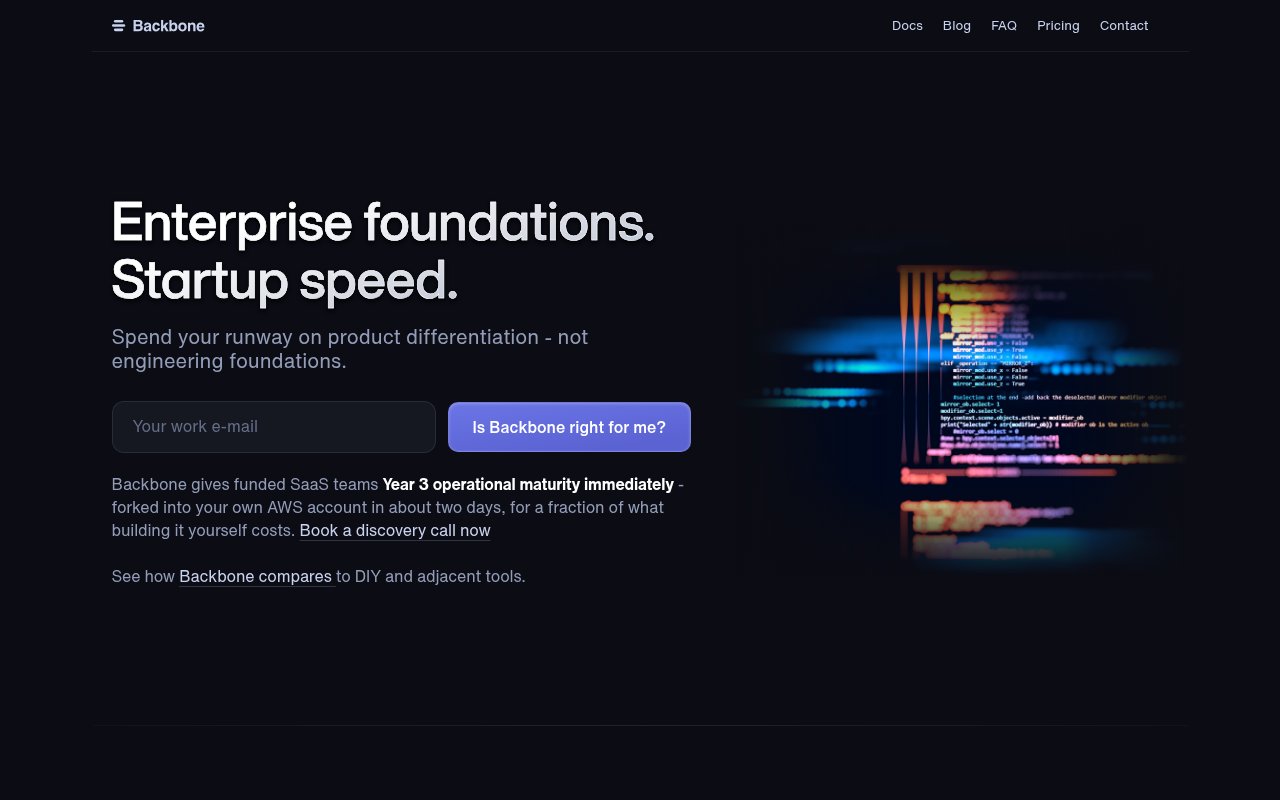
Backbone is a forkable software and infrastructure foundation for funded SaaS teams that need to reach production without spending their first years assembling platform basics. It combines reusable application services with AWS infrastructure, delivery automation, security controls, and operational visibility. The result is deployed into the customer's own AWS accounts and built from a repository in the customer's GitHub organization. Backbone positions this as an alternative to pulling senior engineers away from the product to build authentication, audit trails, pipelines, observability, networking, and compliance foundations from scratch.
Getting started follows a defined handoff rather than a hosted platform signup. A team purchases or obtains a licence, receives contributor access, and forks the Backbone platform repository into its own GitHub organization. It then configures domains, secrets, availability settings, and cost requirements before launching the included continuous delivery workflows. Those workflows provision AWS infrastructure and deploy containerized services to ECS. The customer keeps control of the code, cloud infrastructure, and data, while one licence can cover unlimited environments. This ownership model matters for teams that don't want their production runtime or data locked inside another vendor's hosted service.
The included foundation spans both product plumbing and operations. Six core services cover authentication, user management, notifications, audit events, document upload and parsing, and a backend for frontend proxy. The reference setup includes email and social sign-in, user profiles, ready-made API contracts, and a stateless web application. Infrastructure automation handles networking, databases, object storage, container deployment, multiple environments, and cost controls for nonproduction stages. GitHub workflows cover building, testing, publishing containers, releasing application code, and applying infrastructure changes, so a commit has a prepared route into a running AWS environment. Mature task wrappers and local development documentation are also included.
Backbone also arrives with security and production visibility wired into the same architecture. Its published feature set includes private networking, least-privilege access, secrets outside source code, encryption in transit and at rest, edge protection through a CDN and web application firewall, rate limiting, health checks, caching, and failure isolation. Logs can mask sensitive data, while metrics, dashboards, request tracing, and alerts make the deployed system observable. Audit routing, documented architecture decisions, and control mapping support diligence work. Backbone is clear that this technical baseline isn't a formal compliance attestation, so teams still own the broader organizational and audit process.
The strongest fit is a founding engineering team or CTO facing a launch, customer rollout, security review, or fundraising deadline. It's especially relevant when the product needs customer accounts and is expected to grow beyond a simple hosted monolith, but there isn't yet a dedicated platform group. Unlike a conventional platform as a service, Backbone doesn't host the workload. Unlike a developer portal or governance monitor, it supplies the application services and operational foundation those tools sit around. The tradeoff is focus. Deployment targets AWS, adoption assumes a meaningful infrastructure commitment, and the company describes the platform as greenfield-first even though planned legacy migration is possible.
Access starts with a free Community licence that lasts one year and is intended for development. That edition emulates AWS environments and includes a templating service for rapid application development, but it isn't the production offering. The paid Foundation licence starts at $1,250 per month when billed as $15,000 annually and includes the source code, AWS deployment automation, and email and Slack support. Growth is listed at $2,500 per month billed annually, adding managed observability, customer-managed encryption keys, greater concurrent capacity, and office hours. Enterprise pricing is custom for teams that need high availability, deeper compliance support, or an immutable audit archive. Those prices make Backbone a considered infrastructure purchase, not a lightweight utility, but buyers can inspect the extensive public documentation and try the development edition before committing. The public feature matrix also shows which availability, encryption, observability, and governance settings belong to each licence tier.
Key Features
- Forkable SaaS platform foundation
- Six core application services
- Automated AWS infrastructure provisioning
- GitHub-based delivery pipelines
- Built-in logs metrics and tracing
- Security and audit controls
Pros & Cons
What we like
- Customers retain their code infrastructure and data
- Combines application services and operations in one foundation
- Automates delivery across unlimited environments
- Public documentation exposes detailed technical controls
Room for improvement
- Deployment is centered on AWS
- The platform is designed greenfield-first
- Production licences start at $15,000 annually
- Formal compliance attestation remains the customer's responsibility
Frequently Asked Questions
What is Backbone?
Does Backbone host the application?
Is Backbone free?
Who is Backbone for?
Best For
Featured in
Alternatives to Backbone

Kevin Gabeci
Solo developer building web apps, cozy browser games, and AI creator toolkits.

SoloDevStack
A solo developer blog built on head-to-head tool comparisons, 580+ posts deep.

Codedex
A gamified, story-driven platform that teaches Python, web dev, and more like an RPG quest
Vibe Built
Building real apps with agentic AI. What worked, what broke, what shipped.
Reviews (0)
Badge builder
Add Backbone to your website
Choose a badge style and size, preview it here, then copy the generated HTML. Badge images are self-contained SVGs and do not require an external script.

<a href="https://toolindex.net/tools/backbone?ref=badge" target="_blank" rel="noopener">
  <img src="https://toolindex.net/badge/backbone/medium.svg" alt="Backbone - Listed on Tool Index" width="180" height="50" />
</a>How to use the badge
- 1. Pick the style, size, and theme that fit your layout.
- 2. Copy the generated HTML from the code block.
- 3. Paste it into your footer, homepage, or press page.
Standard badge available
The standard listing badge is available now. Score and circle badges are limited to tools currently ranked in the top 10 of a category.
Badge clicks return visitors to this profile with a referral tag so the source remains identifiable.
Related Tools
Kevin Gabeci
Solo developer building web apps, cozy browser games, and AI creator toolkits.

Coolify
Self-hostable, open source alternative to Heroku and Netlify
Hetzner
High-performance European cloud hosting at unbeatable prices

Warp
The modern terminal reimagined with AI and collaboration
Work on Backbone? Request listing access or correction