
Brian2 Atlas
Run supported Brian2 neural models across CPU, GPU, browser, and distributed backends
Gallery
About Brian2 Atlas
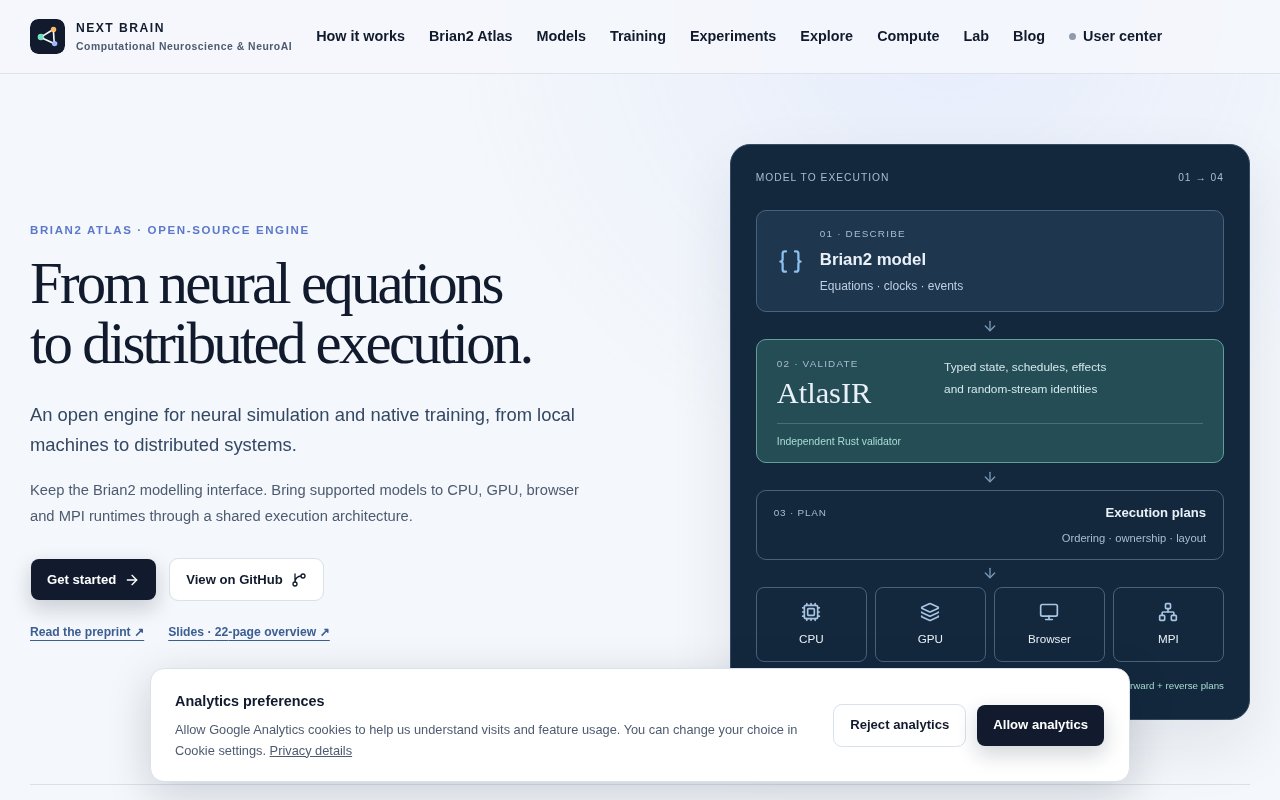
Brian2 Atlas is an open-source engine for neural simulation and native training that takes models written with the familiar Brian2 interface into several execution environments. It is developed by Next Brain for computational neuroscience and NeuroAI work that needs a path beyond a single local runtime. Researchers can continue describing neurons, synapses, clocks, events, and monitors through Brian2 while Atlas supplies its own representation, planning, and execution layers underneath. Supported models can run through a CPU reference engine, a compiled native CPU path, GPU backends, a browser worker, or distributed MPI processes. The project is intended to make execution choices visible and testable instead of hiding them behind one opaque backend. It can be installed and used on a researcher's own machine without creating a Next Brain account.
The central piece is AtlasIR, a shared intermediate representation between the model and the runtime. It records typed state, schedules, effects, and random stream identities, giving the engine a defined contract to validate before it transforms a model into an execution plan. Planning makes ordering, ownership, and memory layout explicit for the selected backend. An independent Rust validator checks the representation, which creates a clearer boundary between the equations a researcher writes and the machinery that executes them. This architecture is useful when the same conceptual model needs to move across hardware or when a team wants to inspect why a runtime scheduled and stored work in a particular way. Atlas doesn't replace the Brian2 modelling frontend. It retains that interface and adds execution backends around it.
The backend choices address different scales and deployment settings. The reference CPU engine offers the straightforward place to start, while the ahead of time CPU path compiles a model specific native executable. GPU execution supports Apple Metal and NVIDIA CUDA for compatible models and uses float32 numeric mode. Browser support exports a compatible model bundle to run inside a web worker, which makes interactive demonstrations possible without moving the whole development environment into a page. The MPI backend partitions supported networks across ranks and makes ownership and event exchange explicit for distributed runs. These aren't interchangeable switches for every Brian2 program. The site directs users to a backend guide because each route has its own supported model features, hardware requirements, and platform toolchains.
Alongside simulation, Atlas includes a bounded training extension that creates forward and reverse execution plans with surrogate gradients for spikes. Next Brain uses the engine in guided online workflows for simulation and spiking network training, but the engine itself remains an independent project. The public project page also reports measured research results rather than only broad performance claims. One documented CPU workload ran faster through the Rust engine than the compared Brian2 C++ configuration on the same host. Other studies demonstrate a large connectome workload on a 16 GB Apple laptop and a multibillion synapse recurrent model across four nodes. The page states the measurement conditions and points readers to a preprint and reproduction materials, so those results can be assessed as specific experiments rather than universal speed guarantees.
Brian2 Atlas is aimed at researchers, scientific software developers, and advanced students who already think in terms of neural equations and simulation experiments. It is a strong fit when a Brian2 model needs inspection through a typed execution representation, a native CPU build, a supported GPU path, a browser demonstration, or a distributed capacity test. It isn't a no-code simulator or a general purpose deep learning framework. The first source installation expects Python 3.12 or newer, Rust, and a working C or C++ compiler, while GPU and MPI routes add their own system dependencies. Model support also varies by backend, and the public release is still young. Teams should begin with the documented CPU example, confirm their model features, and preserve the exact version used in a result.
The main offering is open source and has no usage fee listed. Original Atlas engine code is released under Apache 2.0, while retained Brian2 code remains under the CeCILL 2.1 license. The manuscript and slides use a separate Creative Commons license, and the source repository includes citation information. The project page provides a tagged source release, installation path, examples, backend guidance, an intermediate representation specification, a preprint, slides, and evidence repositories. Questions and contributions go through the public GitHub workflow, and Next Brain invites research collaboration through its About page. For a technical audience willing to manage a source based toolchain, Atlas offers an unusually explicit route from Brian2 equations to heterogeneous and distributed execution, with public methods and limitations alongside the code.
Key Features
- Familiar Brian2 modelling interface
- Typed AtlasIR execution representation
- Independent Rust model validation
- CPU and GPU execution backends
- Browser worker model export
- Distributed MPI network simulation
Pros & Cons
What we like
- Keeps the established Brian2 model interface
- Makes execution plans inspectable
- Supports several hardware and deployment paths
- Publishes methods and reproduction materials
Room for improvement
- Backend model support varies
- Source installation needs a technical toolchain
- GPU and MPI paths require extra setup
- Young release with a smaller community
Frequently Asked Questions
What is Brian2 Atlas?
Is Brian2 Atlas free?
Does it replace Brian2?
Can every model run on every backend?
Best For
Featured in
Alternatives to Brian2 Atlas

Kevin Gabeci
Solo developer building web apps, cozy browser games, and AI creator toolkits.

SoloDevStack
A solo developer blog built on head-to-head tool comparisons, 580+ posts deep.

Codedex
A gamified, story-driven platform that teaches Python, web dev, and more like an RPG quest

Vibe Built
Building real apps with agentic AI. What worked, what broke, what shipped.
Our take
Tool Index Editorial · Oct 2026· 3.5/5
Brian2 Atlas is an open source execution engine for taking supported Brian2 neural models to CPU, GPU, browser, and MPI runtimes. We found more substance than a broad performance pitch. The site explains its typed intermediate representation, validation step, execution plans, backend boundaries, and specific measured studies, with code, a preprint, and reproduction material available. No usage fee is listed.
This is research infrastructure for people already comfortable with Brian2 and systems toolchains, not a general visual simulator. Support varies by model and backend, while GPU and distributed routes bring extra setup and float mode constraints. The architecture is unusually inspectable, but the release is young enough that researchers should reproduce the published cases and pin versions before relying on it for important results.
Editorial opinion from the Tool Index team, written from the public product pages. Not a user review.
Reviews (0)
Badge builder
Add Brian2 Atlas to your website
Choose a badge style and size, preview it here, then copy the generated HTML. Badge images are self-contained SVGs and do not require an external script.

<a href="https://toolindex.net/tools/brian2-atlas?ref=badge" target="_blank" rel="noopener">
  <img src="https://toolindex.net/badge/brian2-atlas/medium.svg" alt="Brian2 Atlas - Listed on Tool Index" width="180" height="50" />
</a>How to use the badge
- 1. Pick the style, size, and theme that fit your layout.
- 2. Copy the generated HTML from the code block.
- 3. Paste it into your footer, homepage, or press page.
Standard badge available
The standard listing badge is available now. Score and circle badges are limited to tools currently ranked in the top 10 of a category.
Badge clicks return visitors to this profile with a referral tag so the source remains identifiable.
Related Tools
Kevin Gabeci
Solo developer building web apps, cozy browser games, and AI creator toolkits.

Coolify
Self-hostable, open source alternative to Heroku and Netlify

Warp
The modern terminal reimagined with AI and collaboration

Bolt.new
Prompt-to-deployed full-stack app inside the browser
Work on Brian2 Atlas? Request listing access or correction