BuyerCue
Find B2B prospects through visible evidence of growth spending
Gallery
About BuyerCue
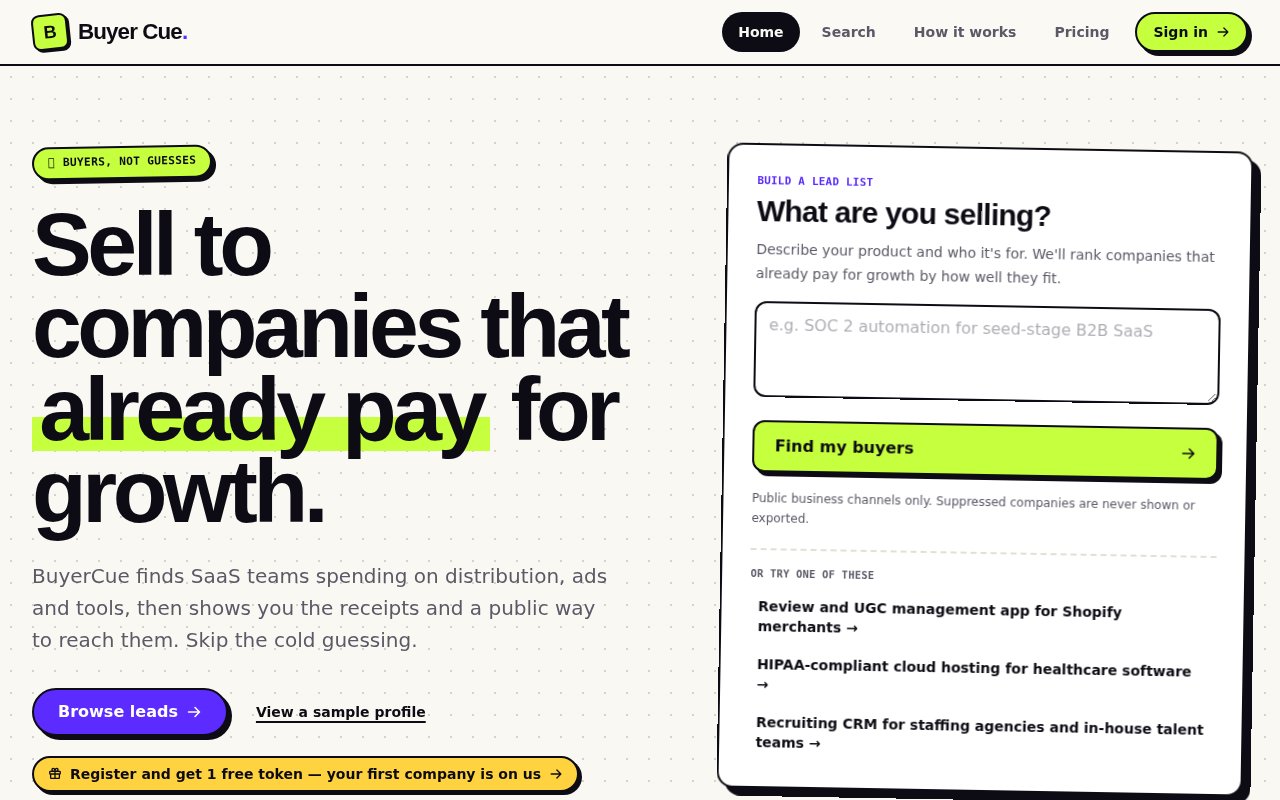
BuyerCue is a lead research tool for sellers who would rather start with evidence than a broad database of names. It tracks software companies that appear to be spending on growth, then packages the useful context around each company into a profile. The central idea is simple. A paid placement, promoted listing, high-effort submission, installed advertising tool, or repeated appearance can be a better reason to investigate a prospect than a job title alone. BuyerCue doesn't claim that a signal proves buying intent. It uses those signals to help a seller decide which companies deserve attention first.
The research starts on public directories, launch boards, marketplaces, listing pages, and company websites. BuyerCue looks for observable distribution activity, checks the business behind it, and records where each fact came from and when it was last seen. It also summarizes the company's product, audience, pricing posture, maturity, technology clues, and available public business contact routes. Unknown information stays blank, and evidence that hasn't been confirmed within 90 days is marked stale. That sourcing matters because a seller can inspect the basis for a score instead of trusting an unexplained prediction.
The free search experience is unusually open. Visitors can use every search filter, see how many companies match, review general buying-signal bands, and inspect the type of evidence behind a result without creating an account. Results also show category, audience, maturity, available contact channel types, and evidence freshness. The company identity and full contact details stay masked until the result is unlocked. One token unlocks one company permanently, including its name, domain, complete placement evidence, public business contact routes, pricing and business context, and unlimited CSV export for that record.
BuyerCue fits founders, agencies, and B2B sales teams that sell products or services to software companies. It is particularly useful when the offer relates to growth, infrastructure, data, marketing, recruiting, or another expense a company with visible distribution activity may plausibly consider. Sellers can filter by category, signal strength, contactability, and maturity, then judge the actual fit themselves. The product doesn't send outreach, run sequences, or contact people on the user's behalf. It provides the research and a published business route, while the message and sales process remain with the user.
A full profile is meant to support that judgment rather than simply reveal an address. It can place a company's distribution evidence beside a short product description, intended audience, categories, maturity, public pricing posture, and contact options. Evidence entries retain the original amount and period instead of combining figures that don't belong together. The reachability score is separate from the buying-signal score, so an easy way to contact a company isn't confused with evidence that it has spent on promotion. Missing funding or employee details are called out as unverified. That separation gives a seller useful context for deciding whether an account matches the actual offer before drafting a message.
Its clearest difference from a conventional lead list is the focus on a checkable reason for each row. Profiles show dated source links, general buying-signal scores, and supporting business context instead of presenting a large spreadsheet as if every company were equally relevant. BuyerCue also limits contact data to public business channels such as company inboxes, contact forms, phone numbers, and brand social accounts. Suppressed companies aren't shown or exported, including to an account that unlocked one earlier. The limits are stated plainly too. A detected advertising pixel isn't proof of current ad spend, and a score isn't a purchase probability or a guarantee that the company needs a particular offer.
Access is freemium and based on tokens rather than a recurring plan. Search and initial evaluation are free, and a new account receives one token without a card. One token reveals one company for good. The published packs are 20 companies for $19, 100 for $69, and 500 for $250, with no subscription tier wrapped around them. Tokens and unlocked records stay with the account, and exporting an unlocked company doesn't cost extra. That structure works well for a seller who wants to inspect the market broadly and pay only for specific prospects, though buyers should note that token purchases are final and the underlying public data isn't guaranteed to be error free.
Key Features
- Evidence-backed prospect profiles
- Buying-signal search filters
- Dated source links
- Public business contact routes
- Permanent company unlocks
- Unlocked record CSV export
Pros & Cons
What we like
- Shows why each prospect may merit attention
- Lets anyone search and filter for free
- Keeps unknown details blank instead of guessing
- Charges per unlocked company without a subscription
Room for improvement
- Signals don't prove active purchase intent
- Company identities stay masked before unlock
- Coverage focuses mainly on software companies
- Token purchases are final
Frequently Asked Questions
What is BuyerCue?
What can someone use for free?
What does one token unlock?
Does BuyerCue send outreach?
Best For
Featured in
Alternatives to BuyerCue

Close
Inside-sales CRM with calling and email built in
HubSpot
All-in-one CRM and growth platform for marketing, sales, and service teams

Upscale B2B
Done-for-you cold email and AI outreach agency that books qualified B2B meetings on your calendar

Prosp
AI LinkedIn outbound that personalizes messages, voice notes, and multi-account campaigns at scale
Our take
Tool Index Editorial · Oct 2026· 4.0/5
BuyerCue is a prospect research tool for finding software companies with visible evidence of growth spending. Rather than sell a giant contact list, it shows dated sources, signal strength, business context, and a public contact route, then lets users unlock selected companies. Search is free, a new account gets one token, and packs cost $19 for 20 companies, $69 for 100, or $250 for 500.
We like the restraint here. Unknown fields stay blank, stale evidence is flagged, and BuyerCue says plainly that ad tools or paid placements do not prove purchase intent. The narrow software-company coverage and masked identities before unlock will not suit every sales motion, but the evidence-first model is more useful than an unexplained intent score for careful, low-volume outreach.
Editorial opinion from the Tool Index team, written from the public product pages. Not a user review.
Reviews (0)
Badge builder
Add BuyerCue to your website
Choose a badge style and size, preview it here, then copy the generated HTML. Badge images are self-contained SVGs and do not require an external script.

<a href="https://toolindex.net/tools/buyercue?ref=badge" target="_blank" rel="noopener">
  <img src="https://toolindex.net/badge/buyercue/medium.svg" alt="BuyerCue - Listed on Tool Index" width="180" height="50" />
</a>How to use the badge
- 1. Pick the style, size, and theme that fit your layout.
- 2. Copy the generated HTML from the code block.
- 3. Paste it into your footer, homepage, or press page.
Standard badge available
The standard listing badge is available now. Score and circle badges are limited to tools currently ranked in the top 10 of a category.
Badge clicks return visitors to this profile with a referral tag so the source remains identifiable.
Related Tools

Boilerroom
An all-in-one outbound sales platform for dialing, sequencing, and follow-up
Close
Inside-sales CRM with calling and email built in
Apollo.io
B2B prospecting database fused with a sales engagement platform
lemlist
Cold email and multichannel outreach with personalized images and video
Work on BuyerCue? Request listing access or correction