Apollo.io
B2B prospecting database fused with a sales engagement platform
Gallery
About Apollo.io
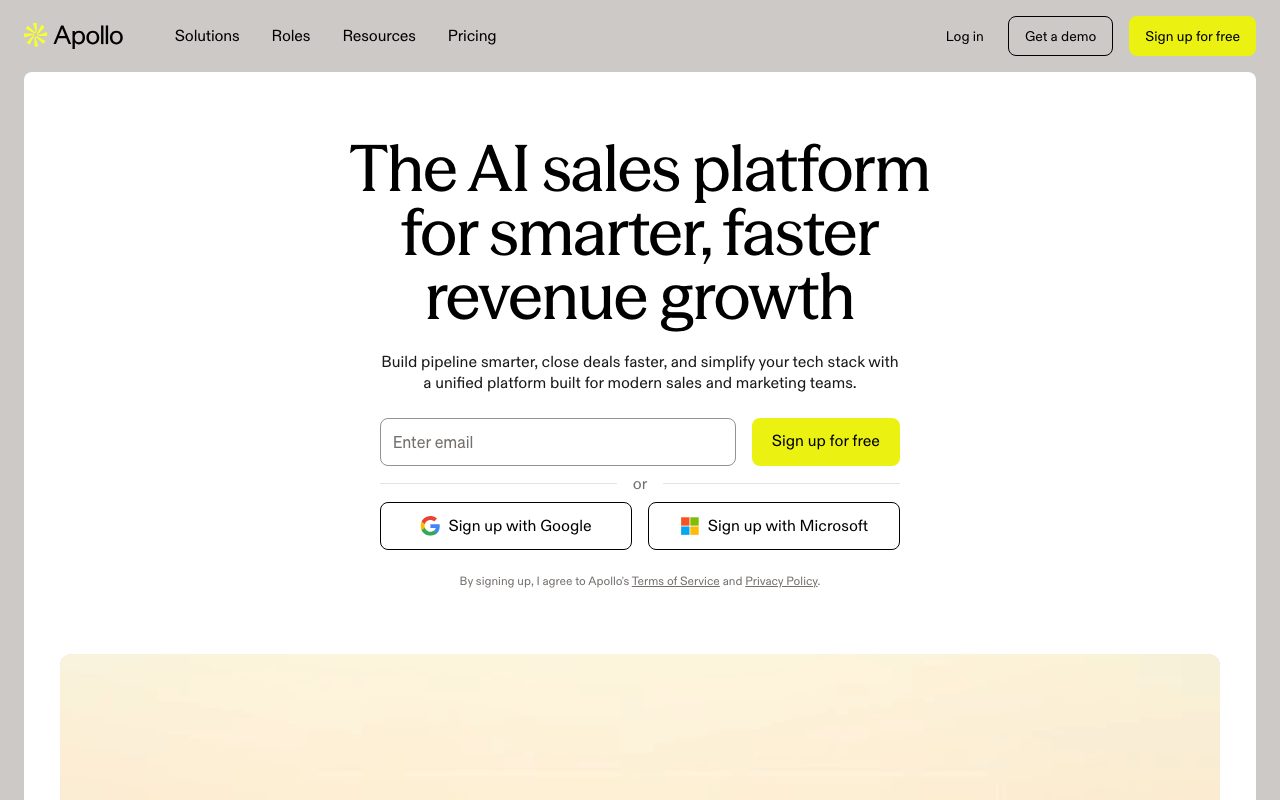
Apollo.io packs a 275 million person B2B contact database into the same window where you actually send the emails. That two-in-one shape is the whole pitch. Most teams either buy a list tool and a sequencer separately, or they stitch ZoomInfo to Outreach with a duct-taped Zap.
Apollo.io collapses that stack. You search for prospects, push them into a sequence, log calls, and watch reply rates without ever leaving the tab. For small sales teams, that consolidation is the difference between three subscriptions and one.
What Apollo.io actually does
Apollo.io has three layers stacked on top of each other. The base is the contact and company database, scraped and verified continuously from public web sources. The middle is the sales engagement engine, which runs multi-step email and call sequences against any list you build.
The top layer is analytics, scoring, and CRM-style deal tracking for teams that don't want to pay for Salesforce yet. You can run the whole outbound motion inside Apollo.io. Or you can use it as a list tool and sync contacts to HubSpot or Salesforce on a schedule.
The data side
Apollo.io's database covers job titles, emails, direct dials, technology stacks, hiring signals, and funding events. The filtering UI feels closer to LinkedIn Sales Navigator than to a clunky list builder. You can save searches and get notified when new people match, which is genuinely useful for territory work.
The engagement side
Sequences in Apollo.io are linear by default but support A/B steps and conditional branches on higher tiers. The sender includes warmup, deliverability monitoring, and an inbox rotation feature that helps you avoid burning a single domain. Reply detection and out-of-office handling are decent, not best in class.
Who Apollo.io is built for
Apollo.io targets founders doing their own sales, two to twenty person revenue teams, and agencies running outbound for clients. If you've been pasting names from LinkedIn into a spreadsheet, Apollo.io will feel like cheating. If you already run a polished outbound motion on Outreach plus ZoomInfo, the data depth might disappoint.
The sweet spot is a startup that wants to test cold outbound without committing five figures a year. That's where Apollo.io's freemium tier and per-seat pricing land hardest.
Apollo.io pricing
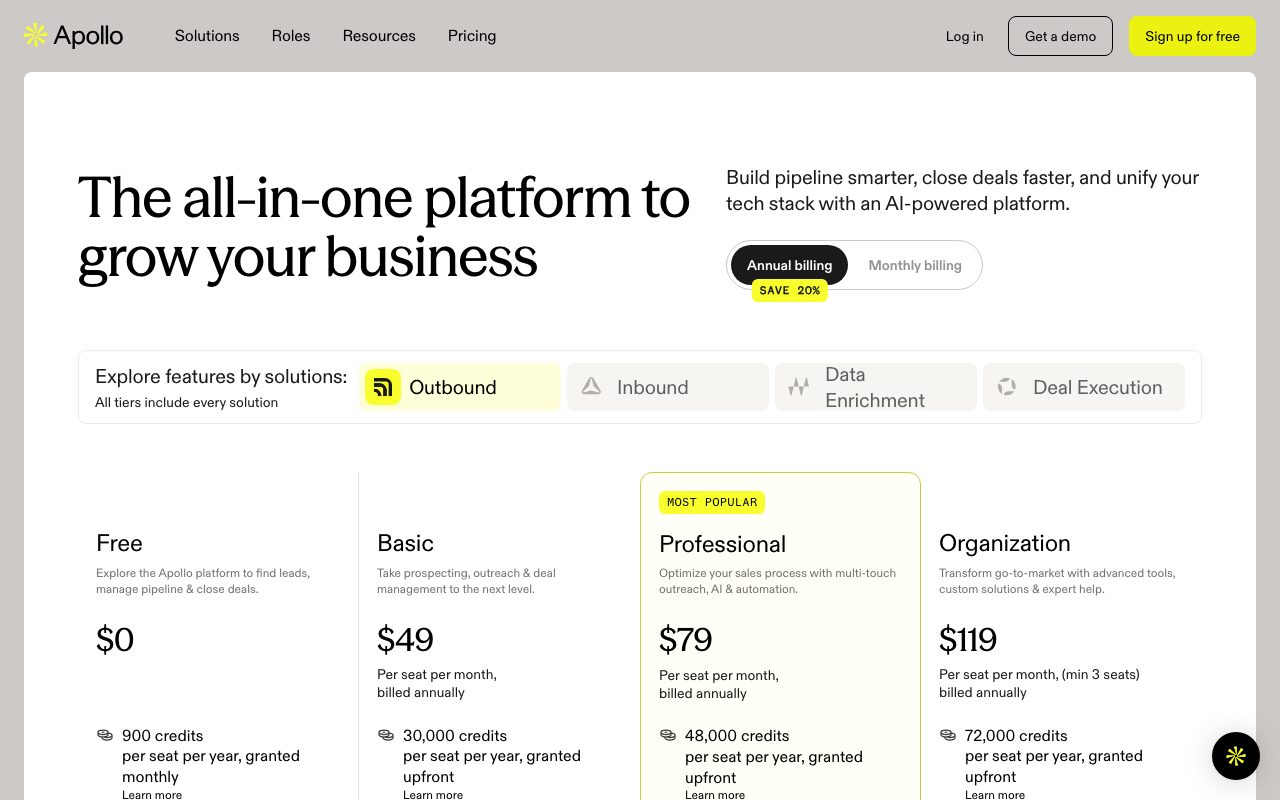
Apollo.io has a real free tier, which is rare in this category. You get 10,000 email credits a month and 60 mobile credits a year, plus basic sequencing. The Basic plan starts around $59 per user per month and unlocks unlimited email and dialer features.
Professional adds A/B testing, advanced analytics, and integrations like Salesforce. Organization adds custom roles, advanced security, and call recording transcription. The pricing model rewards annual commits with meaningful discounts.
Apollo.io's free tier is the most generous in this category, which is why it's become the default starter for solo founders and bootstrapped agencies.
Features that matter
The Chrome extension surfaces Apollo.io data on any LinkedIn profile or company page. That alone replaces a separate enrichment tool for most teams. Buyer intent signals, scraped from third-party browsing data, flag accounts actively researching your category.
The dialer supports parallel calling on higher tiers, so reps can dial four or five lines at once. Email AI helps draft sequence steps, though the output reads generic without heavy editing. Webhooks and a public API let engineering teams pipe Apollo.io data anywhere.
Data quality reality check
Apollo.io's emails verify reasonably well, somewhere in the 80 to 90 percent deliverable range depending on industry. Phone numbers are weaker than ZoomInfo's, especially for senior executives. International data outside North America and Western Europe gets thin fast.
Tradeoffs to know
Apollo.io tries to do everything, which means none of it is best in class. The engagement engine isn't as polished as Outreach. The data isn't as deep as ZoomInfo. The CRM piece is far behind HubSpot or Pipedrive on actual deal management.
What Apollo.io wins on is bundling. You pay once and get 80 percent of three tools. For most small teams, that math is the right tradeoff.
Apollo.io vs alternatives
Compared to ZoomInfo, Apollo.io is dramatically cheaper but with thinner enterprise data. ZoomInfo wins for accounts north of $10K ACV where data accuracy compounds. Apollo.io wins for SMB and mid-market motion where volume matters more than perfect numbers.
Compared to Lemlist or Smartlead, Apollo.io includes the contact database, which those tools don't. Compared to HubSpot Sales Hub, Apollo.io is much stronger on prospecting and weaker on full pipeline management. Many teams run Apollo.io for outbound and HubSpot for inbound and pipeline. See more in our best sales engagement platforms roundup and ZoomInfo alternatives guide.
Bottom line on Apollo.io
Apollo.io is the right starting point for any team that wants outbound to actually work without spending $30K a year on tools. The free tier lets you validate the channel before any commitment. The paid tiers scale reasonably until you hit eight or ten reps.
If you outgrow Apollo.io, you'll usually outgrow it on the data side first. That's a good problem to have. Until then, Apollo.io probably replaces three things on your stack.
Apollo.io workflows that actually work
The pattern that wins for most small teams using Apollo.io looks like this. Build a saved search that matches your ideal customer profile precisely. Set up a sequence with three to five steps spaced over two weeks. Push a small batch of contacts daily into the sequence rather than blasting hundreds at once.
That deliberate pace keeps deliverability high and reply rates honest. Apollo.io's built-in inbox warming and rotation handles the technical side. Your job is to keep the targeting tight and the messaging human.
List building tactics
Apollo.io's filter combinations are where the real prospecting work happens. Combine job title with department, seniority, technology stack, recent funding, and headcount growth. The narrower the slice, the better the response rates. Generic "VP Sales at SaaS companies" lists are dead on arrival in 2026.
The buyer intent signals work best as a tiebreaker. Use them to prioritize within an already-targeted list, not as a replacement for fit-based segmentation. Apollo.io's intent data is decent but not as deep as Bombora or 6sense.
Apollo.io migration considerations
Moving onto Apollo.io from a separate stack of ZoomInfo plus Outreach takes a couple of weeks. The data export from ZoomInfo lives in CSV. Apollo.io can ingest those lists. The sequence migration is manual, since each tool's sequence model differs slightly. Plan for a transition period where both run in parallel.
Moving off Apollo.io is harder than expected because the contact data licensing terms restrict what you can take with you. Activity history exports cleanly to Salesforce or HubSpot. Contact records export but the underlying database access doesn't follow you. Plan that exit path early if you want optionality.
Common Apollo.io questions
How accurate are the emails? Apollo.io claims around 95 percent deliverability for verified emails on its higher tiers. Real-world deliverability lands closer to 80 to 90 percent for most teams. Always run an additional verification pass through NeverBounce or ZeroBounce on critical campaigns.
Can Apollo.io replace my CRM? For very small teams, yes. Once you have more than five reps or any complexity in deal management, you'll want a dedicated CRM. Apollo.io's CRM features work but feel thin compared to Pipedrive or HubSpot for serious pipeline tracking.
Does Apollo.io support international prospecting? Yes for Western Europe, North America, and parts of APAC. Coverage thins fast outside those regions. For Latin America, Africa, or the Middle East, supplement with regional providers.
The Apollo.io API
Apollo.io's API exposes contacts, accounts, sequences, and analytics. Most teams use it to enrich CRM records on a schedule, push lead form submissions into sequences, or pull activity data into a warehouse. The rate limits are reasonable on paid plans and the documentation is solid.
Webhooks fire on events like email opens, replies, and meeting bookings. That makes Apollo.io a viable middle layer in revops architectures where you want sequence data to flow into Snowflake or BigQuery for unified attribution.
Final take on Apollo.io
Apollo.io has shifted what small sales teams expect from their tooling. The bundling of contact data, sequence engine, and lightweight CRM in one product at one subscription used to be impossible. Now it's the default starting point. The pricing pressure on ZoomInfo, Outreach, and Salesloft is real because of Apollo.io's existence.
The product isn't perfect at any single layer. The data has gaps. The sequence engine has rough edges. The CRM is thin. What Apollo.io offers is something different: a coherent system where the parts work together at a price small teams can absorb. That's the right tradeoff for the segment Apollo.io targets, and it's why the company has grown so quickly.
For founders running their own outbound, Apollo.io is the obvious starting point in 2026. For agencies handling outbound for clients, Apollo.io is the standard tool. For mid-market teams that have outgrown spreadsheets but aren't ready for Salesforce plus ZoomInfo, Apollo.io fills the gap perfectly. The free tier is generous enough that there's no reason not to try it.
Tutorial / Demo
Key Features
- B2B contact and company database with email and phone
- Multi-step email and LinkedIn sequences
- Built-in dialer and call recording
- Data enrichment for existing CRM records
- Buying intent signals
- Chrome extension for LinkedIn
Pros & Cons
What we like
- Replaces both a data provider and a sequencing tool
- Generous free tier compared to ZoomInfo or Outreach
- Fast to onboard new BDRs
Room for improvement
- Data quality varies outside North America and tech industries
- Email deliverability still depends on your sender setup
- UI can feel busy with so many features in one app
Frequently Asked Questions
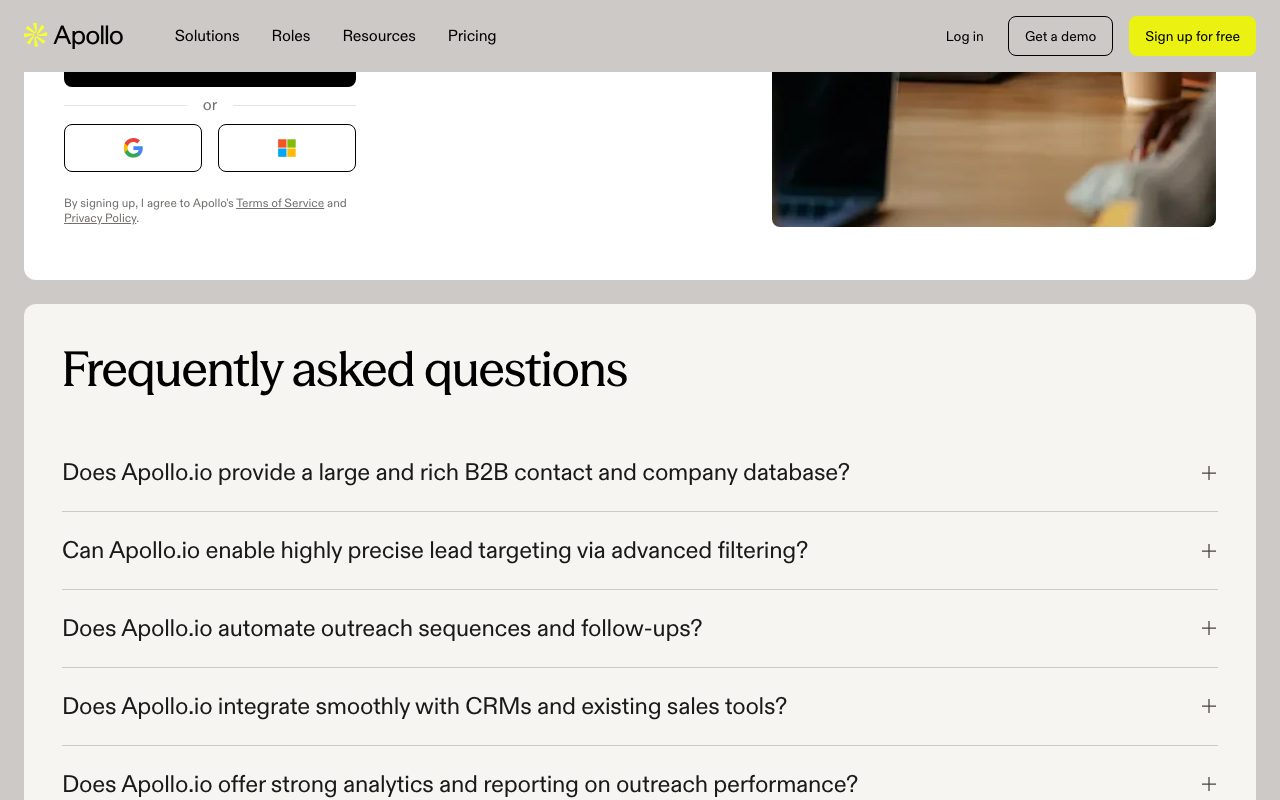
Does Apollo.io have a free tier?
Apollo.io vs ZoomInfo, what's the difference?
Does Apollo include sales engagement (sequences)?
Is Apollo's data accurate?
Does Apollo integrate with my CRM?
Best For
Featured in
Alternatives to Apollo.io
View alllemlist
Cold email and multichannel outreach with personalized images and video
HubSpot
All-in-one CRM and growth platform for marketing, sales, and service teams
Salesloft
Revenue orchestration platform for enterprise sales teams

Close
Inside-sales CRM with calling and email built in
Our take
Tool Index Editorial · May 2026· 4.8/5
Apollo.io positions itself as b2b prospecting database fused with a sales engagement platform, and on the whole it earns the framing.
The standout points: Replaces both a data provider and a sequencing tool, Generous free tier compared to ZoomInfo or Outreach, and Fast to onboard new BDRs. The friction points: Data quality varies outside North America and tech industries and Email deliverability still depends on your sender setup.
In short: Apollo.io is a strong pick when you need outbound prospecting and cold email at scale, and a harder sell if data quality varies outside North America and tech industries would be a dealbreaker.
Editorial opinion from the Tool Index team, written from the public product pages. Not a user review.
Reviews (10)
Apollo.io has been a quiet upgrade
Started using Apollo.io casually, now it's pinned in my dock. What stands out is how generous free tier compared to ZoomInfo or Outreach. Found it works best for enriching CRM contacts with phone and verified email.
Pros
- Fast to onboard new BDRs
Bought it for one feature, stayed for ten
Apollo.io is one of those tools you stop noticing because it just works. Honestly impressed by how fast to onboard new BDRs. Got real value out of data enrichment for existing CRM records. Main use case: outbound prospecting and cold email at scale. Would buy again without thinking twice.
Pros
- Fast to onboard new BDRs
- Replaces both a data provider and a sequencing tool
Hit the Apollo.io sweet spot
The last quarter of using Apollo.io, here's what holds up. The thing I keep coming back to: fast to onboard new BDRs. Chrome extension for linkedin works the way you'd hope. Worth the price for what I get out of it.
Quietly excellent
Hadn't planned on switching, but Apollo.io was hard to ignore. The thing I keep coming back to: generous free tier compared to ZoomInfo or Outreach. Mostly using it for researching target accounts before outreach. That said, email deliverability still depends on your sender setup is a real gripe. Glad I made the switch.
Cons
- Data quality varies outside North America and tech industries
Solid but with caveats
Hadn't planned on switching, but Apollo.io was hard to ignore. Genuine strength: generous free tier compared to ZoomInfo or Outreach. Got real value out of b2B contact and company database with email and phone. That said, email deliverability still depends on your sender setup is a real gripe. Not perfect but better than the alternatives I tried.
Pros
- Generous free tier compared to ZoomInfo or Outreach
- Replaces both a data provider and a sequencing tool
Cons
- Data quality varies outside North America and tech industries
- UI can feel busy with so many features in one app
Finally something that fits
Been using Apollo.io for the past sprint cycle now. What stands out is how fast to onboard new BDRs. Data enrichment for existing crm records works the way you'd hope. It fits well for researching target accounts before outreach.
Pros
- Fast to onboard new BDRs
- Generous free tier compared to ZoomInfo or Outreach
- Replaces both a data provider and a sequencing tool
Apollo.io is fine, here's the real take
Picked Apollo.io for the lower price, stayed for the actual quality. Real selling point: generous free tier compared to ZoomInfo or Outreach. It fits well for researching target accounts before outreach. Honest gripe: data quality varies outside North America and tech industries.
Cons
- Email deliverability still depends on your sender setup
Underrated honestly
Tried Apollo.io on a side project first. Real selling point: generous free tier compared to ZoomInfo or Outreach. Mostly using it for outbound prospecting and cold email at scale. Easy yes for anyone weighing the same trade-offs.
Pros
- Fast to onboard new BDRs
- Generous free tier compared to ZoomInfo or Outreach
- Replaces both a data provider and a sequencing tool
Pulled its weight from week one
Tried half a dozen options before landing on Apollo.io. Genuine strength: generous free tier compared to ZoomInfo or Outreach. The b2B contact and company database with email and phone is more useful than I expected. Main use case: outbound prospecting and cold email at scale. Would buy again without thinking twice.
Pros
- Generous free tier compared to ZoomInfo or Outreach
Genuinely impressed
Took a few weeks for Apollo.io to click, then it stuck. Genuine strength: generous free tier compared to ZoomInfo or Outreach. Their take on built-in dialer and call recording is solid. Worth the price for what I get out of it.
Badge builder
Add Apollo.io to your website
Choose a badge style and size, preview it here, then copy the generated HTML. Badge images are self-contained SVGs and do not require an external script.

<a href="https://toolindex.net/tools/apollo-io?ref=badge" target="_blank" rel="noopener">
  <img src="https://toolindex.net/badge/apollo-io/medium.svg" alt="Apollo.io - Listed on Tool Index" width="180" height="50" />
</a>How to use the badge
- 1. Pick the style, size, and theme that fit your layout.
- 2. Copy the generated HTML from the code block.
- 3. Paste it into your footer, homepage, or press page.
Score badge available
Apollo.io qualifies for the score and circle badges based on its current top-10 positionin Sales.
Badge clicks return visitors to this profile with a referral tag so the source remains identifiable.
Related Tools

Boilerroom
An all-in-one outbound sales platform for dialing, sequencing, and follow-up
Close
Inside-sales CRM with calling and email built in
lemlist
Cold email and multichannel outreach with personalized images and video

SignalPosts
Turn sales call transcripts into LinkedIn posts in each author's voice
Work on Apollo.io? Request listing access or correction