
Cartesia
Ultra-low-latency real-time text-to-speech powered by the Sonic model, built for live voice AI agents
Gallery
About Cartesia
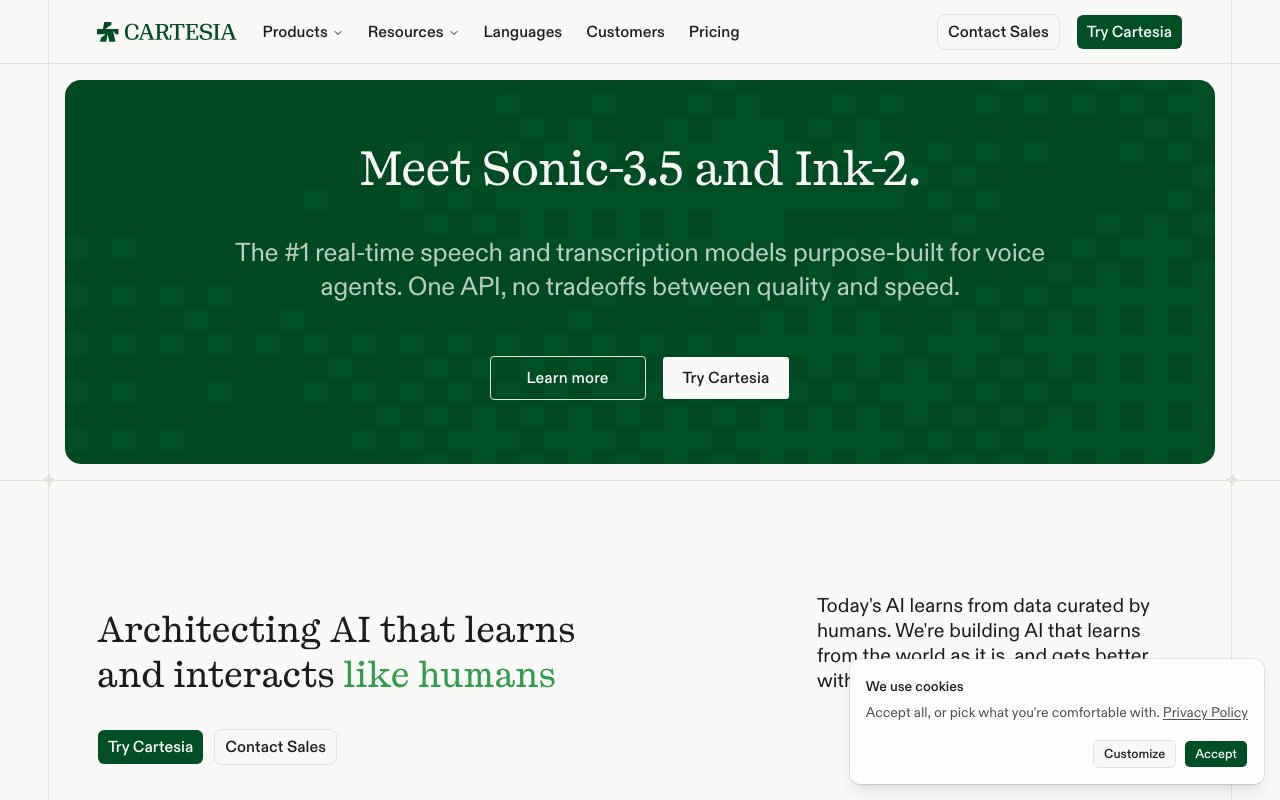
Cartesia builds AI infrastructure for real time voice interactions, offering speech to text, text to speech, and voice agent capabilities designed for applications where latency determines success or failure. Their models power conversational AI systems that need to feel instant and natural, not batch processed with noticeable pauses. If you're building a voice interface for customer support that handles thousands of concurrent calls, a real time transcription system for live broadcasts, or an AI agent that conducts phone conversations with actual humans, Cartesia provides the underlying models and APIs to make that happen without the perceptible delays that break immersion and frustrate users.
The product lineup consists of three core offerings that work together or independently. Sonic handles text to speech generation, producing natural sounding synthetic voices at speeds fast enough for live conversation where any hesitation feels awkward. Cartesia positions Sonic as the fastest and most realistic speech generation model available, designed for scenarios where you need the AI to respond immediately after a user finishes speaking. Ink provides speech to text transcription built specifically for streaming scenarios where you need words appearing as they're being spoken rather than waiting for the complete utterance to finish before processing begins. This streaming approach matters for real time captioning, live meeting transcription, and any application where users expect to see text forming as audio plays. Line is their platform for building and deploying conversational voice agents, combining Sonic and Ink into an integrated system where AI can listen, understand context, reason about responses, and speak back in what feels like natural real time dialogue.
Under the hood, Cartesia's technology runs on State Space Models rather than the transformer architectures that dominate most AI headlines. Their research team pioneered this approach with published work including Mamba and H Nets, developing architectures that emphasize low latency operation, long context reasoning without performance degradation, and computational efficiency that makes real time inference practical. SSMs can handle streaming input and output in ways that transformers struggle to match, processing audio incrementally rather than waiting for complete sequences. The technical difference translates directly into the user experience, making the gap between human speech and AI response small enough that conversations flow naturally.
Deployment flexibility accommodates organizations with vastly different infrastructure requirements and compliance constraints. Cloud deployments run through regional API endpoints distributed globally, minimizing network latency by keeping inference close to your users geographically. On premises installations let you run Cartesia's models entirely within your own data centers for organizations with strict data sovereignty requirements, regulatory compliance obligations, or simply a preference for keeping voice data internal. Edge deployment puts models directly on devices for applications where even network round trips introduce too much delay, relevant for embedded systems, mobile applications operating in areas with unreliable connectivity, or any scenario where milliseconds of latency reduction matters.
Primary use cases cluster around finance, healthcare, and general enterprise customer service operations. In financial services, teams deploy Cartesia for fraud detection phone calls where AI needs to sound convincingly human while probing suspicious transactions, customer support automation handling routine account inquiries, collections workflows where consistent professional tone matters, and loan assistance applications guiding users through complex documentation. Healthcare organizations benefit from the on premises deployment option when voice data contains protected health information that cannot leave controlled environments under HIPAA requirements. The voice agent platform particularly targets enterprise contact centers looking to automate high volume phone interactions while maintaining conversation quality that doesn't immediately signal to callers that they're speaking with a machine.
Cartesia currently ranks first on the Artificial Analysis Speech Arena leaderboards, a benchmark that evaluates voice AI systems across quality and performance dimensions. The company emphasizes that their models achieve this top ranking without sacrificing speed for quality, a claim grounded in their SSM architecture's fundamental ability to handle streaming inference efficiently. Most competing approaches force a tradeoff between voice naturalness and response latency, but Cartesia argues their architectural choices avoid that compromise entirely.
Access comes primarily through their API with developer SDKs available for major programming languages and frameworks. You can experiment with the technology at play.cartesia.ai before committing to integration work, testing voice generation and transcription with your own inputs. Pricing details require contacting their sales team rather than appearing on public pricing pages, positioning this primarily as an enterprise and developer infrastructure tool rather than a consumer product with self serve plans. The technology serves teams building voice AI into their own products, not end users looking for a voice assistant to use directly.
Key Features
- Sonic model with sub-100ms latency and roughly 40ms time-to-first-audio
- Real-time streaming text-to-speech API for live voice agents
- Instant voice cloning from a short audio sample
- Support for 40-plus languages with localization across voices
- Custom pronunciations for names, codes, and domain terms
- Cloud, on-premises, and on-device deployment with HIPAA, PCI, and SOC 2 options
Pros & Cons
What we like
- Among the lowest-latency TTS engines available, well suited to live conversation
- Natural, expressive output that handles alphanumerics and jargon cleanly
- Flexible deployment including on-prem and on-device for compliance-heavy use
- Free tier lets developers test the API before committing
Room for improvement
- Free tier blocks commercial use, voice cloning, and localization
- Character-based credit pricing can get expensive at high volume
- Focused on voice, so it is not a general-purpose creative audio suite
- Premium Pro voice cloning costs more per character plus a training fee
Frequently Asked Questions
What is Cartesia?
How much does Cartesia cost?
What is Cartesia best for?
Why is Cartesia known for low latency?
Best For
Featured in
Alternatives to Cartesia
ElevenLabs
The voice cloning and text-to-speech service everyone benchmarks against
Resemble AI
Secure voice cloning, real-time text-to-speech, and speech-to-speech paired with deepfake detection and watermarking
AssemblyAI
Speech-to-text API with diarization, summarization, and LLM features

Murf AI
AI voiceover and text to speech studio with 200+ realistic voices across 35+ languages for business content
Reviews (9)
Solid daily driver
Have been running Cartesia for a while, here is where I land. Real selling point for me was sonic model with sub-100ms latency and roughly 40ms time-to-first-audio. It slotted into my routine without much fuss. Glad I made the switch.
Genuinely impressed
Have been running Cartesia for a while, here is where I land. What stands out is how it handles cloud, on-premises, and on-device deployment with hipaa, pci, and soc 2 options. It fits well for multilingual narration and localized voice experiences. Worth the price for what I get out of it.
Exactly what I needed
Started using Cartesia casually, now it is pinned in my dock. The output quality holds up better than I expected. Glad I made the switch.
Two months in, no regrets
Hadn't planned on switching, but Cartesia was hard to ignore. It slotted into my routine without much fuss. What stands out is how little babysitting it needs. Hard to imagine going back to my old setup.
Solid daily driver
Hadn't planned on switching, but Cartesia was hard to ignore. The natural, expressive output that handles alphanumerics and jargon cleanly is more useful than I expected. Would sign up again without thinking twice.
Recommended without reservation
Cartesia has quietly become part of my daily flow. Support actually answered when I had a question, which surprised me. It fits well for real-time voice agents for support, healthcare, banking, and insurance. No regrets so far.
Solid but not perfect
Picked Cartesia for the price, stayed for the quality. It does what it says, which is rarer than it should be. The interface stays out of my way, which I appreciate. My only gripe is character-based credit pricing can get expensive at high volume. Hard to imagine going back to my old setup.
Recommended without reservation
Onboarded the whole team to Cartesia in an afternoon. Got real value out of sonic model with sub-100ms latency and roughly 40ms time-to-first-audio. Worth the price for what I get out of it.
It just works
Cartesia has quietly become part of my daily flow. Their take on support for 40-plus languages with localization across voices is genuinely good. Recommending it to people in a similar spot.
Badge builder
Add Cartesia to your website
Choose a badge style and size, preview it here, then copy the generated HTML. Badge images are self-contained SVGs and do not require an external script.

<a href="https://toolindex.net/tools/cartesia?ref=badge" target="_blank" rel="noopener">
  <img src="https://toolindex.net/badge/cartesia/medium.svg" alt="Cartesia - Listed on Tool Index" width="180" height="50" />
</a>How to use the badge
- 1. Pick the style, size, and theme that fit your layout.
- 2. Copy the generated HTML from the code block.
- 3. Paste it into your footer, homepage, or press page.
Score badge available
Cartesia qualifies for the score and circle badges based on its current top-10 positionin AI Voice Generators.
Badge clicks return visitors to this profile with a referral tag so the source remains identifiable.
Related Tools

NexSub
Offline real time subtitle translation using local Whisper models for any video source

Listnr
Ultra-realistic AI text-to-speech and voiceover platform with 1,000+ voices across 142+ languages

List55
Voice transcription app that converts audio recordings into formatted text lists

WellSaid Labs
Enterprise text-to-speech with studio-quality AI voice avatars trained on consenting voice actors
Work on Cartesia? Request listing access or correction