ElevenLabs
The voice cloning and text-to-speech service everyone benchmarks against
Gallery
About ElevenLabs
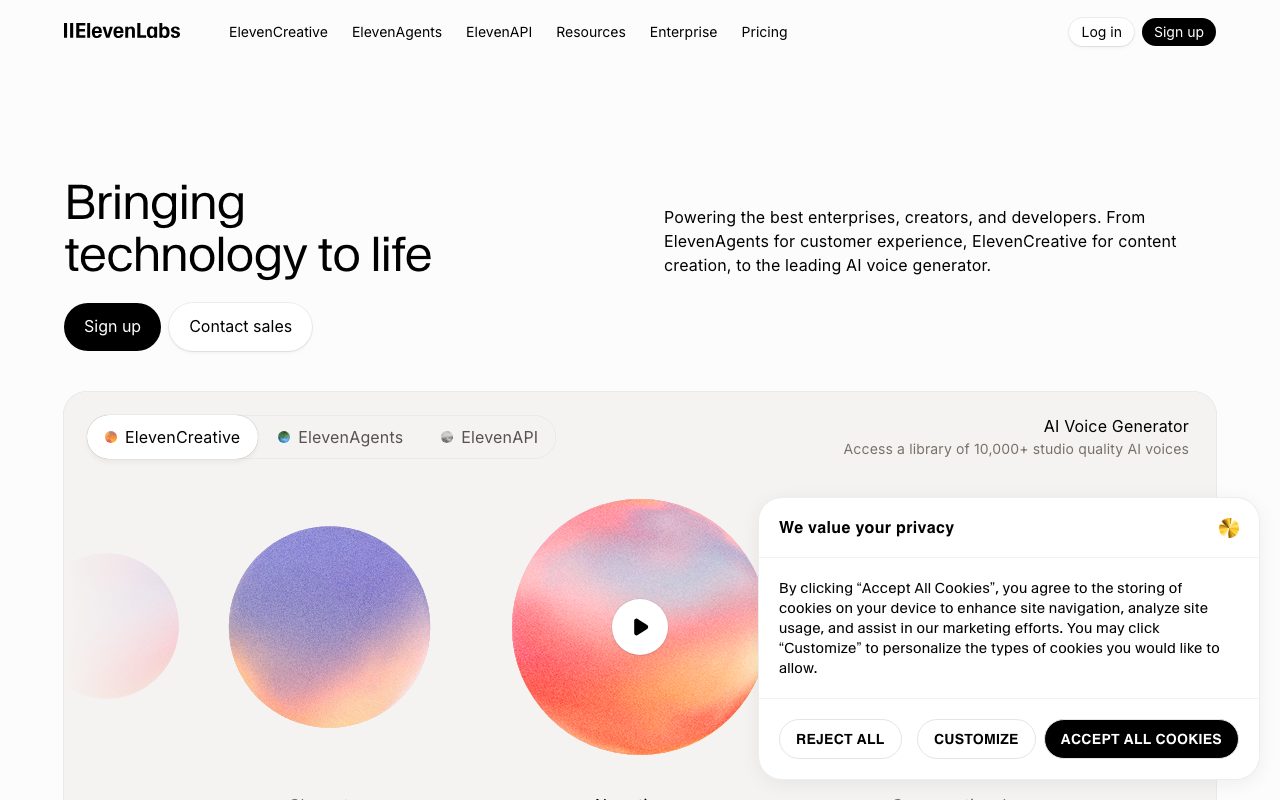
ElevenLabs is the AI voice platform that made everyone realize text-to-speech was actually solved. It generates natural-sounding speech, clones voices, dubs across languages, and powers real-time conversational agents. ElevenLabs is the engine under a surprising number of audiobooks, podcasts, game NPCs, and customer support voicebots you have heard this year.
The category exploded between 2023 and 2026, with OpenAI, Microsoft, Google, and dozens of startups joining. ElevenLabs has stayed in the top tier on quality and voice variety, and it is the one most production teams I know default to.
The first time you hear a cloned voice read a paragraph that you wrote, you stop arguing about whether the future is here. It is.
What ElevenLabs does
ElevenLabs ships a few related products. Text-to-speech generates audio from a script in dozens of languages with thousands of voices. Voice cloning takes a sample of a real voice and produces a model that can read new text in that voice. Studio is a long-form authoring tool for audiobooks and narration.
Conversational AI, their newer product, is a real-time agent that listens, thinks, and speaks. You can wire it to your own LLM and tools, or use the bundled models. Latency is low enough for natural turn-taking, which is the bar this category has been climbing toward.
Dubbing translates and voices content across languages while preserving the speaker's vocal identity. The result is uncanny in a good way, and it is reshaping how international content gets shipped.
Who ElevenLabs is for
Audiobook authors and indie publishers use Studio to narrate full books in their own voice or a licensed one. Podcasters use it to fix retakes, generate intros, and dub episodes for global audiences. Game studios voice NPCs. Customer service teams build voicebots that do not sound like 2014 IVR.
Solo creators on YouTube and TikTok use the basic TTS for voiceovers. The barrier to a clean voiceover dropped from a microphone and a quiet room to a paragraph and ten seconds of compute.
Pricing
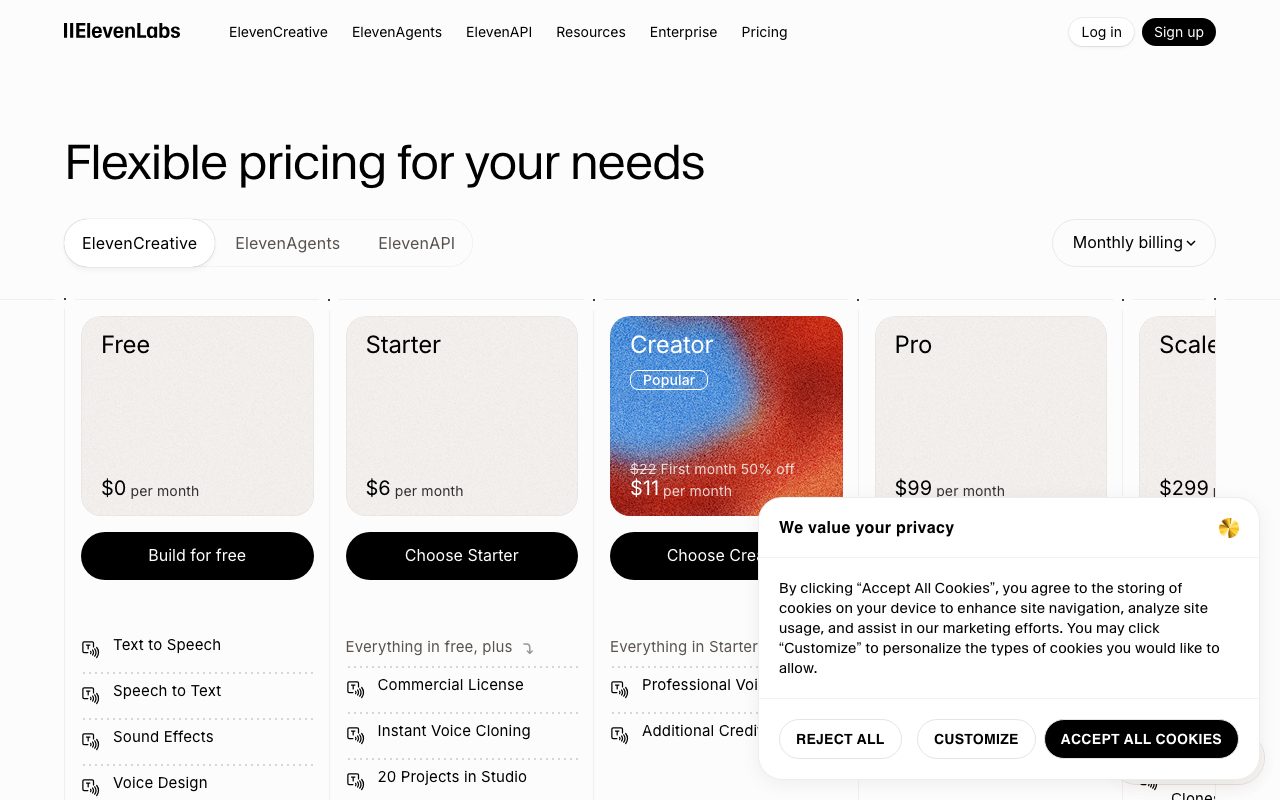
The free tier covers casual use with watermarked attribution. Paid plans scale character counts, voice cloning depth, and commercial usage rights. Enterprise tiers add SSO, dedicated capacity, and custom contracts.
The price-per-character drops sharply as you go up the tiers, which is intentional for production users. If you are running a podcast or audiobook business, the math works out fast.
Features that earn the premium
Voice cloning has two flavors: instant cloning from a short sample and professional cloning from a longer studio recording. The professional path is dramatically better and is what shipping productions use.
Multilingual generation lets one voice speak many languages without losing identity. The model handles accents, prosody, and language-specific nuance better than the field average. It is not perfect on every language, and it is closer than most realize.
Studio handles long-form narration with chapter structure, character voices, paragraph re-rolls, and SSML-style controls for pace and emphasis. It is the closest thing to a real audiobook authoring tool that the AI side has produced.
The conversational agent product handles barge-in, interruption, and tool use in a way that feels natural. Latency is in the hundreds of milliseconds, which is where the line lives between "natural" and "obviously a bot."
Tradeoffs
Quality varies by voice and language. The flagship English voices are world-class. Some less common languages or community-uploaded voices are merely good. Audition voices before locking a production to one.
Voice cloning ethics matter. ElevenLabs has identity verification on cloning, and you should respect both the law and basic decency about cloning real people without consent. The platform's policy is real but not bulletproof.
Cost can scale fast at production volume. Budget it like compute, not like a flat SaaS subscription.
If you ship audio for a living, ElevenLabs is no longer optional to evaluate. The quality bar moved, and "we tried it once in 2023" is not a reason to skip the 2026 version.
ElevenLabs vs alternatives
Versus OpenAI's TTS, ElevenLabs leads on voice variety and cloning depth. OpenAI is improving fast and is cheaper at the basic tier. Pick OpenAI if you live in the OpenAI ecosystem; pick ElevenLabs if voice quality and cloning are core to your product.
Versus PlayHT and Resemble.ai, ElevenLabs has more voices and a stronger Studio product. The competitors compete on price and specific niches like real-time agents.
Versus the open-source crop (Bark, Coqui, XTTS), ElevenLabs is dramatically better on consistency and quality, but you pay for it. If you can host your own and tolerate roughness, open source is improving.
See best AI voice tools, OpenAI TTS alternatives, and ElevenLabs vs OpenAI.
Common questions
Can ElevenLabs clone any voice? Only with consent and verification. Is there a free tier? Yes, with character caps and attribution. Does it support real-time speech? Yes, for the conversational agent product. Is the API documented well? Yes, and the SDKs cover the main languages.
Bottom line
ElevenLabs is the production-grade AI voice platform of this era. It is not the cheapest and not the only one, and it is the safest pick if voice quality is part of your product's reason to exist. Free tier is enough to evaluate seriously in an afternoon.
For audio creators of any size, the gap between ElevenLabs and yesterday's TTS is the kind of gap that changes what you can ship. See tools for content creators and the ElevenLabs profile for current details.
Production workflows
Audiobook narration: pick a voice, paste chapters, generate, regenerate problem paragraphs. Studio handles chapter structure and pacing. A novel-length book takes a few days of authoring time, mostly in re-rolls and quality checks. The result is publishable on Audible if you respect their content guidelines.
Podcast retakes: you forgot to record a segment, or the audio was bad. Clone your voice (with consent and verification, which means clone your own), generate the missing audio, splice into the episode. Listeners cannot tell.
Video voiceover at scale: a YouTube creator with twenty videos a month uses ElevenLabs for narration. Script writing dominates time; voice generation is minutes per video. A creator who could not afford a voice actor now ships videos that sound professional.
Customer support voicebots: the Conversational AI product handles tier-one questions, integrates with your CRM, and escalates to humans on complexity. Real production deployments are reducing call volume meaningfully.
Voice cloning ethics, briefly
The platform's identity verification on cloning is real and not foolproof. The right rule for builders: only clone voices you own or have written, signed consent for. Period.
Stylistic mimicry is in a separate category. Generating a voice that sounds reminiscent of a celebrity without cloning is a legal gray zone; treat it as one and check with counsel before shipping commercially.
Cost optimization
Premium voices cost more characters per generation. For draft and prototype work, use lower-tier voices; switch to premium for final renders. The cost delta is significant at production volume.
Caching matters. If you generate the same intro for every podcast episode, cache it; do not regenerate. ElevenLabs charges by characters generated, not by use.
API limits and rate limits affect production scale. Plan for retries and queueing; do not hammer the endpoint synchronously.
ElevenLabs API integration patterns
The HTTP API is the foundation. POST text plus voice ID, get audio back. Streaming endpoints exist for low-latency use cases like real-time interaction.
SDKs cover Python, Node, and a few other languages. The Python SDK is most mature; the Node SDK is good and a step behind.
Webhook callbacks notify your app when async generations complete. Useful for long-form audiobook authoring where generation takes minutes.
Voice library and custom voices coexist. You can use library voices freely; custom voices have tier limits and verification requirements.
Caching is your friend. ElevenLabs charges per character generated; cache common phrases, intros, and outros aggressively.
Quality controls in production
Voice settings (stability, similarity boost, style) tune the output. Higher stability is more consistent and less expressive; lower stability is more emotional and less predictable. Test both ends of the slider.
SSML-style controls in the input let you direct emphasis, pauses, and pace. Power users get markedly better output than copy-paste users.
Quality assurance for generated audio: listen to a sample, regenerate problem segments, and never ship without human ear review for production work.
ElevenLabs for international content
Multilingual voice generation works across thirty-plus languages. Quality varies; the flagship languages (English, Spanish, French, German) are excellent.
Dubbing preserves voice identity across languages. The result lets a creator reach global audiences without re-recording.
Accent control inside English varies by voice. Some voices nail British, American, Australian; others are less flexible.
Voice library has curated voices in most languages. The quality bar is intentional.
ElevenLabs as a stack component
Many products use ElevenLabs as the voice layer underneath their own product. The white-label and brand-safe tiers exist for serious volume.
Latency-sensitive applications use streaming endpoints to start audio playback before generation completes. Latency drops from seconds to hundreds of milliseconds.
Quality-sensitive applications use the highest-tier voice and SSML controls. The cost is higher; the audio is broadcast-quality.
Tutorial / Demo
Key Features
- Multilingual TTS in 30+ languages
- Instant and Professional voice cloning
- Dubbing Studio with translation and lip-sync
- Conversational AI agents
- Sound effects generation
- Streaming API for real-time apps
- Studio for long-form audio projects
Pros & Cons
What we like
- Quality is the gold standard in the category
- API is reliable and well-documented
- Voice library lets you ship without cloning
- Active feature development
Room for improvement
- Pricing per character climbs fast on real workloads
- Voice cloning misuse remains a real ethical concern
- Free tier is small and watermarked
- Latency on the very best models isn't real-time-fast
Frequently Asked Questions
Does ElevenLabs have a free tier?
ElevenLabs vs OpenAI TTS, which sounds better?
Can I clone my own voice?
How many languages does ElevenLabs support?
Does ElevenLabs have an API?
Best For
Featured in
Tags
Alternatives to ElevenLabs
View all
Cartesia
Ultra-low-latency real-time text-to-speech powered by the Sonic model, built for live voice AI agents
Resemble AI
Secure voice cloning, real-time text-to-speech, and speech-to-speech paired with deepfake detection and watermarking

Murf AI
AI voiceover and text to speech studio with 200+ realistic voices across 35+ languages for business content

WellSaid Labs
Enterprise text-to-speech with studio-quality AI voice avatars trained on consenting voice actors
Our take
Tool Index Editorial · May 2026· 4.6/5
What ElevenLabs is really selling — beyond the marketing copy — is the voice cloning and text-to-speech service everyone benchmarks against.
Where it wins: Quality is the gold standard in the category, API is reliable and well-documented, and Voice library lets you ship without cloning. Less impressive: Pricing per character climbs fast on real workloads and Voice cloning misuse remains a real ethical concern.
Verdict: ElevenLabs comfortably earns its spot in the category — a smart default when you need narrating videos, podcasts, and audiobooks.
Editorial opinion from the Tool Index team, written from the public product pages. Not a user review.
Reviews (9)
Caveats: good ones and frustrating ones
Found ElevenLabs on a Reddit thread, glad I clicked. The biggest win has been active feature development. Found it works best for narrating videos, podcasts, and audiobooks. Not perfect but better than the alternatives I tried.
Pros
- Voice library lets you ship without cloning
- Active feature development
Solid but with caveats
Tried ElevenLabs on a side project first. Where it really wins is quality is the gold standard in the category. Their take on instant and Professional voice cloning is solid. It fits well for narrating videos, podcasts, and audiobooks. Wish they'd address how free tier is small and watermarked. Not perfect but better than the alternatives I tried.
Pros
- Voice library lets you ship without cloning
Cons
- Free tier is small and watermarked
- Voice cloning misuse remains a real ethical concern
Stuck the landing for our team
Adopted ElevenLabs for one project, ended up using it for more. Honestly impressed by how active feature development. Found it works best for game and app character voicing. Easy yes for anyone weighing the same trade-offs.
Pros
- Active feature development
Did exactly what I needed
Adopted ElevenLabs for one project, ended up using it for more. What stands out is how active feature development. Glad I made the switch.
Pulled its weight from week one
First impression of ElevenLabs was 'huh, this is actually thought through.' The thing I keep coming back to: voice library lets you ship without cloning. The sound effects generation is more useful than I expected. Mostly using it for dubbing video content into other languages. Wish they'd address how free tier is small and watermarked. Worth the price for what I get out of it.
Pros
- Voice library lets you ship without cloning
- Active feature development
Cons
- Voice cloning misuse remains a real ethical concern
- Pricing per character climbs fast on real workloads
Worth the price of admission
Adopted ElevenLabs for one project, ended up using it for more. Genuine strength: quality is the gold standard in the category. Instant and professional voice cloning works the way you'd hope. Sticking with ElevenLabs.
ElevenLabs has been a quiet upgrade
Been using ElevenLabs for six months now. The thing I keep coming back to: active feature development. Their take on streaming API for real-time apps is solid. It fits well for dubbing video content into other languages. Would buy again without thinking twice.
Worth the price of admission
Have been using ElevenLabs for a while, here's where I land. Real selling point: voice library lets you ship without cloning. Sound effects generation works the way you'd hope. Found it works best for narrating videos, podcasts, and audiobooks.
Pros
- Quality is the gold standard in the category
- Active feature development
Recommended without reservation
ElevenLabs solves a real problem for me, but it's not magic. Where it really wins is quality is the gold standard in the category. Worth calling out the conversational AI agents too. Would buy again without thinking twice.
Pros
- Active feature development
- Voice library lets you ship without cloning
- Quality is the gold standard in the category
Badge builder
Add ElevenLabs to your website
Choose a badge style and size, preview it here, then copy the generated HTML. Badge images are self-contained SVGs and do not require an external script.

<a href="https://toolindex.net/tools/elevenlabs?ref=badge" target="_blank" rel="noopener">
  <img src="https://toolindex.net/badge/elevenlabs/medium.svg" alt="ElevenLabs - Listed on Tool Index" width="180" height="50" />
</a>How to use the badge
- 1. Pick the style, size, and theme that fit your layout.
- 2. Copy the generated HTML from the code block.
- 3. Paste it into your footer, homepage, or press page.
Score badge available
ElevenLabs qualifies for the score and circle badges based on its current top-10 positionin AI Voice Generators.
Badge clicks return visitors to this profile with a referral tag so the source remains identifiable.
Related Tools
Apatero AI
The creator studio for AI image, video, audio, 3D, and avatars, now at apatero.ai.
Kevin Gabeci Toolkits
Seven AI toolkits for writing books, making music, cutting video, and building agents.

Warp
The modern terminal reimagined with AI and collaboration

Bolt.new
Prompt-to-deployed full-stack app inside the browser
Work on ElevenLabs? Request listing access or correction