AssemblyAI
Speech-to-text API with diarization, summarization, and LLM features
Gallery
About AssemblyAI
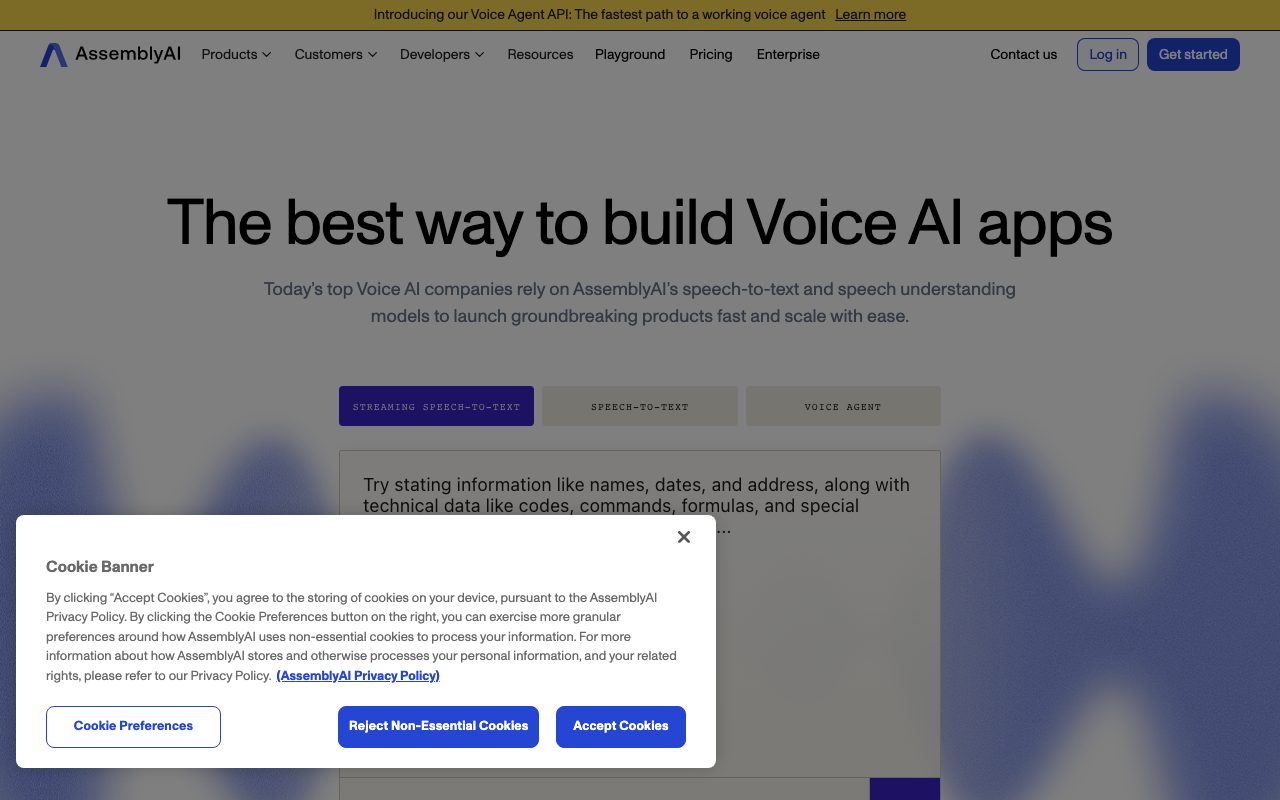
AssemblyAI is a speech-to-text API that quietly became one of the most reliable shipping options for developers. It's not the loudest player. It's just the one a lot of teams settle on after trying Whisper, Deepgram, and Google Speech and getting bored of the tradeoffs.
The pitch is simple. Send audio, get back accurate transcripts with speaker labels, sentiment, summaries, and the ability to ask LLM questions about the content. AssemblyAI handles the parts you'd otherwise stitch together yourself.
If you're building voice features into a SaaS product, podcast tooling, or a meeting analytics layer, AssemblyAI is worth a serious look. It's not always the cheapest. It's often the least painful.
What AssemblyAI actually does
Core transcription runs on the Universal-2 model, which competes head-to-head with Whisper and Deepgram for accuracy on English audio. Diarization labels who spoke when. Real-time streaming handles live captioning use cases.
Beyond raw transcription, AssemblyAI bundles audio intelligence features. Sentiment analysis on each utterance. Topic detection. Content moderation flags. Summarization and chapter generation that turn a 90-minute call into a structured TL;DR.
Then there's LeMUR. It's a layer that lets you run LLM prompts directly over a transcript without managing your own RAG plumbing. Ask "what action items came out of this call" and get a structured answer.
Who AssemblyAI is for
Engineers shipping voice features into SaaS products lean on AssemblyAI heavily. Meeting bots, podcast platforms, sales-call analytics tools, customer support QA platforms. Anywhere voice turns into searchable text.
Indie hackers building their first voice app benefit from the SDKs and free credit. You can prototype a working transcription feature in an afternoon.
If you're transcribing ten files a month, you don't need this. Use Whisper locally. If you're processing thousands of hours, AssemblyAI's pricing math becomes the central question.
Pricing breakdown
Pricing is per-second of audio processed. Transcription starts around $0.37 per hour of async audio at standard quality. Real-time streaming costs more per minute. Audio intelligence features layer on top.
The free tier gives you a few hundred dollars of credit, which translates to dozens of hours for prototyping. It runs out fast on production data.
Compared to running Whisper on your own GPUs, AssemblyAI is more expensive at scale but eliminates all the infra headaches. The crossover point depends on how many hours you process and how cheap your engineers' time is.
Standout features
LeMUR removes a meaningful chunk of work. You'd otherwise transcribe, chunk, embed, store in a vector DB, retrieve, and prompt. Now it's one API call with the transcript already wired in.
Speaker diarization is consistently strong. On two-speaker calls AssemblyAI handles overlap and short turns better than several competitors I've tested.
The SDKs are excellent. Python, Node, Go, Java, and a few others. Documentation reads like it was written by someone who actually shipped a feature, not a marketing team.
Real-time streaming
Streaming transcription works well for live captioning, voice agents, and meeting transcripts. Latency is in the 300-600ms range, which is fine for most product use cases. If you need sub-200ms latency for voice agents, Deepgram still has an edge.
Honest tradeoffs
Per-minute cost adds up quickly on real production loads. A startup processing 5,000 hours a month is looking at meaningful cloud-grade bills.
Some advanced features cost extra. Audio intelligence add-ons multiply the per-minute price. Always model your real workload before committing.
Non-English accuracy varies. AssemblyAI supports many languages, but the gap between English and, say, Swedish or Vietnamese accuracy is wider than the marketing materials suggest.
For most teams shipping a voice feature inside a product, AssemblyAI is the path of least resistance. The accuracy floor is high, the API is clean, and you don't pay infrastructure tax.
AssemblyAI vs alternatives
Versus Deepgram, AssemblyAI wins on built-in audio intelligence and LeMUR. Deepgram wins on streaming latency. See the head-to-head.
Versus self-hosted Whisper, AssemblyAI wins on operational simplicity, speaker diarization quality, and feature breadth. Whisper wins on per-hour cost at scale once your infra is solid.
Versus Google Speech-to-Text, AssemblyAI is more developer-friendly with cleaner pricing. Google wins on language coverage and enterprise procurement paths.
Browse more options on the best speech-to-text APIs and the AssemblyAI alternatives page.
Bottom line
AssemblyAI is the speech-to-text API to default to when you want to ship and stop thinking about transcription. The accuracy is competitive, LeMUR is a real productivity win, and the SDKs respect your time.
Watch your costs as you scale. Plan an exit ramp to self-hosted Whisper if your volume becomes massive. For everything before that point, AssemblyAI is a strong, boring, dependable choice. That's the highest compliment in infrastructure.
Building with AssemblyAI
The fastest path is the async transcription endpoint. Upload audio, poll for completion, get back a structured JSON with words, timestamps, speaker labels, and any audio-intelligence outputs you requested.
Real-time streaming uses WebSockets. Connect, push audio chunks, receive partial and final transcripts. The API is well-documented and the SDKs handle reconnection logic for you.
For LeMUR, you transcribe first, then send the transcript ID and a prompt. The model returns answers grounded in the transcript. Useful for action items, summaries, and Q and A workflows.
Cost optimization tips
Pre-process audio to remove silence and music before sending. AssemblyAI charges by audio duration; trimming saves real money on long calls.
Use lower-quality audio when accuracy headroom exists. For diarization-only use cases, 16kHz mono is enough. Sending 48kHz stereo wastes bandwidth and processing.
Cache transcripts aggressively. Re-running LeMUR queries against existing transcripts is cheap; re-transcribing the same audio is not.
Comparing accuracy in production
AssemblyAI's English accuracy is in the same tier as Whisper Large and Deepgram Nova-2. Differences emerge on specific audio types: heavy accents, multi-speaker overlap, technical jargon.
Run your own test on real production audio. Public benchmarks rarely match your specific use case. A 30-minute test on 10 representative recordings tells you more than any leaderboard.
Diarization accuracy is where AssemblyAI consistently shines. On two-speaker calls, it handles short turns and overlap better than several competitors I've benchmarked.
Common AssemblyAI questions
Does AssemblyAI support languages beyond English? Yes, but accuracy varies. English is the strongest. Spanish, French, and German are good. Asian languages and lower-resource European languages have wider quality gaps.
Is data retained after transcription? Configurable. Default retention is short; you can request immediate deletion or zero-retention modes for compliance use cases.
What's the maximum audio length? Several hours per file in async mode. Long files are chunked internally; you get one combined result.
For more options, browse tools for transcription.
AssemblyAI in voice agent architectures
Voice agents stitch transcription, an LLM, and text-to-speech into a real-time loop. AssemblyAI handles the transcription side cleanly; the streaming endpoint is the relevant API.
Latency budgeting matters. Aim for sub-second total turnaround. AssemblyAI's streaming contributes 300-600ms; you'll need a fast LLM and a fast TTS to hit the budget.
Diarization helps in multi-party voice contexts. Customer support calls, two-party meetings, panel discussions. The speaker labels feed downstream analytics meaningfully.
Quality assurance with AssemblyAI
Spot-check transcripts on a sample of production audio weekly. Word error rate (WER) trends matter more than absolute scores; sudden jumps warn of model regressions or audio-pipeline changes.
Track confidence scores per word. Low-confidence regions correlate with errors; surface them to human reviewers when accuracy matters.
Build a custom vocabulary list for domain terms. Brand names, technical jargon, proper nouns. Custom vocab can lift accuracy on those terms without retraining the model.
Production rollout tips
Start with the async API for non-real-time use cases. It's cheaper, simpler, and lets you iterate on prompt and pipeline design before adding streaming complexity.
Add streaming only when latency requirements demand it. Voice agents need streaming; meeting transcript generation does not.
Final thoughts on AssemblyAI
For teams shipping voice features, AssemblyAI is one of the cleanest paths from "we should add transcription" to "we shipped transcription that works." The accuracy is competitive, the SDKs are pleasant, the pricing is predictable.
The competitive landscape will keep shifting. Whisper improves; Deepgram pushes streaming; new entrants test new approaches. AssemblyAI's bet is on developer experience and bundled audio intelligence, and that bet has aged well.
Try the free tier with your real audio. Thirty minutes of testing tells you more than any benchmark. For more options, check the best voice AI tools.
Quick recap
The product fits teams shipping voice features into a real product. SDK quality, accuracy, and audio intelligence together make the build-vs-buy math favor AssemblyAI for most use cases below the high-volume tier.
Watch the per-minute cost as you scale. Build a clean exit ramp to self-hosted Whisper if your volume grows large. Don't over-engineer the migration before you need it.
LeMUR remains the underrated feature. Teams that build LLM-over-transcript workflows save real engineering time by not stitching their own RAG plumbing.
Browse more options at the best transcription tools, the broader voice AI category, and AssemblyAI alternatives.
Tutorial / Demo
Key Features
- Universal-2 transcription model
- Speaker diarization and labeling
- Real-time streaming transcription
- LeMUR for LLM-over-transcript queries
- Sentiment, topic, and content moderation analysis
- Summarization and chapter detection
- SDKs across major languages
Pros & Cons
What we like
- Accuracy is competitive with Deepgram and Whisper
- LeMUR removes a lot of plumbing work
- Pricing is transparent and per-second
- Documentation and SDKs are excellent
Room for improvement
- Per-minute cost adds up at scale vs. self-hosted Whisper
- Streaming has higher latency than Deepgram
- Some advanced features are extra-cost
- Free tier credit runs out fast on real data
Frequently Asked Questions
Does AssemblyAI have a free tier?
AssemblyAI vs OpenAI Whisper, which is better?
AssemblyAI vs Deepgram?
Does it handle real-time streaming?
What languages are supported?
Best For
Featured in
Tags
Alternatives to AssemblyAI
View allOtter.ai
A meeting assistant that turns conversations into searchable transcripts and summaries
ElevenLabs
The voice cloning and text-to-speech service everyone benchmarks against

Cartesia
Ultra-low-latency real-time text-to-speech powered by the Sonic model, built for live voice AI agents

Murf AI
AI voiceover and text to speech studio with 200+ realistic voices across 35+ languages for business content
Our take
Tool Index Editorial · May 2026· 4.4/5
AssemblyAI is the kind of tool you adopt when you want speech-to-text api with diarization, summarization, and llm features.
The standout points: Accuracy is competitive with Deepgram and Whisper, LeMUR removes a lot of plumbing work, and Pricing is transparent and per-second. The friction points: Per-minute cost adds up at scale vs. self-hosted Whisper and Streaming has higher latency than Deepgram.
Bottom line: pick AssemblyAI when you need adding transcription to a SaaS product; look elsewhere if per-minute cost adds up at scale vs. self-hosted Whisper would be a dealbreaker.
Editorial opinion from the Tool Index team, written from the public product pages. Not a user review.
Reviews (3)
AssemblyAI has been a quiet upgrade
Honest take: AssemblyAI delivers most of what the marketing promises. Honestly impressed by how documentation and SDKs are excellent. Mostly using it for adding transcription to a SaaS product. Glad I made the switch.
Pros
- LeMUR removes a lot of plumbing work
- Pricing is transparent and per-second
Finally something that fits
Two months of using AssemblyAI, here's what holds up. Real selling point: pricing is transparent and per-second. Easy yes for anyone weighing the same trade-offs.
Pros
- Documentation and SDKs are excellent
Worth the price of admission
Started using AssemblyAI casually, now it's pinned in my dock. Honestly impressed by how pricing is transparent and per-second. Glad I made the switch.
Pros
- LeMUR removes a lot of plumbing work
- Documentation and SDKs are excellent
Badge builder
Add AssemblyAI to your website
Choose a badge style and size, preview it here, then copy the generated HTML. Badge images are self-contained SVGs and do not require an external script.

<a href="https://toolindex.net/tools/assemblyai?ref=badge" target="_blank" rel="noopener">
  <img src="https://toolindex.net/badge/assemblyai/medium.svg" alt="AssemblyAI - Listed on Tool Index" width="180" height="50" />
</a>How to use the badge
- 1. Pick the style, size, and theme that fit your layout.
- 2. Copy the generated HTML from the code block.
- 3. Paste it into your footer, homepage, or press page.
Standard badge available
The standard listing badge is available now. Score and circle badges are limited to tools currently ranked in the top 10 of a category.
Badge clicks return visitors to this profile with a referral tag so the source remains identifiable.
Related Tools

Apatero AI
The creator studio for AI image, video, audio, 3D, and avatars, now at apatero.ai.
Kevin Gabeci Toolkits
Seven AI toolkits for writing books, making music, cutting video, and building agents.

Warp
The modern terminal reimagined with AI and collaboration

Bolt.new
Prompt-to-deployed full-stack app inside the browser
Work on AssemblyAI? Request listing access or correction