
Cinderella
Free valuation and a marketplace for selling half-finished GitHub projects, with escrow and code scrubbing
Gallery
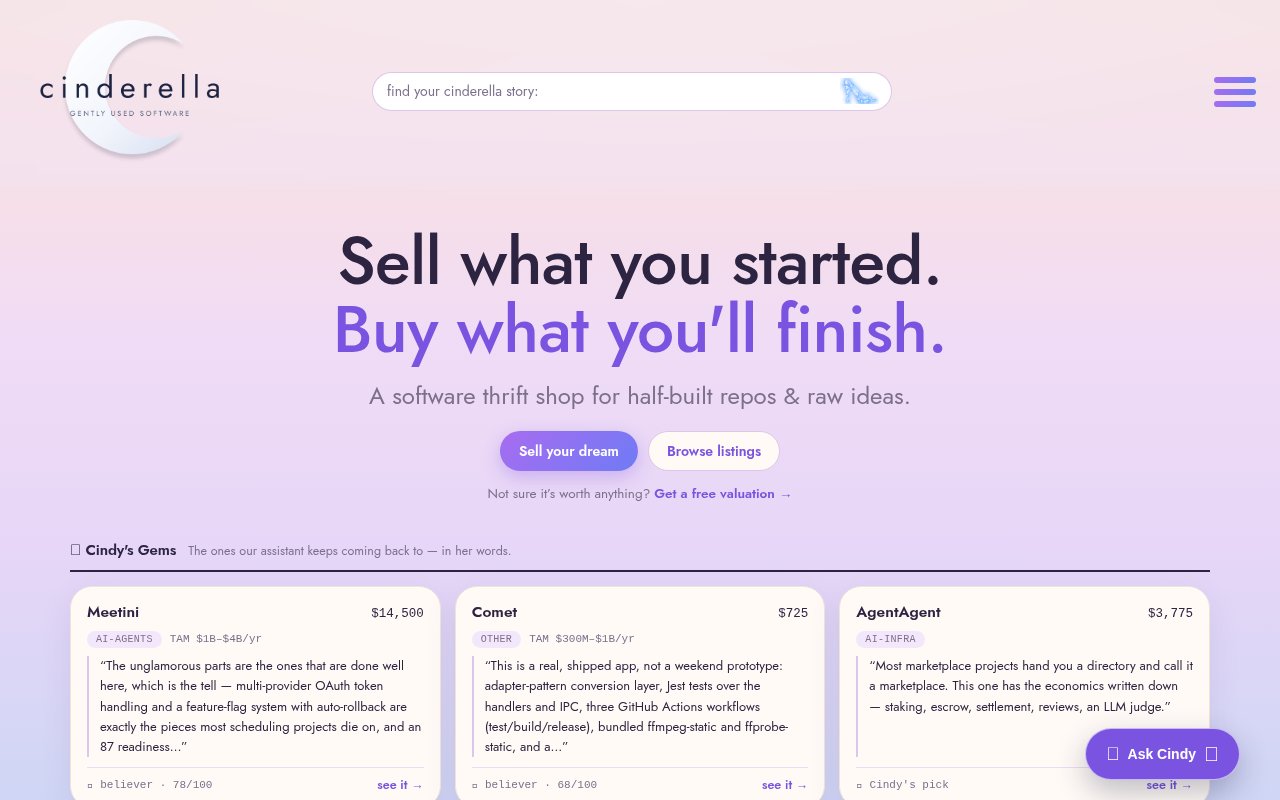
About Cinderella
Cinderella is a marketplace for what it calls gently used software, the half-finished GitHub repositories most developers have a few of. It starts with a free valuation tool. Point it at a public repo and it returns a readiness score from 0 to 100 and an estimated asking price range. If you like the number you can list the project for sale, and Cinderella handles the scrubbing, the escrow, and the hand-off to a buyer. The framing is that a project that never shipped isn't worthless, it's just unpriced.
The problem is that abandoned side projects have value and no market. A working prototype with tests and docs is worth something to someone who wants a head start, but the seller has no idea what to ask and the buyer has no way to trust what's in the box. Existing acquisition marketplaces are built for businesses with revenue and customers, which leaves the far larger pile of promising prototypes with nowhere to go except an archive folder. Cinderella gives both sides a number to argue from and a process that doesn't depend on either party being honest by default.
The valuation reads six signals through GitHub's public API, namely completeness, code volume, tests, documentation, polish, and cleanliness. Each is weighted, the total is adjusted for demand in the project's category, and the breakdown is shown rather than hidden. Category demand matters because a half-built developer tool and a half-built game don't fetch the same price even with identical scores, and the range moves accordingly. It never downloads your code to score it, needs no account, and works on public repositories only. Sellers can accept the recommended price, set their own, or open the listing to offers.
Listing is where the heavier machinery kicks in. Every upload is scrubbed of .env files, API keys, credentials, and personal data, with safe placeholders swapped in, and anything that can't be cleaned automatically goes to human review before it's published. Three checks produce badges on the listing, Scrubbed for secrets removed, Verified build for code that installed, built, and tested in a sandbox, and Deep-scanned for passing everything. A build that fails is published anyway, with the logs. Sellers can prove they control the original repo through its commit history, shown as ranges so the listing can't be traced straight back to GitHub. Buyers browse and search, purchase at a fixed price or make an offer, and the money sits in escrow through Stripe while the buyer receives the scrubbed bundle and assets. Funds release when the buyer confirms the hand-off or automatically after a seven-day inspection window, and buyers rate sellers afterwards, so repeat sellers build a public track record. Offers above a certain size require a card authorisation, never charged, which earns a verified buyer badge.
It's for developers with a drawer of unfinished projects, indie hackers who'd rather sell a prototype than let it rot, and buyers looking for a head start on a product they'd otherwise build from scratch. It also allows equity or revenue-share deals instead of cash, and a category for ideas with full pitches protected behind sign-in and a confidentiality acknowledgement, with access logged.
What makes it different from posting on a forum or a general acquisition marketplace is the tooling around trust. Automated secret scrubbing, sandbox builds with public logs, escrow tied to an inspection window, and a transparent scoring rubric are the pieces that make buying a stranger's half-built repo less of a gamble. The scrubbing step alone is a service, since it catches the committed .env file and the hard-coded key that would otherwise leak the moment a stranger opened the bundle, and human review handles the cases automation can't clean.
The limits are obvious. It's a young marketplace, so liquidity is the open question, and a valuation is a model's estimate, not an offer. Public repos only means private code has to be made public to be scored, and the exact weights behind the six signals aren't published. There's no operator information or contact email on the site, only a support page, no stated refund policy beyond the escrow mechanics, and the commission is steep at the low end. Access is free to value and free to list, with no subscription. Cinderella earns a commission only when something sells, 24 percent on sales up to $10,000 and a sliding rate above that, working out to 18.6 percent on a $25,000 sale and 12.4 percent at $100,000, with payment processing included. Payouts go to a connected Stripe account once escrow releases, and equity and revenue-share listings carry no upfront commission, with buyers proposing terms and sellers negotiating.
Key Features
- Free readiness score and price range
- Six-signal transparent valuation rubric
- Automatic secret and credential scrubbing
- Sandbox builds with public logs
- Stripe escrow with a seven-day inspection window
- Equity and revenue-share listings
Pros & Cons
What we like
- Valuing and listing cost nothing
- Never downloads your code to score it
- Escrow protects both buyer and seller
- Badges show what was verified
Room for improvement
- Young marketplace with unproven liquidity
- 24 percent commission at the low end
- Public repositories only
- No operator details or contact email
Frequently Asked Questions
What is Cinderella?
Is Cinderella free?
How does it protect buyers?
Does it need access to my code?
Best For
Featured in
Alternatives to Cinderella
View all
Kevin Gabeci
Solo developer building web apps, cozy browser games, and AI creator toolkits.

SoloDevStack
A solo developer blog built on head-to-head tool comparisons, 580+ posts deep.

Codedex
A gamified, story-driven platform that teaches Python, web dev, and more like an RPG quest

Vibe Built
Building real apps with agentic AI. What worked, what broke, what shipped.
Our take
Tool Index Editorial · Sep 2026· 3.0/5
Cinderella is a marketplace for unfinished repositories and software ideas, with valuation, secret scrubbing, build checks, and escrow around the handoff. It is a clever fit for developers who have a usable prototype but no operating business to sell. Valuation and listing are free, while the homepage states a 24 percent commission on completed sales.
We opened a marketplace showing 42 listings, but only six were labeled as repositories with code. That is enough to make the concept tangible, not enough to prove strong buyer liquidity. The scrubbing and escrow process reduce obvious risk, yet buyers still need to inspect ownership, dependencies, licenses, and maintainability. Sellers should also weigh the high commission against the uncertain chance of a sale.
Editorial opinion from the Tool Index team, written from the public product pages. Not a user review.
Reviews (0)
Badge builder
Add Cinderella to your website
Choose a badge style and size, preview it here, then copy the generated HTML. Badge images are self-contained SVGs and do not require an external script.

<a href="https://toolindex.net/tools/cinderella?ref=badge" target="_blank" rel="noopener">
  <img src="https://toolindex.net/badge/cinderella/medium.svg" alt="Cinderella - Listed on Tool Index" width="180" height="50" />
</a>How to use the badge
- 1. Pick the style, size, and theme that fit your layout.
- 2. Copy the generated HTML from the code block.
- 3. Paste it into your footer, homepage, or press page.
Standard badge available
The standard listing badge is available now. Score and circle badges are limited to tools currently ranked in the top 10 of a category.
Badge clicks return visitors to this profile with a referral tag so the source remains identifiable.
Related Tools
Kevin Gabeci
Solo developer building web apps, cozy browser games, and AI creator toolkits.

Coolify
Self-hostable, open source alternative to Heroku and Netlify

Warp
The modern terminal reimagined with AI and collaboration

Bolt.new
Prompt-to-deployed full-stack app inside the browser
Work on Cinderella? Request a listing correction