Clair APIs
Job postings and news data APIs with normalized fields, sourced from public ATS boards
Gallery
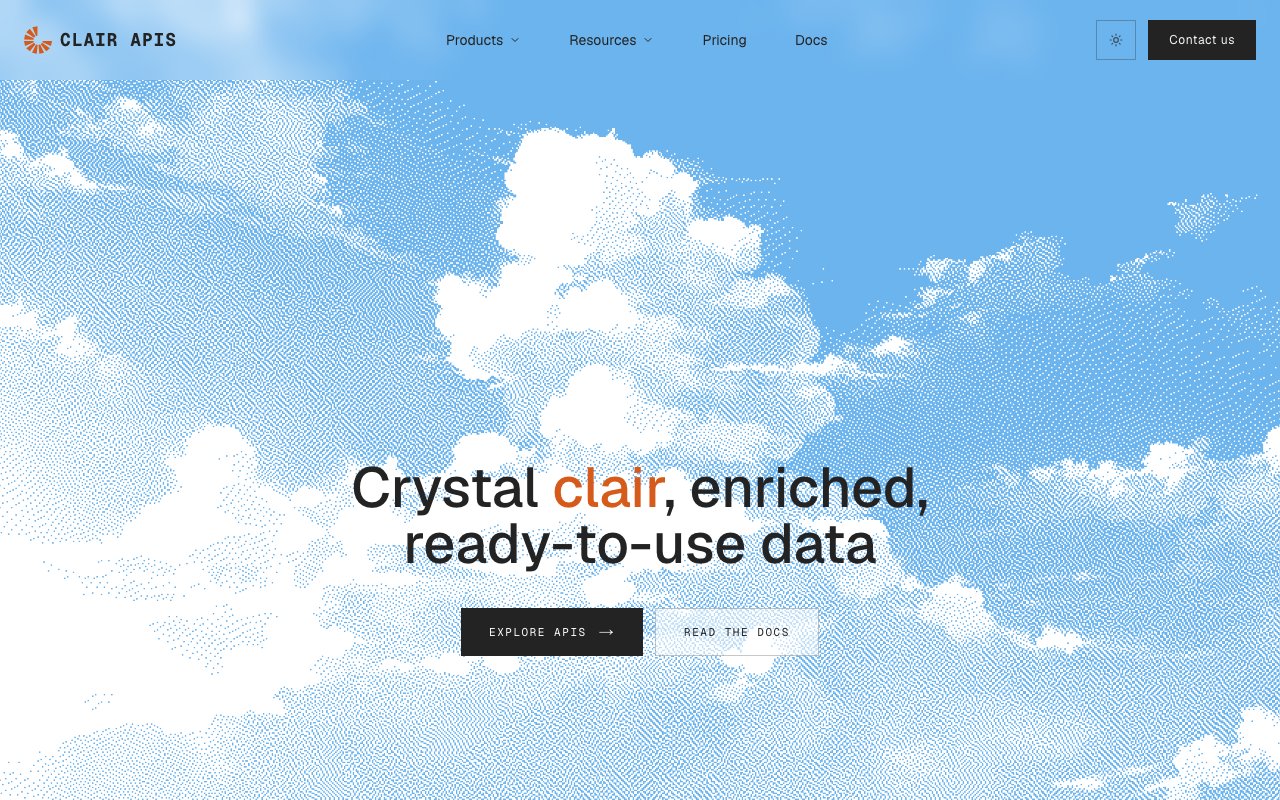
About Clair APIs
Clair is a developer API platform built around structured data feeds, and its flagship offering is an active jobs dataset indexed from public applicant tracking system boards. Instead of scraping job sites yourself and wrestling the results into shape, you query an API that has already normalized postings into consistent fields for roles, skills, seniority levels, workplace types, locations, salaries, and company details. A separate News API covers editorial content from validated publishers, so the platform is two focused data products under one roof rather than a sprawling data marketplace.
The problem it solves is one every job board builder and recruiting tool founder hits early. Job data is public but messy. It lives across thousands of company ATS pages in inconsistent formats, postings expire without notice, and fields like salary or seniority are buried in free text when they exist at all. Clair does the collection and normalization continuously, and the dataset page is unusually honest about what that yields. At the time of writing it indexes more than 800,000 active postings across more than 6,700 distinct known company names, with country data on about 80 percent of postings, full job descriptions on 62 percent, and salary information on roughly 20 percent. Those numbers matter because job data vendors usually talk in vague superlatives, and knowing the actual field coverage up front saves you from discovering the gaps three weeks into an integration.
Access runs through RapidAPI. You subscribe to a plan there, get a key, and hit documented endpoints with cursor pagination and a maximum page size of 100 results. The API supports filtering by skills, country, workplace type, seniority, salary, company, and data source, and both latest and relevance search modes are available on every plan. Keys, quotas, metering, and billing are all managed by RapidAPI rather than a native Clair dashboard, which keeps setup fast but does mean your account lives on a third-party platform. Full documentation sits on the Clair site itself, with an introduction that walks through the jobs API before you commit to anything. In practical terms, you can go from reading the dataset page to pulling real postings in a single sitting, since the free tier requires no card and the endpoint is live on RapidAPI already.
It fits developers building job boards, recruiting and sourcing tools, market research products, or anything that needs a live picture of hiring activity. Because postings come from public ATS boards and carry a freshness guarantee on the dataset page, it also suits analytics work, like tracking which companies are hiring for which skills over time. The dataset page showed a verification date of the current day when this listing was researched, which suggests the freshness claim is an operational habit rather than marketing copy. The News API side serves products that need a clean editorial feed without negotiating publisher relationships one by one, and since both APIs share the same pricing shape and platform, adding the second one later doesn't mean learning a new vendor.
What sets it apart from the big job data vendors is scope and posture. This isn't an enterprise data contract with a sales call in front of it. It's a self-serve API with a real free tier, published per-request overage pricing, and coverage statistics stated plainly on the page, including the ones that aren't flattering, like salary data appearing on only a fifth of postings. That transparency makes it easy to judge fit before you write a line of code. The tradeoff is that the catalog is narrower than a large aggregator, and the normalization work, while real, inherits whatever gaps exist in the source ATS boards.
Pricing is the same shape for both APIs. The Basic tier is free with no card required and includes 250 requests a month at 10 requests per minute, enough to prototype against real data. Pro runs 25 dollars a month for 25,000 requests, Ultra is 75 dollars for 125,000, and Mega is 199 dollars for 500,000, all at 5 requests per second. Overage requests are billed per request at rates that drop with tier, from 0.0015 dollars down to 0.0004. The company publishes contact@serinlabs.com for direct questions. If you've been putting off a job data feature because the collection work looked painful, the free tier here is a low-risk way to find out whether the coverage matches your market before any money changes hands. Two hundred fifty requests at a hundred results each is a real sample, not a teaser.
Key Features
- Active jobs dataset from public ATS boards
- Normalized role, skill, and seniority fields
- Salary, location, and workplace type filters
- News API from validated publishers
- Cursor pagination with documented endpoints
- Self-serve access through RapidAPI
Pros & Cons
What we like
- Free Basic tier with no card required
- Normalized structured fields instead of raw scrapes
- Coverage statistics published openly, including the weak spots
- Clear per-tier quotas and per-request overage pricing
Room for improvement
- Keys, quotas, and billing run through RapidAPI, not a native dashboard
- Free tier caps at 250 requests a month
- Salary data present on only about a fifth of postings
- Narrower catalog than large enterprise job data vendors
Frequently Asked Questions
What is Clair?
Is there a free tier?
Where does the jobs data come from?
How do I access the APIs?
Best For
Featured in
Alternatives to Clair APIs

Kevin Gabeci
Solo developer building web apps, cozy browser games, and AI creator toolkits.

SoloDevStack
A solo developer blog built on head-to-head tool comparisons, 580+ posts deep.

Codedex
A gamified, story-driven platform that teaches Python, web dev, and more like an RPG quest

Vibe Built
Building real apps with agentic AI. What worked, what broke, what shipped.
Reviews (0)
Badge builder
Add Clair APIs to your website
Choose a badge style and size, preview it here, then copy the generated HTML. Badge images are self-contained SVGs and do not require an external script.

<a href="https://toolindex.net/tools/clair-apis?ref=badge" target="_blank" rel="noopener">
  <img src="https://toolindex.net/badge/clair-apis/medium.svg" alt="Clair APIs - Listed on Tool Index" width="180" height="50" />
</a>How to use the badge
- 1. Pick the style, size, and theme that fit your layout.
- 2. Copy the generated HTML from the code block.
- 3. Paste it into your footer, homepage, or press page.
Standard badge available
The standard listing badge is available now. Score and circle badges are limited to tools currently ranked in the top 10 of a category.
Badge clicks return visitors to this profile with a referral tag so the source remains identifiable.
Related Tools
Kevin Gabeci
Solo developer building web apps, cozy browser games, and AI creator toolkits.

Coolify
Self-hostable, open source alternative to Heroku and Netlify

Warp
The modern terminal reimagined with AI and collaboration

Bolt.new
Prompt-to-deployed full-stack app inside the browser
Work on Clair APIs? Request listing access or correction