
Cloro
Unified API for extracting structured data from AI models and search engines
Gallery
About Cloro
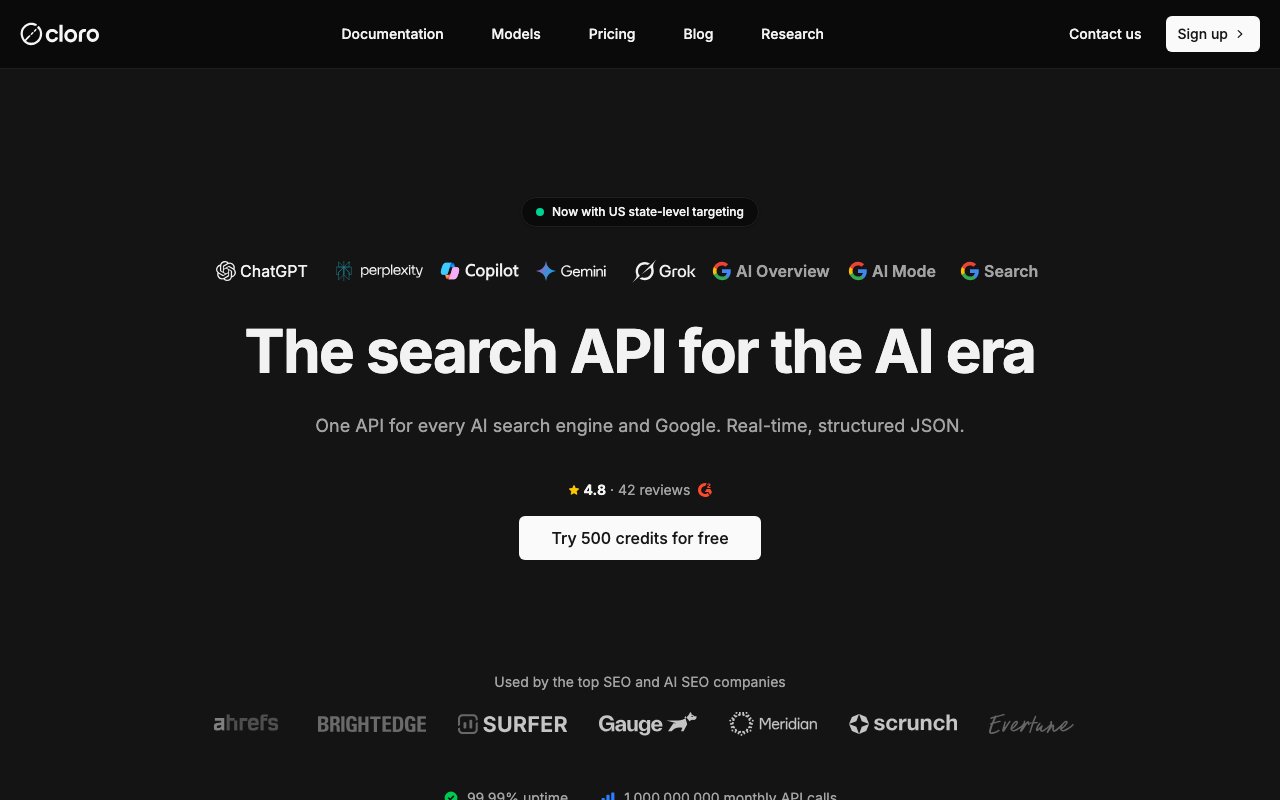
Cloro is an API platform that pulls structured data from major AI models and search engines, wrapping everything into clean JSON so developers don't have to scrape or maintain their own parsers. It connects to ChatGPT, Perplexity, Google Gemini, Microsoft Copilot, Grok, Google Search, Google News, and Google AI Overview, returning parsed markdown responses, source citations with URLs and labels, shopping results, query suggestions, and more in a single request. The platform processes over a billion API calls monthly and claims 99.99% uptime, making it infrastructure that teams can build production systems on top of rather than a fragile side project that breaks whenever a platform updates its interface.
The problem it solves is familiar to anyone who has tried to build on top of AI search or LLM responses. Each platform has its own output format, rate limits, authentication quirks, and parsing challenges. ChatGPT structures responses differently than Perplexity, and Google's AI Overview is another format entirely. Building your own scrapers means constant maintenance as these platforms evolve, plus dealing with authentication, rate limiting, and anti-bot measures. Cloro normalizes all of that behind one endpoint, so you can query multiple engines and get back consistent, machine-readable results without juggling half a dozen integrations. The structured JSON output includes the AI response in parsed markdown, all source citations with their URLs and labels, related queries, and any additional context the platform provides.
Geographic targeting is one of the standout features that makes Cloro particularly valuable for market research. The API supports all countries globally, over 250 in total, plus US state-level targeting for fine-grained regional research. Requests route through regional proxies so you can see exactly what users in a specific location would see when they ask the same question. That matters for SEO monitoring, competitive research, and localized market analysis where results vary heavily by region. A search about restaurants in Chicago will return different results than the same query made from London, and AI responses similarly adapt to regional context. If you're tracking how your brand appears in AI-generated answers across different markets, or you're monitoring competitor positioning in specific geographies, this is the infrastructure layer that handles the complexity for you.
For high-volume workloads, Cloro offers asynchronous endpoints with webhook delivery. You submit a task, go do something else, and receive results via webhook when they're ready. This makes it practical to run large-scale extraction jobs without holding connections open for every request or overwhelming your own systems with concurrent polling. Response times average 30 to 45 seconds depending on the engine, and the system retries automatically up to ten times with a maximum wait of five minutes if something fails. Credits only deduct on successful extractions, so failed requests don't eat into your quota. If you exceed your concurrent job limit, the API returns a 429 status rather than silently dropping requests, giving you clear feedback to manage your throughput.
The audience here is SEO teams, marketing agencies, market researchers, e-commerce businesses, and brand managers who need to monitor AI-generated answers and search results at scale. If you're tracking how your brand appears in ChatGPT or Perplexity responses, or you're watching competitor positioning across different markets, this is the layer that handles the scraping and parsing so you can focus on analysis. The structured output includes everything you need for monitoring dashboards, alerting systems, or feeding into your own analytics pipelines. E-commerce teams can track how their products appear in shopping results and AI recommendations across regions. Marketing agencies can offer AI visibility monitoring as a service to their clients without building the infrastructure themselves.
On the integration side, there are native SDKs for Python and JavaScript with TypeScript support, plus connections to LangChain, n8n, Zapier, OpenClaw, and MCP Server. That means you can wire Cloro into existing automation workflows or agent pipelines without writing custom glue code. If you need the raw HTML alongside the parsed response, you can request it with an include parameter, giving you flexibility for edge cases where parsing needs customization. The LangChain integration is particularly useful for teams building AI agents that need to retrieve and reason over fresh search results or AI responses as part of their workflows.
Pricing runs on a credit model with a generous free tier of 500 credits per month. Paid plans start at $30 per month for the Lite tier with 10 concurrent jobs, scaling through Starter at $250, Growth at $500, and Business at $1,000, up to enterprise tiers at $2,000 or $5,000 for teams needing up to 255 concurrent jobs and millions of credits. Per-engine costs vary from 3 credits for Perplexity to 4 for Gemini, AI Mode, and Grok, 5 for ChatGPT with web search, and 7 for a full ChatGPT response. Google Search uses a formula based on pages requested plus AI Overview bonuses. Credits don't roll over between billing cycles, so plan your usage accordingly and monitor consumption through the dashboard.
Key Features
- Unified API for multiple AI and search engines
- Geographic targeting with state-level precision
- Async endpoints with webhook delivery
- Parsed citations and source links
- Python and JavaScript SDKs
- Automatic retry and failover system
Pros & Cons
What we like
- Consolidates scraping across many AI and search platforms into one endpoint
- Geographic routing supports localized market research
- Free tier includes 500 credits per month
- Integrates with LangChain, n8n, and Zapier
Room for improvement
- Response times of 30 to 45 seconds may feel slow for interactive use
- Credit costs vary by engine, which requires planning
- Younger product with a smaller community than established scraping services
- Enterprise pricing can climb quickly at scale
Frequently Asked Questions
What is Cloro?
Is Cloro free?
Who is Cloro for?
How does geographic targeting work?
Best For
Featured in
Alternatives to Cloro
View all
Moz Pro
SEO toolset with keyword research, site audits, link analysis, and the well-known Domain Authority and Page Authority metrics.
Frase
AI-assisted SEO content tool that turns SERP research into briefs, outlines, and optimized drafts inside one editor.

Semrush
Comprehensive SEO and digital marketing suite covering keywords, backlinks, competitive research, content, and PPC.

Postdex
An exclusive marketplace for finished, human-made articles. Every piece sells once.
Reviews (0)
Badge builder
Add Cloro to your website
Choose a badge style and size, preview it here, then copy the generated HTML. Badge images are self-contained SVGs and do not require an external script.

<a href="https://toolindex.net/tools/cloro?ref=badge" target="_blank" rel="noopener">
  <img src="https://toolindex.net/badge/cloro/medium.svg" alt="Cloro - Listed on Tool Index" width="180" height="50" />
</a>How to use the badge
- 1. Pick the style, size, and theme that fit your layout.
- 2. Copy the generated HTML from the code block.
- 3. Paste it into your footer, homepage, or press page.
Standard badge available
The standard listing badge is available now. Score and circle badges are limited to tools currently ranked in the top 10 of a category.
Badge clicks return visitors to this profile with a referral tag so the source remains identifiable.
Related Tools

SEOdata.dev
Simple API for keyword search volume, CPC, and competition data

Surfer SEO
Content optimization tool that scores drafts in real time against the top-ranking pages for any target keyword.

Screaming Frog SEO Spider
Desktop website crawler trusted by SEO professionals for technical audits, broken link checks, and structured data analysis.
Frase
AI-assisted SEO content tool that turns SERP research into briefs, outlines, and optimized drafts inside one editor.
Work on Cloro? Request listing access or correction