
CostClaw
Audit Claude Code token usage and workflow signals from local logs
Gallery
About CostClaw
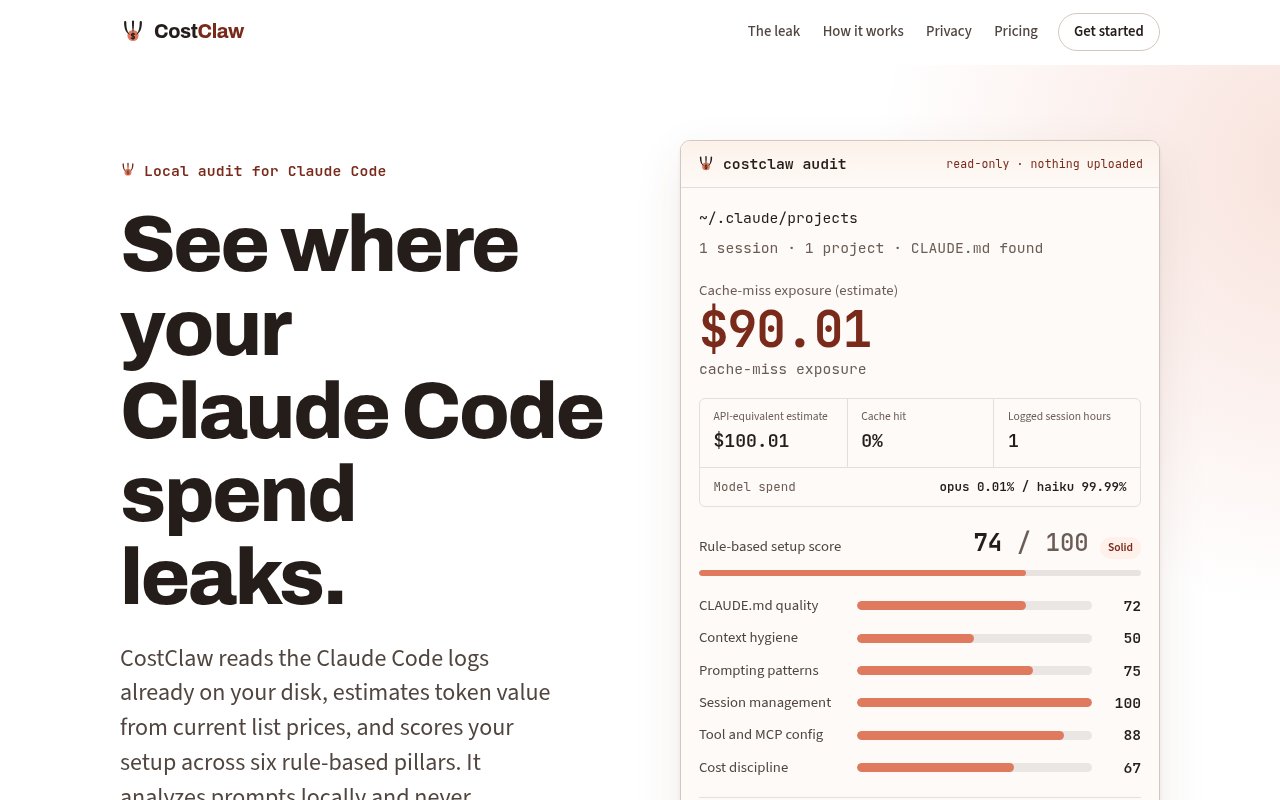
CostClaw is a local audit tool for understanding how Claude Code sessions use tokens and where a setup may be creating avoidable cost. It reads the JSONL session logs already stored under the user's Claude directory, including subagent and workflow logs, then prints a report in the terminal. There is no account requirement for the audit and the free CLI doesn't upload the logs. Its main value is turning a pile of session records into a compact view of estimated API-equivalent value, cache behavior, model mix, tool use, session timing, and configuration signals. It is aimed at developers who use Claude Code enough that intuition and a monthly total no longer explain which habits are expensive.
The audit runs in three stages. First, CostClaw parses the local logs in memory. It then derives summaries from logged token fields using dated list prices for the reported models, deduplicating repeated cumulative updates before it calculates totals. The derived data includes cache hit rate by turn, tool activity, session timing, and estimated value by model. Finally, a rule-based scorer reviews six pillars covering CLAUDE.md quality, context hygiene, prompting patterns, session management, tool and MCP configuration, and cost discipline. If the evidence for a pillar isn't present, the report marks it as unavailable rather than filling the gap with a guess. The finished audit can be read in the terminal or exported as an HTML report, score card, and README badge.
CostClaw focuses on several patterns that are hard to see in a single billing number. It estimates cache-miss exposure by comparing logged usage with a cache-read counterfactual, which can show when repeated context was priced like fresh input. It counts reactive tool loops that repeatedly call the same operation, flags short tasks that may merit review for a cheaper model, and tracks long sessions whose cache reuse falls as the context grows. Its Burn Clock groups estimated value by local day and time so a user can see when usage accumulates. Findings are ranked by modeled exposure and paired with the evidence behind them, giving the developer a review queue instead of an undifferentiated wall of warnings. It is most useful after enough sessions have accumulated to expose patterns that a single run cannot show.
The limits of those numbers matter. CostClaw doesn't reconcile an Anthropic invoice, prove which provider served a model, know every discount or billing modifier, or guarantee that switching models will preserve task quality. Its dollar figures are list-price estimates and counterfactual scenarios based on fields in the logs. They aren't a promise of cash savings or a statement about subscription quota. That makes the tool best suited to investigation and workflow tuning, not accounting. An individual developer can use it to decide whether to compact a long session or improve a CLAUDE.md file. A team lead or consultant can use the same report to discuss model routing, repeated tool calls, and the rhythm of usage with concrete evidence.
Privacy is handled by keeping raw material on the machine. Prompts are analyzed locally, while prompt text, source code, and file paths are dropped from the derived AuditRecord that the product can save. The site describes build tests that insert recognizable prompt and path markers into sample logs, run the pipeline, and fail if those markers survive into the derived record. The free CLI sends nothing to a hosted service. A future hosted dashboard is planned to receive only that reduced record for history and sharing. This design still requires the user to trust and inspect software that reads local Claude logs, but it gives the boundary a specific implementation and test instead of relying only on a broad privacy promise.
The core audit is free and can be run with npx, so it is easy to try on existing logs without creating an account. CostClaw also sells a $39 one-time license for an optimize command. That paid command scans a project and produces five local artifacts, including a filled-in CLAUDE.md, a ranked fix playbook, suggested settings, a work order for Claude Code, and a browser dashboard that compares the token receipt and configuration before and after. The hosted plan is still in progress, so buyers who need shared history or a client-ready hosted reporting workflow have to wait. For current users, the appeal is narrower and practical. It provides an offline way to inspect Claude Code usage, test cost assumptions, and leave with a prioritized set of setup changes rather than another generic optimization checklist.
Key Features
- Local Claude Code log parsing
- Dated list-price usage estimates
- Six-pillar rule-based setup score
- Cache and tool-loop analysis
- Time-based Burn Clock view
- HTML reports and README badges
Pros & Cons
What we like
- Runs the core audit entirely on-device
- Explains estimates and their limits clearly
- Ranks findings by modeled cost exposure
- Requires no account for the free CLI
Room for improvement
- Limited specifically to Claude Code logs
- Estimates don't reconcile the actual invoice
- Hosted history and sharing are not ready
- Optimization artifacts require a paid license
Frequently Asked Questions
What is CostClaw?
Does CostClaw upload prompts or code?
Is CostClaw free?
Are CostClaw's dollar figures the same as an invoice?
Best For
Featured in
Alternatives to CostClaw

Kevin Gabeci
Solo developer building web apps, cozy browser games, and AI creator toolkits.

SoloDevStack
A solo developer blog built on head-to-head tool comparisons, 580+ posts deep.

Codedex
A gamified, story-driven platform that teaches Python, web dev, and more like an RPG quest
Vibe Built
Building real apps with agentic AI. What worked, what broke, what shipped.
Reviews (0)
Badge builder
Add CostClaw to your website
Choose a badge style and size, preview it here, then copy the generated HTML. Badge images are self-contained SVGs and do not require an external script.

<a href="https://toolindex.net/tools/costclaw?ref=badge" target="_blank" rel="noopener">
  <img src="https://toolindex.net/badge/costclaw/medium.svg" alt="CostClaw - Listed on Tool Index" width="180" height="50" />
</a>How to use the badge
- 1. Pick the style, size, and theme that fit your layout.
- 2. Copy the generated HTML from the code block.
- 3. Paste it into your footer, homepage, or press page.
Standard badge available
The standard listing badge is available now. Score and circle badges are limited to tools currently ranked in the top 10 of a category.
Badge clicks return visitors to this profile with a referral tag so the source remains identifiable.
Related Tools
Kevin Gabeci
Solo developer building web apps, cozy browser games, and AI creator toolkits.
Coolify
Self-hostable, open source alternative to Heroku and Netlify

Warp
The modern terminal reimagined with AI and collaboration

Bolt.new
Prompt-to-deployed full-stack app inside the browser
Work on CostClaw? Request listing access or correction