
Arena by Dravensoft
One design system with 73 components that renders identically in React and Angular from one contract
Gallery
About Arena by Dravensoft
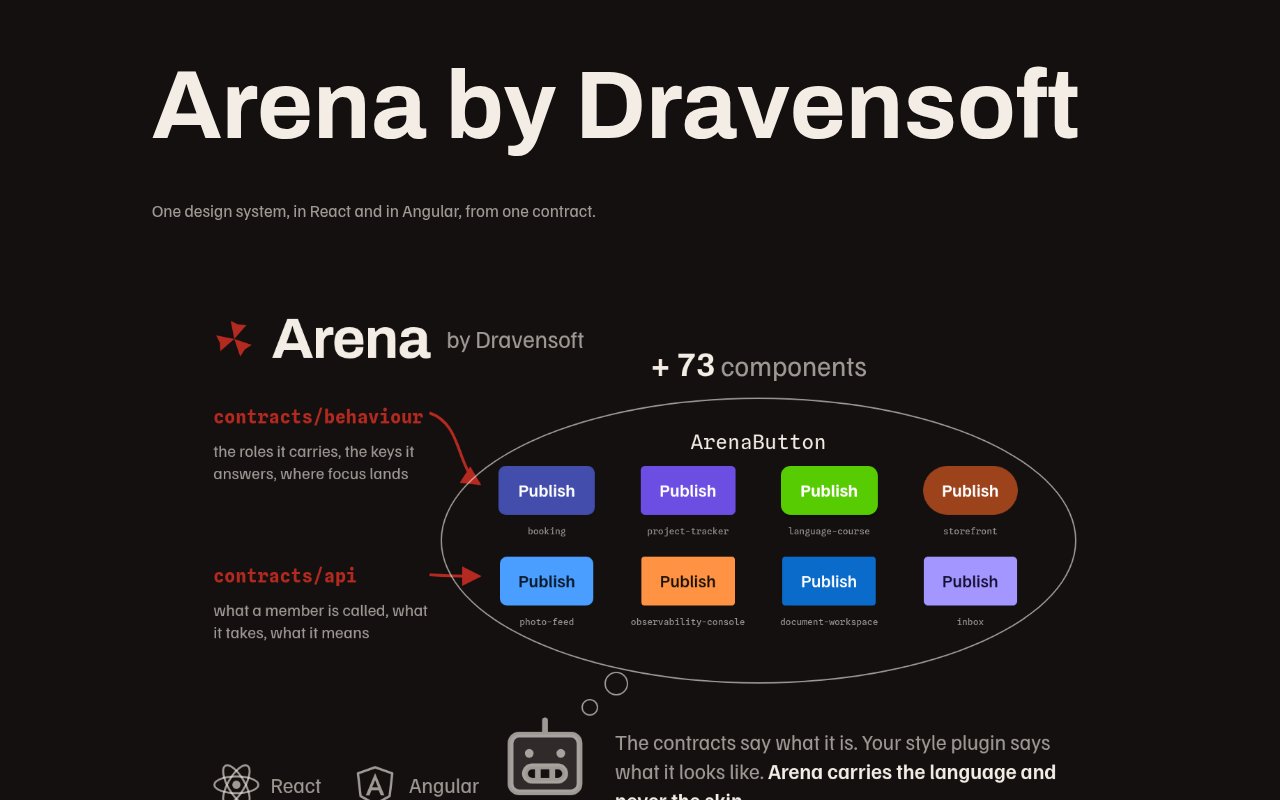
Arena is an open-source design system from Dravensoft that ships the same 73 components in React and in Angular, generated from one shared contract. The two packages render identical pixels and expose identical component APIs, so a team running both frameworks, or migrating between them, can stop maintaining two design systems that slowly drift apart.
The problem it's built around is the divergence that happens whenever a design system exists twice. The React version gets a fix, the Angular version gets it a month later or never, tokens are copied by hand, and accessibility behaviour quietly differs between the two. Arena's answer is to make the contract the source of truth. Design tokens, API contracts and accessibility patterns live in contract files rather than in documentation, and both framework packages are derived from them.
In practice you install @dravensoft/arena-react or @dravensoft/arena-angular from npm, with bun add or the package manager you prefer, and describe your product's appearance in an arena.config.json file plus a style plugin. The components sit on a shared Tailwind layer, and the README's own phrase for the split is that Arena carries the language and never the skin. Every styling question resolves to a design token, so there are no hex values or bare pixel numbers in the codebase, and a project's look is a config change rather than a fork. Fonts are self-hosted with no CDN dependency, and the icon set is Phosphor Icons. Accessibility is declared per component and checked by automated validation rather than left to convention. The repository also ships an MCP server and a Claude Code plugin, so an AI coding agent can read the contract that governs what it's about to write before it writes it, which is a sensible way to keep generated UI code inside the system instead of beside it.
Getting started is ordinary front-end work. You add the package for your framework, write an arena.config.json that names your tokens, and attach a style plugin that turns those tokens into the skin, then import components as you would from any library. The kitchen sink pages are the quickest way to see all 73 components under your config, and the benches are the place to look when you want to know how a real product screen, a scheduling calendar, a task board, a language lesson, a storefront, comes together from the same parts. Because the components sit on a Tailwind layer, they drop into a Tailwind project without a second styling system fighting for control.
It's aimed at front-end teams who need one visual language across React and Angular, whether that's a company with products on both stacks, an agency that inherits both, or a migration that will take a year. To show the system holds up at application scale, Dravensoft publishes eight templated reference products it calls benches, including takes on Calendly, ClickUp, Duolingo, Etsy, Grafana, Instagram, Notion and Superhuman, each built in both frameworks, along with a kitchen sink page for each framework that exercises every component.
What sets it apart from the big component libraries is the contract-first, dual-framework design rather than any single widget. Most libraries pick a framework and port later if at all. Arena treats the two packages as outputs of one specification, and its token-only styling rule is stricter than most. The limits are equally clear. It's React and Angular only, so Vue and Svelte are out. The GitHub repository is small in community terms, and the project is at version 11 with a rapid release cadence, which means breaking changes between majors are a real possibility. Adopting the token discipline also takes some buy-in from a team used to ad hoc CSS. Compared with the two paths most teams take, keeping two libraries or standardising on one framework, the trade is discipline for consistency. Two libraries mean two backlogs and a drift you can't see until a designer notices. Standardising on one framework means a migration nobody has budgeted for. Arena offers a third route where the contract is the thing you maintain and both packages follow, which suits a team that expects to live with React and Angular side by side for a while. The price is that every visual decision has to become a token, which is exactly the constraint that keeps the two outputs identical.
Access is open source under the MIT license, with the packages on npm and the code in the dravensoft-dev/arena repository on GitHub. There's no paid tier and no signup, and the documentation, benches and kitchen sinks are all on the arena.dravensoft.org site. No contact email is published, so issues and questions go through GitHub.
Key Features
- 73 components in React and Angular
- One contract driving both packages
- Token-only styling via arena.config.json
- Per-component accessibility validation
- MCP server and Claude Code plugin
- Eight full reference applications
Pros & Cons
What we like
- Same component API and pixels in both frameworks
- Style plugins replace forking the library
- Accessibility checked automatically
- MIT licensed with no paid tier
Room for improvement
- React and Angular only
- Small community so far
- Frequent major versions
- Token discipline takes team buy-in
Frequently Asked Questions
What is Arena?
Is Arena free?
Which frameworks does Arena support?
How is Arena different from other component libraries?
Best For
Featured in
Alternatives to Arena by Dravensoft

Kevin Gabeci
Solo developer building web apps, cozy browser games, and AI creator toolkits.

SoloDevStack
A solo developer blog built on head-to-head tool comparisons, 580+ posts deep.

Codedex
A gamified, story-driven platform that teaches Python, web dev, and more like an RPG quest

Vibe Built
Building real apps with agentic AI. What worked, what broke, what shipped.
Reviews (0)
No reviews yet
Be the first to share your experience with Arena by Dravensoft
Sign in to write a reviewBadge builder
Add Arena by Dravensoft to your website
Choose a badge style and size, preview it here, then copy the generated HTML. Badge images are self-contained SVGs and do not require an external script.

<a href="https://toolindex.net/tools/dravensoft-arena?ref=badge" target="_blank" rel="noopener">
  <img src="https://toolindex.net/badge/dravensoft-arena/medium.svg" alt="Arena by Dravensoft - Listed on Tool Index" width="180" height="50" />
</a>How to use the badge
- 1. Pick the style, size, and theme that fit your layout.
- 2. Copy the generated HTML from the code block.
- 3. Paste it into your footer, homepage, or press page.
Standard badge available
The standard listing badge is available now. Score and circle badges are limited to tools currently ranked in the top 10 of a category.
Badge clicks return visitors to this profile with a referral tag so the source remains identifiable.
Related Tools
Kevin Gabeci
Solo developer building web apps, cozy browser games, and AI creator toolkits.
Coolify
Self-hostable, open source alternative to Heroku and Netlify

Warp
The modern terminal reimagined with AI and collaboration

Bolt.new
Prompt-to-deployed full-stack app inside the browser
Work on Arena by Dravensoft? Request listing access or correction