
Echo
Unified AI model delivering Claude-level quality at roughly one third the cost
Gallery
About Echo
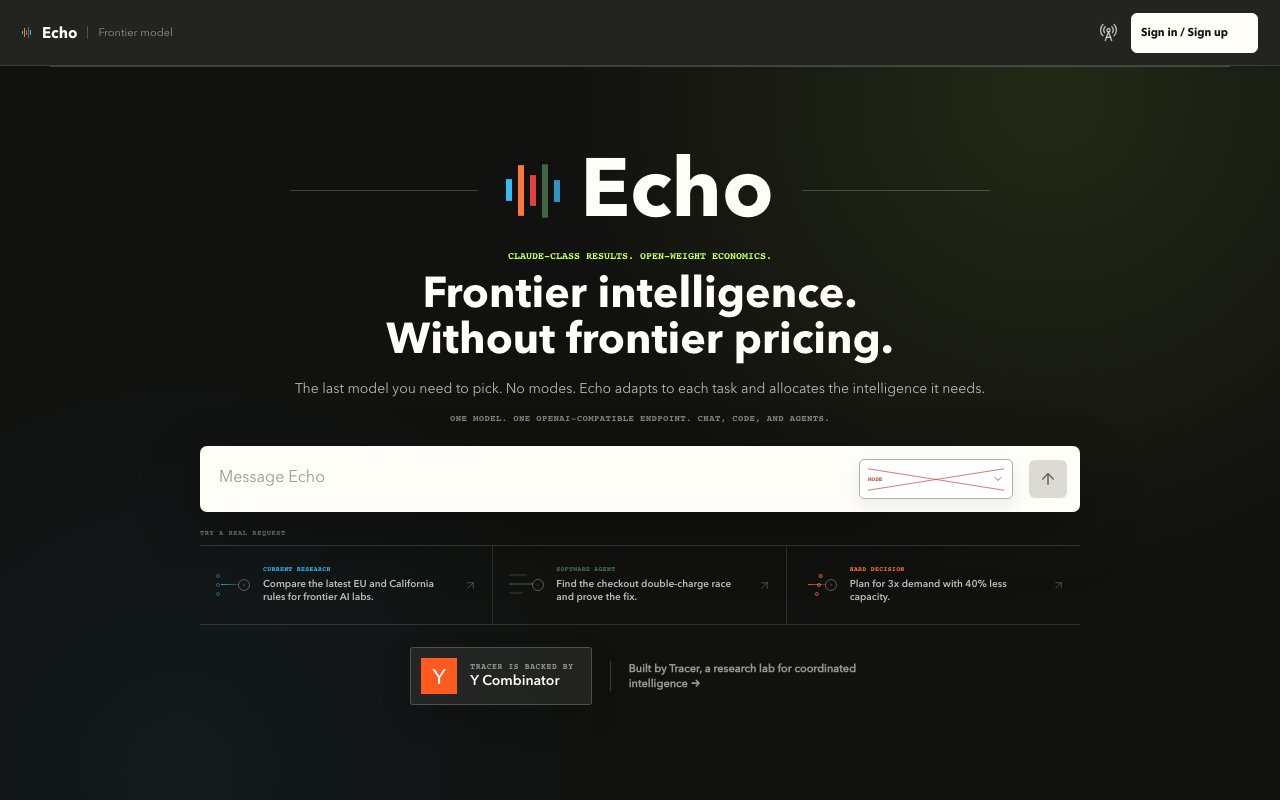
Echo is an AI model built by Tracer that positions itself as a cost-effective alternative to frontier models like Claude. The pitch is straightforward. You get comparable quality on complex tasks while paying roughly a third of what you would spend on the leading commercial models. It exposes a single OpenAI-compatible endpoint, so integration follows the same patterns you already use if you are building against the OpenAI SDK. You do not need to learn a new API or change how your application handles requests and responses. If you have existing code that calls OpenAI or a compatible endpoint, you can point it at Echo and see what happens without rewriting anything.
The technical approach differs from how most providers structure their offerings. Instead of shipping multiple model variants for different use cases, a fast cheap one for simple tasks and a slow expensive one for reasoning, Echo is a unified model that adapts to task complexity automatically. You do not pick between versions. The system allocates computational resources based on what the task actually requires. If you send a simple classification or extraction query, it uses less compute. If you send something that needs deeper reasoning or multi-step analysis, it scales up. The idea is that you stop thinking about model selection entirely and just send requests. The model figures out how hard the task is and allocates accordingly. This simplifies application architecture because you do not have to build logic to route different request types to different model tiers.
Quality claims are grounded in published evaluations rather than vague marketing language. The team posts their methodology and results comparing Echo to Claude and other frontier models. They note that Echo matches or approaches Claude-level performance on their benchmark suite, with particular strength in code generation, complex research analysis, and agent workflows where the model needs to plan and execute multiple steps. The foundation uses open weights, which means the underlying model outperforms the individual baselines it was built from. Whether those benchmarks translate to your specific workload is something you would need to test, but at least the methodology is public so you can assess the claims yourself. They are not hiding behind vague quality assertions.
Right now, Echo is in public alpha. During this phase, there are no charges or billing required. You can use the API without paying, which makes it easy to test against your actual workloads and compare results to what you get from Claude or GPT-4 before committing to anything. The team publishes cost estimates based on internal metrics and guardrail provider rates, so you can get a sense of what pricing might look like when it goes live. They note that actual bills once pricing kicks in may differ due to caching, tooling overhead, and regional variations, but the estimates give you a rough target to plan against. The free alpha period is a genuine opportunity to validate whether the model works for your use case before any money changes hands.
The product is backed by Y Combinator and built by the Tracer research lab. Tracer has been working on model efficiency and evaluation tooling for a while, and Echo is the inference product that came out of that research. The YC backing and research lab pedigree suggest this is not a weekend project or a thin wrapper around someone else's model. The team has published research and built tooling in the space before shipping Echo as a product. That said, it is still early stage. The alpha label is real. If you need production guarantees and SLAs today, this may be too early. If you are exploring options and willing to validate the claims on your own tasks, the free access period is a low risk way to find out whether the quality holds up on real workloads rather than benchmarks.
Echo fits teams and developers who are hitting cost ceilings on Claude or GPT-4 class models and want to see if they can get similar results for less. The single endpoint approach means you do not have to restructure your application to try it. Swap the base URL, run your test suite, compare outputs. If the quality holds up on your workloads during the free alpha, you have a clear path to cutting inference costs significantly when pricing goes live. The honest caveat is that this is alpha software from a young company. The quality comparisons are self-reported, even if the methodology is published. If the benchmarks do not match your use case, you may find gaps. The way to know is to test it yourself while the testing is free.
Key Features
- Unified model adapting to task complexity
- OpenAI-compatible API endpoint
- Claude-level quality at lower cost
- Published evaluation methodology and benchmarks
- Code generation and agent workflow support
- Free public alpha with no billing
Pros & Cons
What we like
- Roughly one third the cost of Claude for comparable tasks
- Single model replaces multiple specialized variants
- Free during public alpha with no usage charges
- Standard OpenAI SDK integration pattern
Room for improvement
- Public alpha means production stability is unproven
- Quality claims are self-reported benchmarks
- Pricing not finalized until alpha ends
- Younger product from a small research lab
Frequently Asked Questions
What is Echo?
Is Echo free?
How does Echo compare to Claude?
Who is Echo for?
Best For
Featured in
Alternatives to Echo
View all
Reviews (7)
Quietly excellent
Tried Echo on a side project first, then rolled it out everywhere. Where it really wins is roughly one third the cost of claude for comparable tasks. What stands out is how little babysitting it needs. Found it works best for testing cost-effective alternatives before committing to a provider.
It just works
Have been running Echo for a while, here is where I land. The output quality holds up better than I expected. Easy yes for anyone weighing the same trade offs.
Decent with some rough edges
Tried Echo on a side project first, then rolled it out everywhere. The output quality holds up better than I expected. My only gripe is pricing not finalized until alpha ends.
Pulled its weight from week one
Tried Echo on a side project first, then rolled it out everywhere. Got real value out of published evaluation methodology and benchmarks. It does what it says, which is rarer than it should be. Glad I made the switch.
Good, with a few caveats
Came to Echo after getting frustrated with what I had before. What stands out is how it handles roughly one third the cost of claude for comparable tasks. The thing I keep coming back to is how reliable it is. The catch is public alpha means production stability is unproven. Hard to imagine going back to my old setup.
It just works
Started using Echo casually, now it is pinned in my dock. Got real value out of published evaluation methodology and benchmarks. It fits well for running complex research analysis at lower spend. Would sign up again without thinking twice.
Genuinely impressed
Have been running Echo for a while, here is where I land. The unified model adapting to task complexity is more useful than I expected. It fits well for testing cost-effective alternatives before committing to a provider. It earns its place in my stack.
Badge builder
Add Echo to your website
Choose a badge style and size, preview it here, then copy the generated HTML. Badge images are self-contained SVGs and do not require an external script.

<a href="https://toolindex.net/tools/echo-tracer?ref=badge" target="_blank" rel="noopener">
  <img src="https://toolindex.net/badge/echo-tracer/medium.svg" alt="Echo - Listed on Tool Index" width="180" height="50" />
</a>How to use the badge
- 1. Pick the style, size, and theme that fit your layout.
- 2. Copy the generated HTML from the code block.
- 3. Paste it into your footer, homepage, or press page.
Standard badge available
The standard listing badge is available now. Score and circle badges are limited to tools currently ranked in the top 10 of a category.
Badge clicks return visitors to this profile with a referral tag so the source remains identifiable.
Related Tools

Apatero AI
The creator studio for AI image, video, audio, 3D, and avatars, now at apatero.ai.
Kevin Gabeci Toolkits
Seven AI toolkits for writing books, making music, cutting video, and building agents.

Warp
The modern terminal reimagined with AI and collaboration

Bolt.new
Prompt-to-deployed full-stack app inside the browser
Work on Echo? Request listing access or correction