
emailverifier.dev
A simple email verification API with credits that never expire
Gallery
About emailverifier.dev
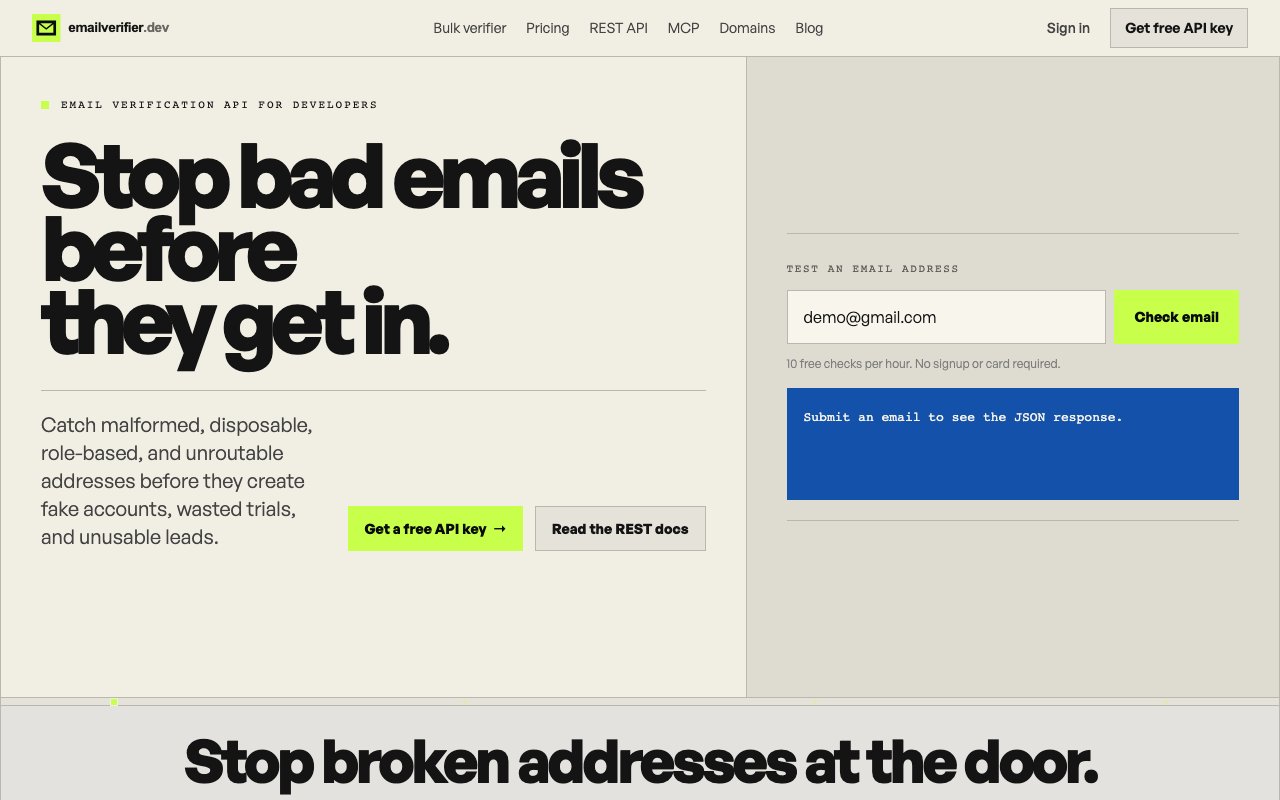
emailverifier.dev is an email verification API built for developers who want to stop fake, mistyped, and disposable addresses before they reach the database. You send an address to its REST endpoint and get back a JSON verdict, deliverable, undeliverable, risky, or unknown, along with the classification detail you need to decide what happens next. The whole product is deliberately narrow. There is no marketing suite bolted on and no dashboard-first workflow to click through, just an API that answers one question well and a pricing model that undercuts the established verification services. There is a live demo right on the homepage, so you can watch a verdict come back on a real address before you write a single line of code.
The problem it goes after shows up in every product with a signup form. People fat-finger their addresses, bots register with throwaway inboxes, and free trial abusers rotate through disposable providers to claim the same offer again and again. Each bad address costs something real. Welcome emails bounce, the CRM fills with contacts nobody can reach, and your sender reputation quietly erodes until mail providers start routing your messages to spam for everyone, including the customers who typed their addresses correctly. Verifying at the moment an address enters your system is far cheaper than cleaning up after it has spread through every downstream tool you own. A single verification call at signup is about the cheapest insurance a sender can buy.
The verification itself runs in layers. Syntax validation catches malformed and mistyped addresses first, before any network calls happen. Domain classification then works out whether the domain belongs to a disposable provider, a free provider, or something unclassified, so you can treat a temp-mail signup differently from a personal account on a mainstream provider. Mailbox verification goes deeper still and checks whether the specific address can actually receive mail. Role-based accounts like admin and info addresses get flagged as well, which matters when you want actual people on your list rather than shared inboxes that nobody reads. The domain intelligence is useful on its own too, because knowing an address sits on a disposable provider is often reason enough to route a signup into review even when the mailbox itself technically checks out.
The part worth singling out is how it handles uncertainty. Plenty of verifiers force every address into a clean pass or fail, which means legitimate users sometimes get rejected because a mail server was slow or deliberately cagey about answering. emailverifier.dev returns unknown when it genuinely cannot tell, and every result maps to a clear action, allow, review, or block. That honesty pushes some edge-case decisions back to you, but it also means you are not turning away a paying customer on a false negative, which is the quiet failure mode of stricter services that always insist on a definitive answer.
It is developer-first in the practical sense rather than the marketing sense. The REST API lives at a single verify endpoint, the OpenAPI spec is published so you can generate typed clients in whatever language you already work in, and MCP support means AI agents and assistants can call the verifier directly as a tool in their own workflows. Responses come back as plain JSON, so wiring a verdict into a signup handler is a few lines of code in any stack. You can even try it without creating an account at all. Keyless checks are limited to ten per hour, which is plenty to see the response shape, poke at a few edge cases, and decide whether it fits before you sign up for anything or read a single page of docs.
Pricing is where it separates hardest from the incumbents. Most verification services sell monthly subscriptions with credit allowances that reset or expire at the end of each cycle, so you pay for capacity you never use. Here there is no subscription at all. Every account starts with 1,000 free credits that never expire, and when those run out a ten dollar pack buys 20,000 more, which works out to fifty cents per thousand checks. One check costs one credit whether it is an email verification or a domain check, and an optional auto top-up refills the balance when it drops to 1,000 credits so a production integration never stalls waiting on someone to make a manual purchase.
The natural fit is anyone wiring validation into a signup flow, a lead capture form, a free trial system, or a CRM import, and especially solo developers and small teams who resent paying subscription prices for an occasional-use utility. Teams that send a lot of transactional mail will get the most out of it, since deliverability problems compound quietly and are far easier to prevent than to repair once a domain's reputation has slipped. It will not clean a million-row marketing list through a polished bulk dashboard, and it does not pretend to. If what you want is a straightforward, honest verification API at a fraction of the usual price, the free starter credits and the keyless trial mean you can have it checking real addresses the same afternoon, without a sales call and without entering a card.
Key Features
- Syntax, domain, and mailbox verification layers
- Deliverable, undeliverable, risky, and unknown verdicts
- Disposable and free provider detection
- Role-based account flagging
- REST API with published OpenAPI spec
- MCP support for AI agents
Pros & Cons
What we like
- Credits never expire and no subscription is required
- 1,000 free starter credits plus keyless trial checks
- Fifty cents per thousand verifications on paid packs
- Returns unknown honestly instead of falsely rejecting valid addresses
Room for improvement
- Narrow focus on verification, no bulk list-cleaning suite
- Younger service without the track record of incumbents
- Unknown results still need your own handling logic
- No published support email, contact goes through a form
Frequently Asked Questions
What is emailverifier.dev?
Is emailverifier.dev free?
How is it different from other verification services?
Who is emailverifier.dev for?
Best For
Featured in
Alternatives to emailverifier.dev

Kevin Gabeci
Solo developer building web apps, cozy browser games, and AI creator toolkits.

SoloDevStack
A solo developer blog built on head-to-head tool comparisons, 580+ posts deep.

Codedex
A gamified, story-driven platform that teaches Python, web dev, and more like an RPG quest

Vibe Built
Building real apps with agentic AI. What worked, what broke, what shipped.
Reviews (0)
No reviews yet
Be the first to share your experience with emailverifier.dev
Sign in to write a reviewBadge builder
Add emailverifier.dev to your website
Choose a badge style and size, preview it here, then copy the generated HTML. Badge images are self-contained SVGs and do not require an external script.

<a href="https://toolindex.net/tools/emailverifier?ref=badge" target="_blank" rel="noopener">
  <img src="https://toolindex.net/badge/emailverifier/medium.svg" alt="emailverifier.dev - Listed on Tool Index" width="180" height="50" />
</a>How to use the badge
- 1. Pick the style, size, and theme that fit your layout.
- 2. Copy the generated HTML from the code block.
- 3. Paste it into your footer, homepage, or press page.
Standard badge available
The standard listing badge is available now. Score and circle badges are limited to tools currently ranked in the top 10 of a category.
Badge clicks return visitors to this profile with a referral tag so the source remains identifiable.
Related Tools
Kevin Gabeci
Solo developer building web apps, cozy browser games, and AI creator toolkits.

Coolify
Self-hostable, open source alternative to Heroku and Netlify

Warp
The modern terminal reimagined with AI and collaboration

Bolt.new
Prompt-to-deployed full-stack app inside the browser
Work on emailverifier.dev? Request listing access or correction