Ephemerals
Disposable cloud dev environments with one machine per branch and an AI coding agent preinstalled
Gallery
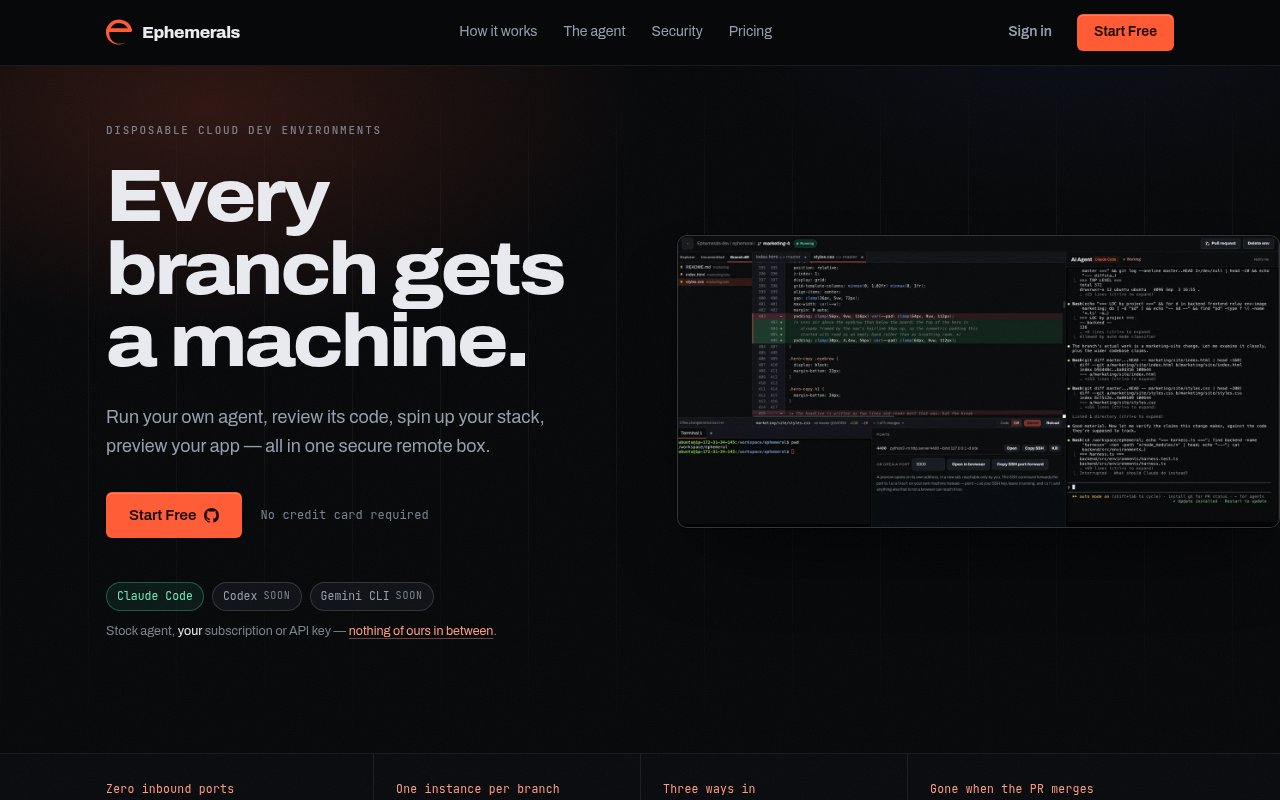
About Ephemerals
Ephemerals is a cloud development environment service that gives every git branch its own dedicated machine, with an AI coding agent already installed on it. Instead of running Claude Code on a laptop that's also running the app, the database and a browser, each branch gets a fresh cloud box that lives exactly as long as the work does. When the pull request merges, the machine and its secrets are deleted, and nothing is left behind to tidy up.
The problem it targets is what happens once a team starts using coding agents in earnest. Agents eat CPU and memory, they fight over ports, and a second agent on a second branch means two checkouts stepping on each other on the same disk. There's a safety question too, since an agent with shell access to a personal machine can reach far more than the repository it's meant to be working on. Ephemerals moves all of that onto an isolated machine per branch, so the agent's reach ends at the edge of one disposable box and the laptop goes back to being a laptop.
Getting started is a GitHub sign-in, a repository selection and a launch. Each environment is a dedicated EC2 instance sized from 2 to 16 vCPUs, with Claude Code ready to run the moment it boots. Codex and Gemini CLI are listed as coming soon. You reach the machine through a browser terminal, over SSH, or through preview URLs, and sessions run inside tmux so closing a tab or putting the laptop to sleep doesn't kill an agent partway through a task. Development servers get live previews with hot reload, which means a teammate can look at the branch in a real browser without pulling it down locally.
In practice the loop is short. You open a branch, launch its environment, point the agent at the task and step away. The agent works on the remote box while you do something else, the tmux session holds its state, and when you come back the terminal is where you left it. Once the change looks right, the preview URL goes to whoever needs to see it, the PR opens from the branch, and the merge takes the machine down with it.
The preview URLs deserve a mention on their own. A development server running on the branch machine gets a URL that anyone on the team can open, with hot reload so the page updates as the agent or the developer changes code. That makes review something a designer or a product manager can do from a link, and it means a branch can be demonstrated without anyone cloning it or setting up a local environment first.
Security is a large part of the pitch. Instances have zero inbound ports, secrets are encrypted with KMS, every request passes an authorization check, and any support access to a machine is audit logged. Environments belong to the organization rather than to an individual, so someone else can pick up a branch mid-flight, and commits are authored by whoever actually initiated them, which keeps the git history honest through a handoff. The automatic cleanup after merge closes the loop, since a forgotten environment is also a forgotten set of credentials.
It's built for development teams that already use Claude Code or a compatible agent and have felt the local resource squeeze. Solo developers can use it as well, and the free tier is enough to try the loop on a real branch, but the organization-owned environments and per-user pricing make the most sense for a team running several agents across several branches at the same time. If your workflow is one branch at a time on a well-specced machine, the gain is smaller.
Compared with a general cloud IDE, the difference is the unit of work. Ephemerals doesn't hand you a persistent workspace to look after. It hands you a machine per branch that appears when the branch does and disappears when the PR merges, and that lifecycle is the product. The agent-first setup means the box is ready to do work rather than ready to be configured, and the preview URL turns a branch into something a designer or product manager can click through before review. It's also a younger product with a short track record, it runs on AWS only, and agent choice today is effectively Claude Code, so teams standardized on a different agent will want to wait for the promised additions.
Access is freemium. The free tier gives 30 minutes a day on a 2 vCPU machine. Paid plans are $10 per user per month plus compute metered by the second, from $0.18 to $1.44 an hour depending on machine size, so a long-running agent on a large box is a real line item worth watching. At the published rates, a full working day on the smallest machine costs under two dollars in compute, while the largest size is eight times that per hour, so the meter matters most when big boxes are left running. A Slack app and a mobile workspace are listed as in progress, and the site publishes no contact address, so signing up at app.ephemerals.dev is the way in.
Key Features
- Dedicated cloud machine per git branch
- Claude Code preinstalled on every environment
- Browser terminal, SSH and preview URLs
- Automatic teardown when the PR merges
- Zero inbound ports with KMS-encrypted secrets
- Organization-owned environments for handoffs
Pros & Cons
What we like
- Keeps agent workloads off the laptop
- Machine lifecycle tied to the branch, so nothing lingers
- Sessions survive closed tabs through tmux
- Free tier lets you try it on a real branch
Room for improvement
- AWS EC2 only, no other cloud
- Claude Code is the only agent available today
- Per-second compute on big machines adds up
- Younger product with a short track record
Frequently Asked Questions
What is Ephemerals?
Is Ephemerals free?
Which AI agents does it support?
What happens to the environment when the branch merges?
Best For
Featured in
Alternatives to Ephemerals

Kevin Gabeci
Solo developer building web apps, cozy browser games, and AI creator toolkits.

SoloDevStack
A solo developer blog built on head-to-head tool comparisons, 580+ posts deep.

Codedex
A gamified, story-driven platform that teaches Python, web dev, and more like an RPG quest

Vibe Built
Building real apps with agentic AI. What worked, what broke, what shipped.
Reviews (0)
Badge builder
Add Ephemerals to your website
Choose a badge style and size, preview it here, then copy the generated HTML. Badge images are self-contained SVGs and do not require an external script.

<a href="https://toolindex.net/tools/ephemerals?ref=badge" target="_blank" rel="noopener">
  <img src="https://toolindex.net/badge/ephemerals/medium.svg" alt="Ephemerals - Listed on Tool Index" width="180" height="50" />
</a>How to use the badge
- 1. Pick the style, size, and theme that fit your layout.
- 2. Copy the generated HTML from the code block.
- 3. Paste it into your footer, homepage, or press page.
Standard badge available
The standard listing badge is available now. Score and circle badges are limited to tools currently ranked in the top 10 of a category.
Badge clicks return visitors to this profile with a referral tag so the source remains identifiable.
Related Tools
Kevin Gabeci
Solo developer building web apps, cozy browser games, and AI creator toolkits.

Coolify
Self-hostable, open source alternative to Heroku and Netlify

Warp
The modern terminal reimagined with AI and collaboration

Bolt.new
Prompt-to-deployed full-stack app inside the browser
Work on Ephemerals? Request listing access or correction