
ErrLookup
Machine readable error knowledge base for open source libraries
Gallery
About ErrLookup
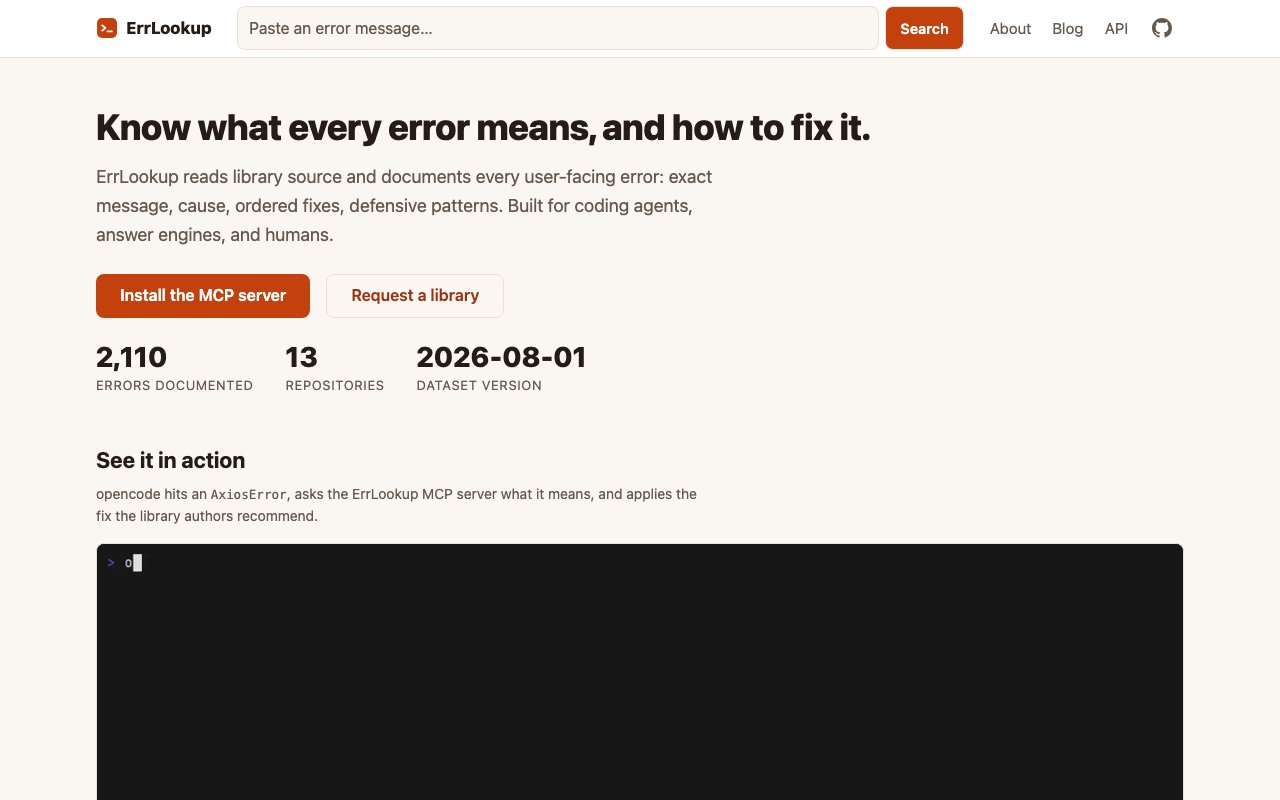
ErrLookup is a machine readable error knowledge base that documents user facing errors from popular open source libraries. When a developer or a coding agent encounters a cryptic error message from a library like Hugo, Docker CLI, SQLAlchemy, or Prisma, the tool provides the exact message, the root cause, ordered fixes to try, and defensive coding patterns to avoid the same error in the future. It currently covers 2,110 errors across 13 repositories spanning Go, Python, TypeScript, JavaScript, C, and Rust ecosystems, with Hugo alone contributing 545 documented errors and Docker CLI adding another 668. Additional libraries include curl, Redis, Flask, and axios, giving broad coverage across backend, frontend, and infrastructure tooling.
The problem it addresses is familiar to anyone who has pasted an error message into a search engine and come up empty, or worse, found a Stack Overflow thread from 2017 that no longer applies to the current version. Library errors often lack context in official documentation. The docs may not mention the message at all, the contributing developer who wrote the throw statement moved on years ago, and large language models tend to hallucinate solutions when they don't have grounded data to draw from. ErrLookup closes that gap by pinning every documented error to a specific commit SHA in the source library, which means the guidance is verifiable and traceable rather than best effort guessing. You can follow the link back to the actual line of code that throws the error and confirm the advice applies to your version before you invest time in applying a fix that may not work.
Developers can access the knowledge base through a web search interface on the site or install a local Model Context Protocol server. The MCP server runs entirely offline with no API keys required, which makes it ideal for air gapped environments, enterprise security policies that restrict external network calls, or coding agents that need deterministic, low latency lookups without network round trips. Each error record includes the exact string the library throws, an explanation of why that error surfaces under various conditions, a prioritized list of fixes to try in order of likelihood, and coding patterns that prevent the error from happening in the first place. The records are generated with AI assistance but remain tied to source commits so users can audit the provenance and trust that the advice matches the library version they're running. If a library updates and changes its error messages, the commit link lets you track when that happened.
The audience is broad but specific. Coding agents benefit because they get structured, grounded error context instead of guessing based on pattern matching or stale training data that predates the library's latest release. Answer engines and chatbots benefit because they can serve accurate fixes to developers without hallucinating solutions that don't compile or reference deprecated methods. Human developers benefit because they spend less time hunting through issue trackers, out of date blog posts, or library changelogs trying to figure out what an error means. Teams building retrieval augmented generation systems can also point their pipelines at ErrLookup as a reliable, well structured error corpus that integrates cleanly with existing tooling and doesn't require custom scraping or cleaning.
What sets it apart from generic documentation, GitHub issues, or Stack Overflow is the structure and provenance. Every error links back to the exact commit that introduced or modified it, so you know the advice applies to your version of the library and hasn't drifted out of date as maintainers refactored the codebase. The offline MCP server means you don't depend on external connectivity, rate limits, or third party uptime, which matters for production toolchains that run at scale. And the focus on error messages specifically, rather than general how to guides or API reference docs, keeps the scope tight and the answers actionable. You're not wading through tutorial content to find the one paragraph about why your Docker build failed. The knowledge base treats errors as first class objects worth documenting, not noise to ignore.
Access appears to be free with no disclosed pricing. Users can request documentation for additional libraries not yet covered, and the project publishes the total error count and repository list openly on the homepage so you know exactly what's covered before you integrate. The MCP server installation is straightforward for developers already using Model Context Protocol in their toolchains, and the web interface works for quick one off lookups when you don't need local infrastructure. For teams tired of chasing down cryptic library errors or for anyone building tooling that needs reliable error context, ErrLookup offers a focused, verifiable source of truth that treats error messages as first class knowledge rather than an afterthought in documentation.
Key Features
- 2100 plus documented error messages
- MCP server for agent integration
- Offline capable local caching
- Commit SHA pinned accuracy
- Ordered fix steps per error
- Multi language repository coverage
Pros & Cons
What we like
- Agents get structured cause and fix data instead of guessing
- No API key required for integration
- Works offline after initial cache download
- Covers major libraries across Go, Python, Rust, and more
Room for improvement
- Limited to thirteen repositories currently
- Coverage depends on maintainer update cadence
- Less useful if your stack uses uncovered libraries
- Documentation is sparse beyond the MCP install
Frequently Asked Questions
What is ErrLookup?
Which libraries does ErrLookup cover?
Is ErrLookup free?
How do I integrate ErrLookup with my coding agent?
Best For
Featured in
Alternatives to ErrLookup

Kevin Gabeci
Solo developer building web apps, cozy browser games, and AI creator toolkits.

SoloDevStack
A solo developer blog built on head-to-head tool comparisons, 580+ posts deep.

Codedex
A gamified, story-driven platform that teaches Python, web dev, and more like an RPG quest

Vibe Built
Building real apps with agentic AI. What worked, what broke, what shipped.
Reviews (0)
Badge builder
Add ErrLookup to your website
Choose a badge style and size, preview it here, then copy the generated HTML. Badge images are self-contained SVGs and do not require an external script.

<a href="https://toolindex.net/tools/errlookup?ref=badge" target="_blank" rel="noopener">
  <img src="https://toolindex.net/badge/errlookup/medium.svg" alt="ErrLookup - Listed on Tool Index" width="180" height="50" />
</a>How to use the badge
- 1. Pick the style, size, and theme that fit your layout.
- 2. Copy the generated HTML from the code block.
- 3. Paste it into your footer, homepage, or press page.
Standard badge available
The standard listing badge is available now. Score and circle badges are limited to tools currently ranked in the top 10 of a category.
Badge clicks return visitors to this profile with a referral tag so the source remains identifiable.
Related Tools
Kevin Gabeci
Solo developer building web apps, cozy browser games, and AI creator toolkits.

Coolify
Self-hostable, open source alternative to Heroku and Netlify

Warp
The modern terminal reimagined with AI and collaboration

Bolt.new
Prompt-to-deployed full-stack app inside the browser
Work on ErrLookup? Request listing access or correction