
Extractor
Web extraction API that turns URLs and search results into structured Markdown or JSON
Gallery
About Extractor
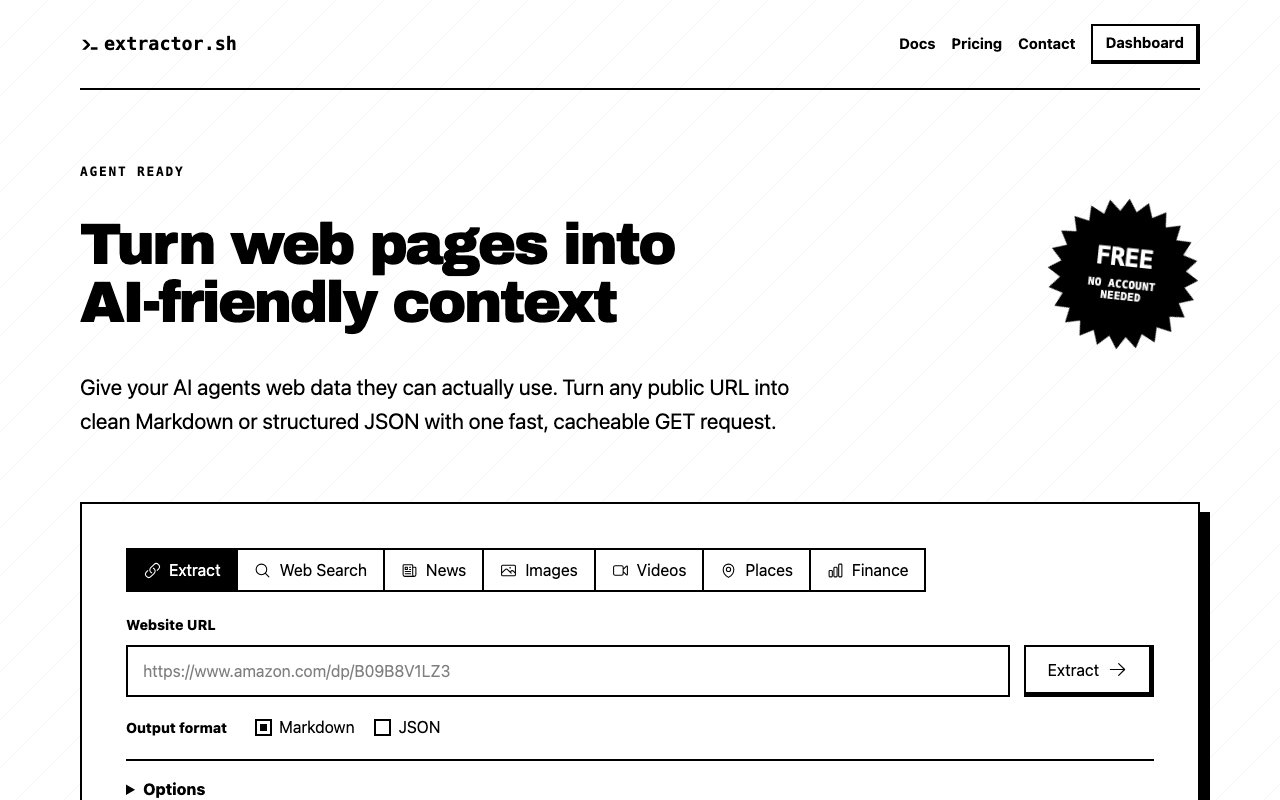
Extractor is a web extraction API built for developers who need structured data from public URLs without dealing with the usual scraping headaches. You give it any URL or search query, and it returns clean Markdown or JSON through simple GET requests. The service handles all the messy work of parsing pages, extracting content, and normalizing outputs into consistent formats. If you have ever written a scraper and then watched it break when a site changed its markup, or spent hours figuring out how to extract data from a platform with aggressive anti-bot measures, Extractor is the kind of service that handles that maintenance for you. The API abstracts away the fragility of web scraping so you can treat web data as a reliable input rather than a constant source of breakage.
The service covers both content extraction and search functionality in a single API. On the extraction side, it supports seventeen or more platforms with dedicated parsers. These include Amazon product pages, YouTube videos, Instagram posts, Reddit threads, TikTok content, Spotify tracks, posts from X, Shopify stores, WooCommerce catalogs, and generic web pages for everything else. Each platform parser knows where the useful fields live. For a YouTube video, you get the title, description, view count, and channel information in structured fields. For an Amazon product, you get pricing, availability, and reviews. The parsers save you from writing and maintaining the extraction logic yourself. When a platform changes its structure, the Extractor team updates the parser rather than you scrambling to fix your own code.
On the search side, Extractor offers endpoints that let you find content before you extract it. You can run public web searches, news searches that pull current coverage, image searches that include licensing metadata so you know whether you can actually use what you find, video searches with creator and duration information, places searches for local business data, and stock market data with symbol lookup. The combination of search and extraction in a single API means you can discover URLs and then pull structured data from them in the same workflow without switching between services. This is useful for workflows where you do not know the exact URL ahead of time but need to find and process relevant content dynamically.
The API design prioritizes simplicity and predictability. You make GET requests with your query or URL and your preferred output format. Results are cached, so repeated requests for the same content return instantly without counting against your quota. The endpoints follow consistent patterns and are documented well enough that you can wire them into a backend service, a quick script, or a data pipeline without learning a complex SDK. You authenticate with a Bearer token for signed-in usage, and the caching behavior works the same across all endpoints. No surprises, no hidden complexity.
The target audience is anyone building something that needs fresh data from the public web. That includes research tools that aggregate information from multiple sources, price comparison engines that monitor product pages across retailers, social listening dashboards that track mentions and posts, content aggregators that pull articles from news sites, and personal automations that grab headlines or check stock prices every morning. If your project involves pulling data from URLs at scale, Extractor removes the scraping layer so you can focus on what you actually want to do with the information rather than how to get it.
Where Extractor stands apart from similar services is the breadth of functionality in a single product. Many scraping APIs focus exclusively on extraction. Many search APIs only return search results without offering a way to parse the pages you find. Extractor bundles both, so you can search for something, get a list of URLs, and then extract detailed data from each one using the same API and the same authentication. The licensing metadata on image search is particularly useful if you need to know whether results are available for commercial use, which is information that most image search APIs do not surface.
Pricing follows a freemium model with some nuance worth understanding. The free tier gives you ten uncached operations per day per IP address, which is enough to test the API and run small personal automations. New accounts also receive a one-time bonus of a thousand non-expiring credits that you can use however you want. Beyond that, signed-in users draw from their account balance. The service does not publish fixed tier pricing on the homepage, so if you need high volume access, you will likely need to reach out through their contact form for a quote. That opaque pricing is a downside if you want to know exact costs upfront, but the free tier and bonus credits are generous enough to evaluate whether the service works for your needs before committing to any paid usage.
Key Features
- Structured extraction from 16+ platforms
- Web, news, image, and video search
- Cacheable GET request API design
- Markdown and JSON output formats
- Image licensing metadata in results
- Stock market data and symbol lookup
Pros & Cons
What we like
- Combines search and extraction in one API
- Cached requests return instantly without quota hit
- Supports major social and ecommerce platforms
- Free tier includes generous startup credits
Room for improvement
- Transparent volume pricing not listed publicly
- No self-hosted or open source option
- Platform-specific parsers may lag behind site changes
- Free daily limit is low for production use
Frequently Asked Questions
What is Extractor?
Is Extractor free?
Which platforms does Extractor support?
How is Extractor different from other scraping tools?
Best For
Featured in
Alternatives to Extractor

Kevin Gabeci
Solo developer building web apps, cozy browser games, and AI creator toolkits.

SoloDevStack
A solo developer blog built on head-to-head tool comparisons, 580+ posts deep.

Codedex
A gamified, story-driven platform that teaches Python, web dev, and more like an RPG quest

Vibe Built
Building real apps with agentic AI. What worked, what broke, what shipped.
Reviews (0)
Badge builder
Add Extractor to your website
Choose a badge style and size, preview it here, then copy the generated HTML. Badge images are self-contained SVGs and do not require an external script.

<a href="https://toolindex.net/tools/extractor-sh?ref=badge" target="_blank" rel="noopener">
  <img src="https://toolindex.net/badge/extractor-sh/medium.svg" alt="Extractor - Listed on Tool Index" width="180" height="50" />
</a>How to use the badge
- 1. Pick the style, size, and theme that fit your layout.
- 2. Copy the generated HTML from the code block.
- 3. Paste it into your footer, homepage, or press page.
Standard badge available
The standard listing badge is available now. Score and circle badges are limited to tools currently ranked in the top 10 of a category.
Badge clicks return visitors to this profile with a referral tag so the source remains identifiable.
Related Tools
Kevin Gabeci
Solo developer building web apps, cozy browser games, and AI creator toolkits.

Coolify
Self-hostable, open source alternative to Heroku and Netlify

Warp
The modern terminal reimagined with AI and collaboration

Bolt.new
Prompt-to-deployed full-stack app inside the browser
Work on Extractor? Request listing access or correction