
FetchIndex
Compare scraping, browser, proxy, and search API costs with transparent formulas
Gallery
About FetchIndex
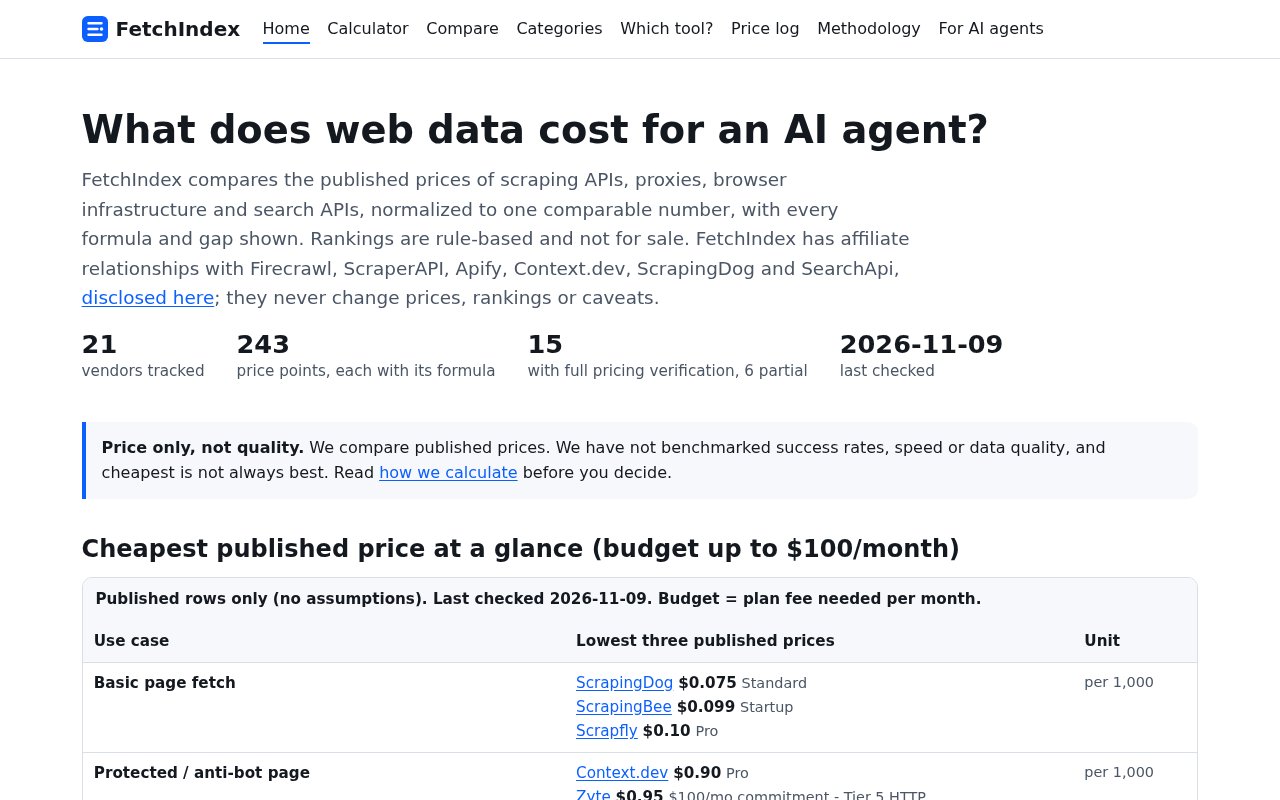
FetchIndex is a free price comparison and cost calculator for the services developers use to collect web data. It covers scraping and crawling APIs, proxy and unblocking products, hosted browser infrastructure, and search APIs used by applications and AI agents. Those products rarely bill in the same way. One vendor sells credits, another charges per request, another prices browser hours, and another bundles an allowance into a monthly plan. FetchIndex normalizes the published numbers into comparable units and keeps the calculation visible, so a developer can estimate cost without rebuilding every vendor's pricing model in a spreadsheet.
The calculator is the most direct way to use it. A visitor enters the expected number of pages or searches per month, chooses the kind of request, and sees an estimated monthly bill for each vendor with usable public pricing. Supported workloads include plain page fetches, JavaScript-rendered pages, protected pages, URL-to-markdown extraction, structured search results, and search designed for AI agents. Annual plans can be included or excluded. The result selects the cheapest published plan that can cover the requested volume, then separates incomplete or assumption-based numbers instead of mixing them into a confident ranking. A calculation can also be shared through a link, and the calculator runs in the browser without sending the entered volume to FetchIndex.
The underlying method is unusually explicit for a comparison site. FetchIndex starts with official public pricing and documentation, records when each source was checked, and converts plan fees, allowances, credit multipliers, prepaid packs, and published overage rates into a common effective cost. Each normalized row carries the inputs and a recomputable formula. Entries are labelled according to whether every value was published, whether the number covers only one component, or whether an assumption was necessary. Missing information remains missing rather than being filled with a guess. The site also separates monthly and annual billing and doesn't treat a promotional discount as the normal list price. Its model includes units for page requests, browser hours, and residential proxy bandwidth, which helps keep unlike services from being forced into one misleading measure.
Developers and agents don't have to scrape the website to use the data. FetchIndex publishes versioned JSON and CSV files with no key requirement beyond normal hosting limits. Available feeds cover vendors, normalized price rows, calculator inputs, and the cheapest published options for defined use cases and spending limits. There is also a discovery index, a JSON schema, per-vendor files, and an llms.txt guide. The dataset is offered under a Creative Commons Attribution 4.0 license, so it can be copied and adapted with attribution. Each feed carries version information and source check dates, which gives automated consumers a way to tell which snapshot they're reading. That makes the service useful both as a human research tool and as a small data source inside procurement scripts, internal dashboards, or agent workflows.
The product is aimed at teams choosing web data infrastructure, especially when projected volume makes a small unit-price difference meaningful. An engineer can compare what 100,000 rendered pages might cost before integrating a vendor. A technical buyer can inspect whether an attractive rate requires annual billing or a monthly commitment. An AI team can retrieve a current shortlist for agent search or content extraction in a machine-readable form. FetchIndex also maintains head-to-head comparisons, category tables, use case guides, and a price change log. Those editorial pages add context, but the calculator and structured feeds are what make it a usable developer utility rather than only a collection of articles.
Its boundaries are stated clearly. FetchIndex compares published prices and packaging, not speed, extraction quality, success rate, support, or reliability. Free allowances are listed but aren't subtracted from calculator estimates. The calculator models one request type at a time, so mixed workloads need separate calculations, and it returns “not enough data” when a public plan cannot support the requested volume without an unpublished enterprise quote. The site discloses affiliate relationships and says they don't affect its rule-based rankings or caveats. There is no paid plan for the calculator or data feeds shown on the site, so access is best described as free. Buyers should still confirm the final quote and technical fit with the chosen vendor before committing.
Key Features
- Multi-vendor cost calculator
- Normalized pricing comparisons
- Volume-based plan estimates
- Versioned JSON and CSV feeds
- Rule-based vendor rankings
- Published formula transparency
Pros & Cons
What we like
- Makes mismatched pricing easier to compare
- Shows assumptions and data gaps
- Offers keyless machine-readable feeds
- Keeps affiliate relationships disclosed
Room for improvement
- Measures price rather than service quality
- Depends on public vendor pricing
- Models one workload type at a time
- Free tiers aren't deducted from estimates
Frequently Asked Questions
What is FetchIndex?
Is FetchIndex free?
Does FetchIndex compare service quality?
Can developers use FetchIndex data programmatically?
Best For
Featured in
Alternatives to FetchIndex
View all
Kevin Gabeci
Solo developer building web apps, cozy browser games, and AI creator toolkits.

SoloDevStack
A solo developer blog built on head-to-head tool comparisons, 580+ posts deep.

Codedex
A gamified, story-driven platform that teaches Python, web dev, and more like an RPG quest

Vibe Built
Building real apps with agentic AI. What worked, what broke, what shipped.
Reviews (0)
Badge builder
Add FetchIndex to your website
Choose a badge style and size, preview it here, then copy the generated HTML. Badge images are self-contained SVGs and do not require an external script.

<a href="https://toolindex.net/tools/fetchindex?ref=badge" target="_blank" rel="noopener">
  <img src="https://toolindex.net/badge/fetchindex/medium.svg" alt="FetchIndex - Listed on Tool Index" width="180" height="50" />
</a>How to use the badge
- 1. Pick the style, size, and theme that fit your layout.
- 2. Copy the generated HTML from the code block.
- 3. Paste it into your footer, homepage, or press page.
Standard badge available
The standard listing badge is available now. Score and circle badges are limited to tools currently ranked in the top 10 of a category.
Badge clicks return visitors to this profile with a referral tag so the source remains identifiable.
Related Tools
Kevin Gabeci
Solo developer building web apps, cozy browser games, and AI creator toolkits.

Coolify
Self-hostable, open source alternative to Heroku and Netlify

Warp
The modern terminal reimagined with AI and collaboration

Bolt.new
Prompt-to-deployed full-stack app inside the browser
Work on FetchIndex? Request listing access or correction