
Forgx
Compile markdown specs into production ready multi tenant backends with Postgres and Node.js
Gallery
About Forgx
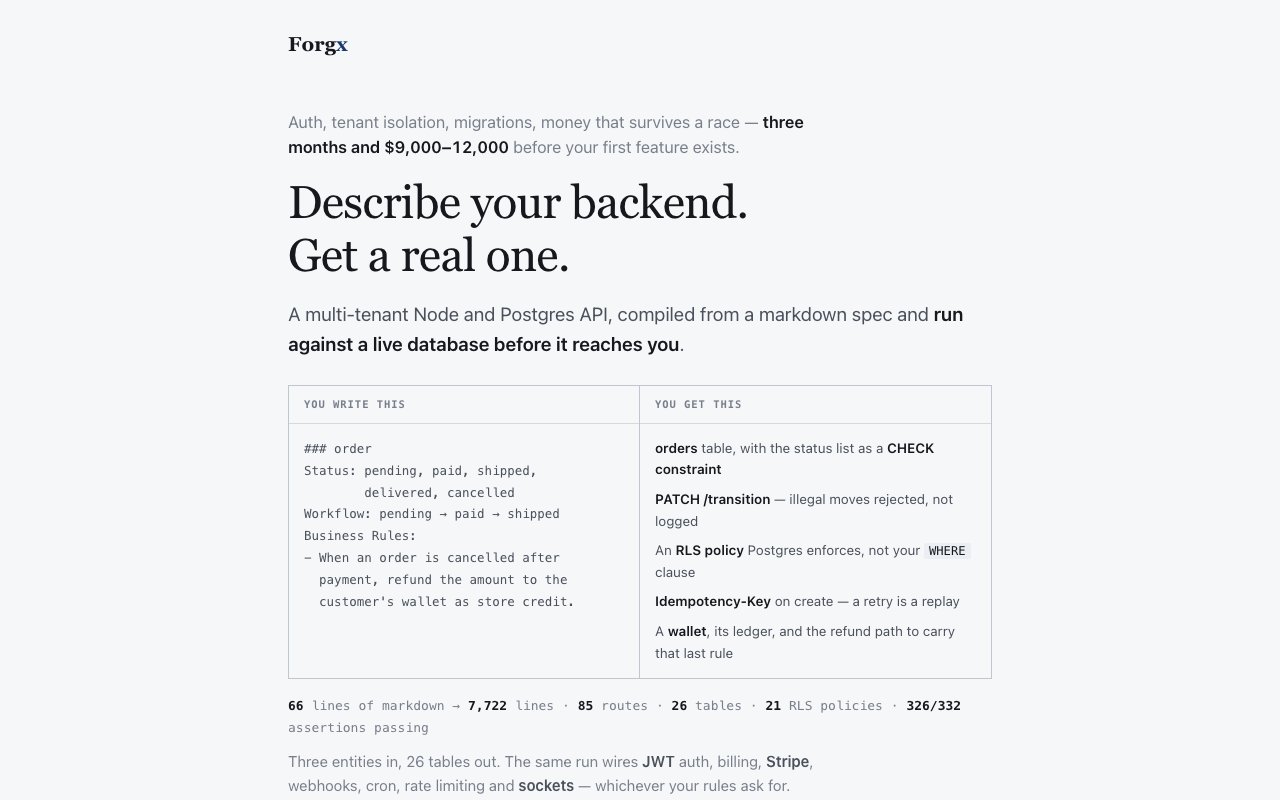
Forgx is a backend compiler that transforms markdown specifications into production ready Node.js and PostgreSQL applications. You write a structured document describing your data models, business rules, and workflows. The compiler reads that spec, validates all references at compile time, and outputs thousands of lines of working code complete with authentication, multi tenancy, row level security, and Docker deployment configuration. A 66 line specification can yield over 7,000 lines of production code. A 130 line specification produces closer to 8,000. The value proposition is that you skip the three to five months typically spent building foundational backend infrastructure and instead receive a working codebase in one to two days.
Every generated backend ships with the same core features regardless of your domain. Authentication uses PBKDF2 hashing at 310,000 iterations with JWT tokens that rotate via httpOnly SameSite strict cookies. Multi tenancy is enforced at the PostgreSQL level through row level security policies rather than application code, which means tenant isolation happens inside the database itself and cannot be bypassed by a bug in your business logic. Transactions include row locks and idempotency keys to prevent double charges or duplicate operations. Audit logging captures who did what and when. A cron scheduler handles background jobs. Rate limiting, CORS configuration, and Helmet security headers are wired up from the start. Database migrations ship with checksums so you can track schema changes over time. The entire output is Docker ready with multi stage builds, health checks, and a non root user for container security.
Beyond the framework, the compiler includes 46 domain specific engines that handle common backend patterns. The money and payments category covers wallets, double entry ledgers, multi currency support, escrow, fraud detection, and EMI calculations. Billing engines handle SaaS subscriptions with proration and Stripe integration. Commerce engines provide ratings, loyalty points, inventory management, booking systems, and waitlists. Logistics includes route assignment, geofencing, and delivery sequencing. Healthcare covers bed allocation, doctor scheduling, and FHIR R4 compliance. Operations engines add approval workflows, webhooks with HMAC signing and retry logic, and PDF or CSV export. If your backend fits one of these patterns, you do not need to implement the logic yourself. The compiler pulls in the relevant engine and wires it into your spec.
The workflow is straightforward. You write your specification using the documented markdown format, describing entities, their relationships, and the rules governing them. Forgx validates everything at compile time, catching reference errors before any code is generated. After compilation, the creator runs the output against a live PostgreSQL database to identify and fix issues. You receive the final codebase after that verification pass. Ten minutes to compile. One to two days to deliver. The extended timeline exists because real database testing catches bugs that static analysis misses.
Two verified deployments demonstrate what the compiler produces. Ledgerpro is a fintech backend generated from a 130 line spec. It outputs 78 routes, 19 tables, and 8,274 lines of code. An assertion suite tests 255 scenarios with 251 passing. Quickkart is an e-commerce backend from a 66 line spec that outputs 85 routes, 26 tables, and 7,722 lines of code with 326 of 332 assertions passing. Both repositories publish their markdown specs and full source code so you can verify the claimed ratios yourself. The failing assertions are documented rather than hidden, which gives you a realistic picture of what ships.
Forgx generates Node.js with Express and PostgreSQL. There is no support for other languages, frameworks, or databases. It does not generate frontends, client libraries, or automated test suites. The focus is multi tenant CRUD workflows, money handling, and operational APIs rather than games, machine learning systems, or highly specialized domains. Custom logic that the compiler cannot anticipate is handled through Feature Contracts, which are structured definitions that compile if valid or emit nothing if unclear. Hook files are generated once and never overwritten on recompilation, so you can extend the codebase without losing your customizations when you update the spec.
Pricing is quoted per project based on scope. The site notes that backend fundamentals typically cost nine to twelve thousand dollars and consume 66 to 98 developer days before feature work begins. Forgx compresses that timeline to days. You submit your specification and receive a quote. The generated code is source available, but you should confirm licensing terms for commercial deployment. The audience is founders, small teams, and agencies building multi tenant SaaS, fintech, or e-commerce platforms who want production grade infrastructure without months of development. If your requirements align with what the compiler produces, the tradeoff is speed for flexibility. If you need something outside the supported patterns, this is not the right tool.
Key Features
- Markdown spec to Node.js and Postgres backend
- JWT auth with rotating refresh tokens
- Row level security enforced at database layer
- 46 pre built domain engines for payments, commerce, HR
- Compile time validation of all references
- Docker ready deployment configuration
Pros & Cons
What we like
- Generates thousands of lines of production code from a short spec
- Multi tenancy and row level security built in from the start
- Includes domain engines for common backend patterns
- Turnaround is days instead of months
Room for improvement
- Node.js and PostgreSQL only, no other stacks
- Generated code is source available but not commercially licensed by default
- No frontend generation included
- Requires alignment with the compiler's architecture and patterns
Frequently Asked Questions
What is Forgx?
How much does Forgx cost?
What technology stack does Forgx generate?
Can I use the generated code commercially?
Best For
Featured in
Alternatives to Forgx

Kevin Gabeci
Solo developer building web apps, cozy browser games, and AI creator toolkits.

SoloDevStack
A solo developer blog built on head-to-head tool comparisons, 580+ posts deep.

Codedex
A gamified, story-driven platform that teaches Python, web dev, and more like an RPG quest

Vibe Built
Building real apps with agentic AI. What worked, what broke, what shipped.
Reviews (0)
Badge builder
Add Forgx to your website
Choose a badge style and size, preview it here, then copy the generated HTML. Badge images are self-contained SVGs and do not require an external script.

<a href="https://toolindex.net/tools/forgx?ref=badge" target="_blank" rel="noopener">
  <img src="https://toolindex.net/badge/forgx/medium.svg" alt="Forgx - Listed on Tool Index" width="180" height="50" />
</a>How to use the badge
- 1. Pick the style, size, and theme that fit your layout.
- 2. Copy the generated HTML from the code block.
- 3. Paste it into your footer, homepage, or press page.
Standard badge available
The standard listing badge is available now. Score and circle badges are limited to tools currently ranked in the top 10 of a category.
Badge clicks return visitors to this profile with a referral tag so the source remains identifiable.
Related Tools
Kevin Gabeci
Solo developer building web apps, cozy browser games, and AI creator toolkits.

Coolify
Self-hostable, open source alternative to Heroku and Netlify

Warp
The modern terminal reimagined with AI and collaboration

Bolt.new
Prompt-to-deployed full-stack app inside the browser
Work on Forgx? Request listing access or correction