
gitdebt
GitHub repository analytics with star history, health metrics, and embeddable charts
Gallery
About gitdebt
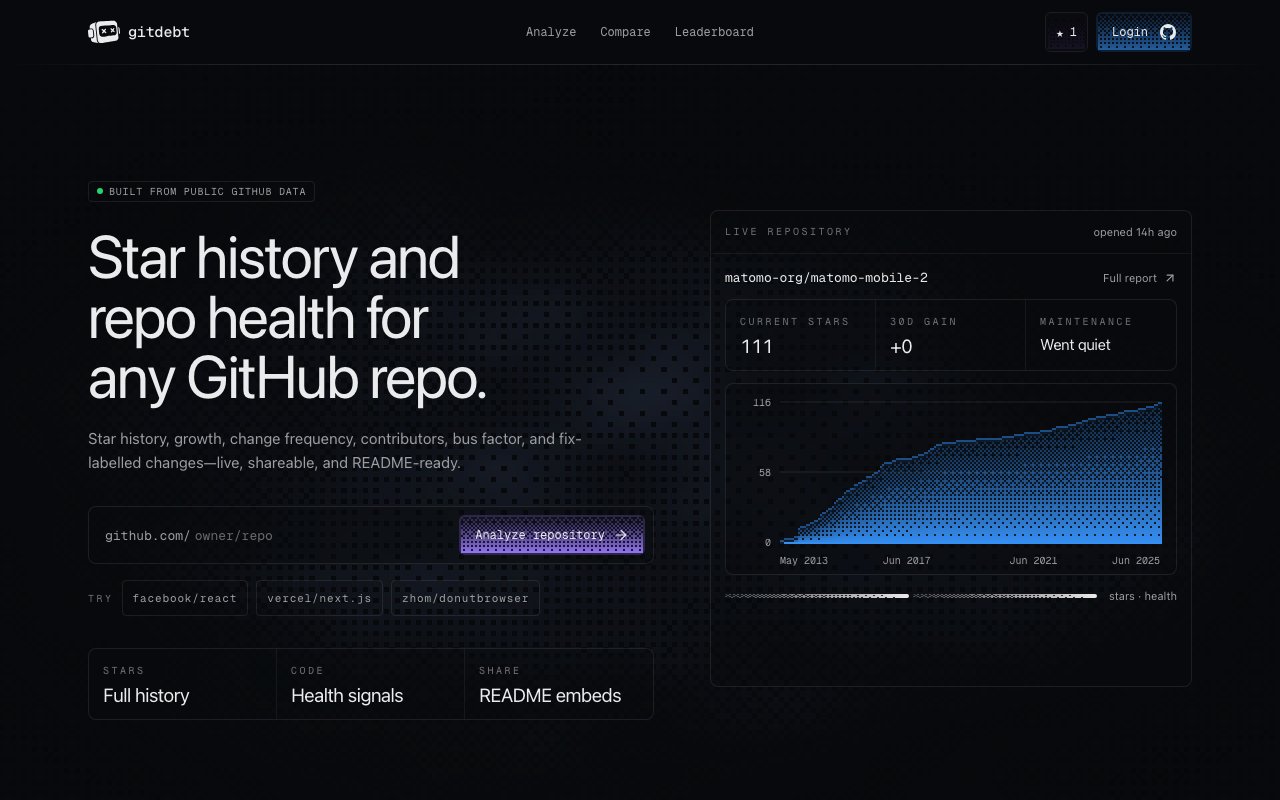
gitdebt is a web-based analytics platform that visualizes GitHub repository metrics and health indicators. It combines star history charts with technical signals derived from commit analysis, giving developers and maintainers a clearer picture of how a project is actually doing beyond just the star count. The tool addresses a gap in how we evaluate open source projects. Stars tell you popularity, but they say nothing about whether a project is actively maintained, whether knowledge is concentrated in one contributor, or whether the codebase is accumulating technical debt faster than it gets fixed.
The core problem is that GitHub's native interface shows surface metrics without surfacing deeper health signals. You can see that a library has 40,000 stars, but you can't tell whether commits have slowed to a trickle, whether a single maintainer handles everything, or how the star growth trajectory compares to alternatives you're evaluating. gitdebt pulls this information from public repository data and presents it in readable charts that actually answer the questions developers care about when choosing dependencies or assessing the health of their own projects.
The platform generates live reports displaying several categories of metrics. Star history shows the accumulation curve over time, which reveals growth patterns, viral moments, and plateaus. File change frequency indicates how actively the codebase evolves, measuring what gitdebt calls shipping velocity. Contributor concentration, measured through the bus factor metric, shows how distributed the knowledge base is across the team. Fix-labeled change ratios compare maintenance work against feature development, hinting at whether technical debt is piling up or being addressed. The platform also tracks known technical debt by following the movement of TODO and FIXME comments across commits. Each of these metrics appears as a visual chart, and you can export them in SVG, PNG, WebP, or GIF formats for embedding directly in READMEs or documentation.
One of the more practical features is the comparison builder. You can overlay up to eight repositories on the same chart, which is useful when evaluating competing libraries or frameworks. The tool includes pre-built comparison categories for common choices like frontend frameworks (six projects), JavaScript build tools (six projects), AI coding tools (six projects), and SQL databases (seven projects), so you don't have to assemble the comparisons yourself. There's also a toggle between calendar-date views and normalized-start views. The normalized view aligns all repositories to the same starting point, letting you compare growth trajectories fairly regardless of when each project launched. This equal-start comparison is particularly useful when comparing a young project against an established one, since raw star counts would otherwise make the comparison meaningless.
The badge studio rounds out the embedding features. It generates theme-aware embeddable assets that adapt to dark and light mode, so charts fit naturally into projects regardless of how the documentation is styled. Assets use cacheable URLs with attribution links, and the single-snippet embedding makes integration straightforward. This makes gitdebt particularly useful for maintainers who want to showcase their project's health metrics without manually updating images. The charts pull live data, so your README stays current without intervention.
gitdebt targets three main audiences. Open source maintainers use it to track their own project's health over time and spot warning signs before they become problems. Project evaluators use the comparison tools to vet dependencies before committing to them, checking whether a library with impressive stars actually has healthy maintenance patterns. Documentation authors use the embeddable charts to add visual metrics that communicate project status at a glance. The pre-curated comparison categories make it easy to explore alternatives in a given space without manually researching which projects to include.
The tool is completely free, open source under the MIT license, and requires no authentication or sign-up for basic lookups. An optional GitHub login enables personalized features, but the core functionality works without it. The codebase is hosted publicly at zhom/gitdebt on GitHub. You point it at any public repository URL and get results immediately, which makes it one of the lower-friction options in this space. The platform is web-based and requires a JavaScript-enabled browser. The tradeoff is scope. It works only with public GitHub repositories, so it won't help with private repos, enterprise installations, or projects hosted on GitLab or Bitbucket. If your evaluation needs stay within public GitHub, that limitation rarely matters.
Key Features
- Star history and growth trend charts
- Contributor concentration and bus factor metrics
- Multi-repository comparison builder
- README-ready embeddable badges
- Pre-built category comparisons
- Theme-aware SVG, PNG, and GIF exports
Pros & Cons
What we like
- Free and open source with no sign-up required
- Compares up to eight repositories side by side
- Embeddable charts adapt to dark and light themes
- Works instantly on any public GitHub repository
Room for improvement
- Limited to public repositories only
- Focuses on GitHub, not other git hosting platforms
- Health signals depend on commit labeling conventions
- No integration with private or enterprise repositories
Frequently Asked Questions
What is gitdebt?
Is gitdebt free?
Can I embed gitdebt charts in my README?
What metrics does gitdebt track?
Best For
Featured in
Alternatives to gitdebt

Kevin Gabeci
Solo developer building web apps, cozy browser games, and AI creator toolkits.

SoloDevStack
A solo developer blog built on head-to-head tool comparisons, 580+ posts deep.

Codedex
A gamified, story-driven platform that teaches Python, web dev, and more like an RPG quest

Vibe Built
Building real apps with agentic AI. What worked, what broke, what shipped.
Reviews (0)
Badge builder
Add gitdebt to your website
Choose a badge style and size, preview it here, then copy the generated HTML. Badge images are self-contained SVGs and do not require an external script.

<a href="https://toolindex.net/tools/gitdebt?ref=badge" target="_blank" rel="noopener">
  <img src="https://toolindex.net/badge/gitdebt/medium.svg" alt="gitdebt - Listed on Tool Index" width="180" height="50" />
</a>How to use the badge
- 1. Pick the style, size, and theme that fit your layout.
- 2. Copy the generated HTML from the code block.
- 3. Paste it into your footer, homepage, or press page.
Standard badge available
The standard listing badge is available now. Score and circle badges are limited to tools currently ranked in the top 10 of a category.
Badge clicks return visitors to this profile with a referral tag so the source remains identifiable.
Related Tools
Kevin Gabeci
Solo developer building web apps, cozy browser games, and AI creator toolkits.

Coolify
Self-hostable, open source alternative to Heroku and Netlify

Warp
The modern terminal reimagined with AI and collaboration

Bolt.new
Prompt-to-deployed full-stack app inside the browser
Work on gitdebt? Request listing access or correction