
Gradium
Build real-time voice products with speech generation transcription translation and cloning
Gallery
About Gradium
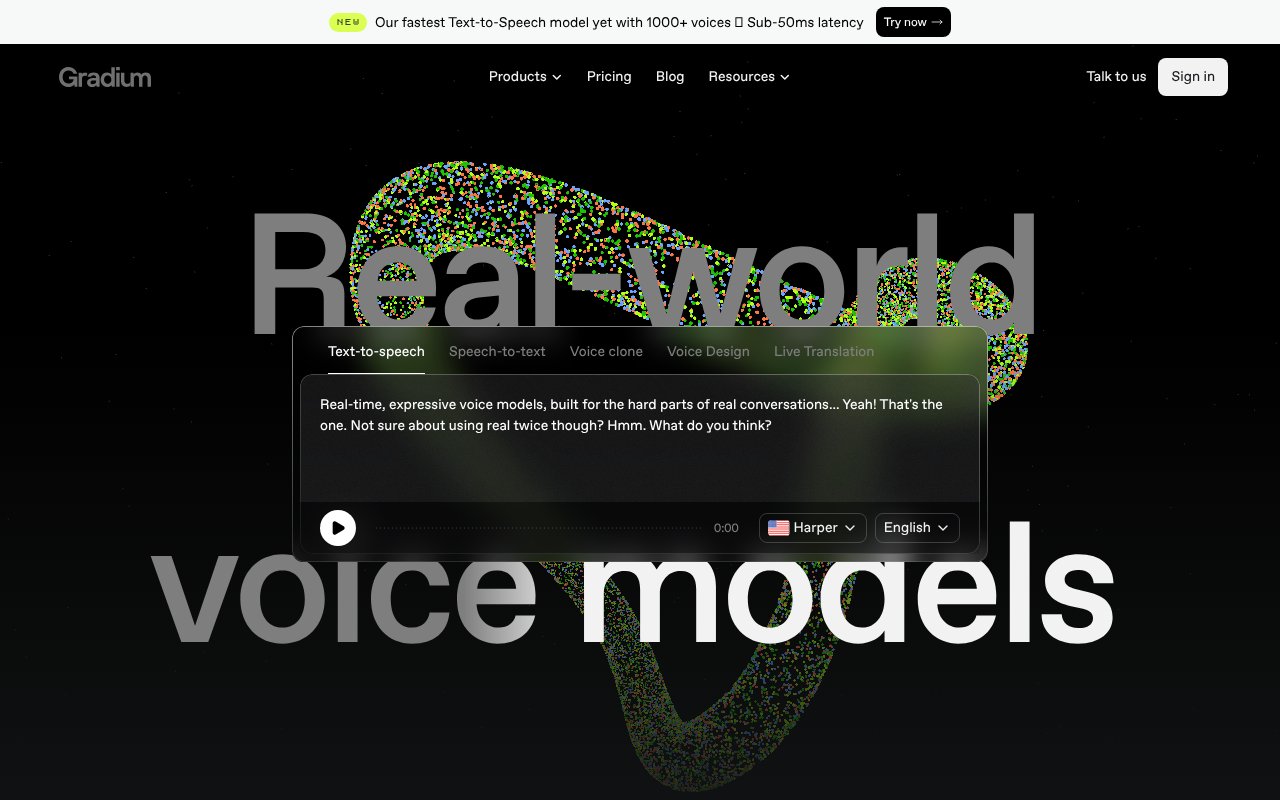
Gradium is a voice AI platform for developers building products that need to speak, listen, or translate during a live interaction. Its API covers text-to-speech, speech-to-text, speech-to-speech translation, voice cloning, and voice design, with a browser based studio for trying the models before wiring them into an application. The focus is not simply producing an audio file after a request. Gradium is designed for conversational systems where the first audible response, stable streaming, and knowing when a person has finished talking all affect whether the interaction feels natural. That makes it relevant to voice agents, phone workflows, accessibility tools, and other products that work with speech as it happens.
Text-to-speech can run through a streaming WebSocket so an application can send text as it is generated and receive audio before the full passage is ready. The product pages emphasize fast time to first audio, no leading silence, telephony formats, and steady latency as concurrency rises. Developers can choose from a voice library, create a new voice from a written description, or make an instant clone from a short recording. Voice Design accepts details such as perceived age, accent, texture, and mood, then creates a reusable voice in the studio. Instant cloning works from ten seconds of audio without a separate training step. More involved professional cloning is available on larger plans, while all custom voice use remains subject to moderation and the service terms.
On the listening side, Gradium streams speech-to-text results and includes semantic turn detection in the same model. Instead of treating any silence as the end of a turn, it sends inactivity probabilities as the conversation develops, giving an agent more context for deciding when to respond. Teams can adjust the transcription delay to favor faster output or higher accuracy and can boost a custom vocabulary of product names, people, or specialist terms without retraining a model. The documented behavior keeps words stable after they appear, which is useful for captions and interfaces where rewriting earlier text would cause visible jumping. REST and WebSocket interfaces are documented, along with recipes for browser audio, telephony, turn taking, and LLM output sent into speech.
Live translation uses a direct speech model rather than requiring a separate transcription, text translation, and synthesis chain. The service listens in one supported language and produces speech in another while the speaker is still talking. Gradium currently documents English, French, German, Spanish, and Portuguese across its main speech models, including regional variants and mid-sentence language switching. Any of the five can translate into any of the others, and the output can use a catalog voice or a custom clone. This is narrower language coverage than broad transcription services offer, but the common API across speaking, listening, translation, and custom voices reduces the number of separate vendors a team has to combine for a multilingual conversation.
It suits engineering teams that need a programmable voice layer more than creators looking only for a one-off narration download. A support agent can combine streamed transcription, turn detection, an LLM, and synthesized replies. A calling product can use telephony audio formats, while a translation experience can carry a selected or cloned voice into another language. Gradium documents deployment through its cloud by default, with dedicated, marketplace, self-hosted, and private infrastructure options discussed for larger requirements. Its public materials also state zero data retention and ISO 27001 certification for the managed service. Those deployment and compliance details matter most to teams handling sensitive conversations, though buyers should still review the current trust materials and terms for their own workload.
Access is freemium. The free plan includes 45,000 credits, Studio and API access, and up to five custom voices, but it doesn't include commercial use. Paid tiers begin with larger credit pools, higher concurrency, commercial use, and many more custom voices, while enterprise terms are custom. Credits are consumed differently by text-to-speech characters, transcription time, and translation time, so expected cost depends heavily on the mix of operations rather than one simple hourly rate. Voice Design itself is included across plans, and the studio can be tried without a credit card. The submitted link pointed to a Voice Design demo, but the canonical product is the broader Gradium platform at gradium.ai, where the full API, studio, documentation, and pricing are presented together.
Key Features
- Streaming text-to-speech API
- Semantic speech turn detection
- Real-time voice translation
- Prompt-based voice design
- Instant voice cloning
- REST and WebSocket interfaces
Pros & Cons
What we like
- Combines core voice models in one platform
- Supports live streaming and telephony formats
- Includes a useful free developer tier
- Offers custom voices without model training
Room for improvement
- Main speech models cover five languages
- Free plan excludes commercial use
- Credit costs vary by operation type
- Professional clones require larger paid plans
Frequently Asked Questions
What is Gradium?
Is Gradium free?
Which languages does Gradium support?
Can Gradium create a custom voice?
Best For
Featured in
Alternatives to Gradium

Cartesia
Ultra-low-latency real-time text-to-speech powered by the Sonic model, built for live voice AI agents
ElevenLabs
The voice cloning and text-to-speech service everyone benchmarks against

Listnr
Ultra-realistic AI text-to-speech and voiceover platform with 1,000+ voices across 142+ languages
Resemble AI
Secure voice cloning, real-time text-to-speech, and speech-to-speech paired with deepfake detection and watermarking
Reviews (0)
Badge builder
Add Gradium to your website
Choose a badge style and size, preview it here, then copy the generated HTML. Badge images are self-contained SVGs and do not require an external script.

<a href="https://toolindex.net/tools/gradium?ref=badge" target="_blank" rel="noopener">
  <img src="https://toolindex.net/badge/gradium/medium.svg" alt="Gradium - Listed on Tool Index" width="180" height="50" />
</a>How to use the badge
- 1. Pick the style, size, and theme that fit your layout.
- 2. Copy the generated HTML from the code block.
- 3. Paste it into your footer, homepage, or press page.
Standard badge available
The standard listing badge is available now. Score and circle badges are limited to tools currently ranked in the top 10 of a category.
Badge clicks return visitors to this profile with a referral tag so the source remains identifiable.
Related Tools

NexSub
Offline real time subtitle translation using local Whisper models for any video source
Listnr
Ultra-realistic AI text-to-speech and voiceover platform with 1,000+ voices across 142+ languages
List55
Voice transcription app that converts audio recordings into formatted text lists

WellSaid Labs
Enterprise text-to-speech with studio-quality AI voice avatars trained on consenting voice actors
Work on Gradium? Request listing access or correction