
Deacon
AI customer support agent that lives inside your app and answers users in plain language
Gallery
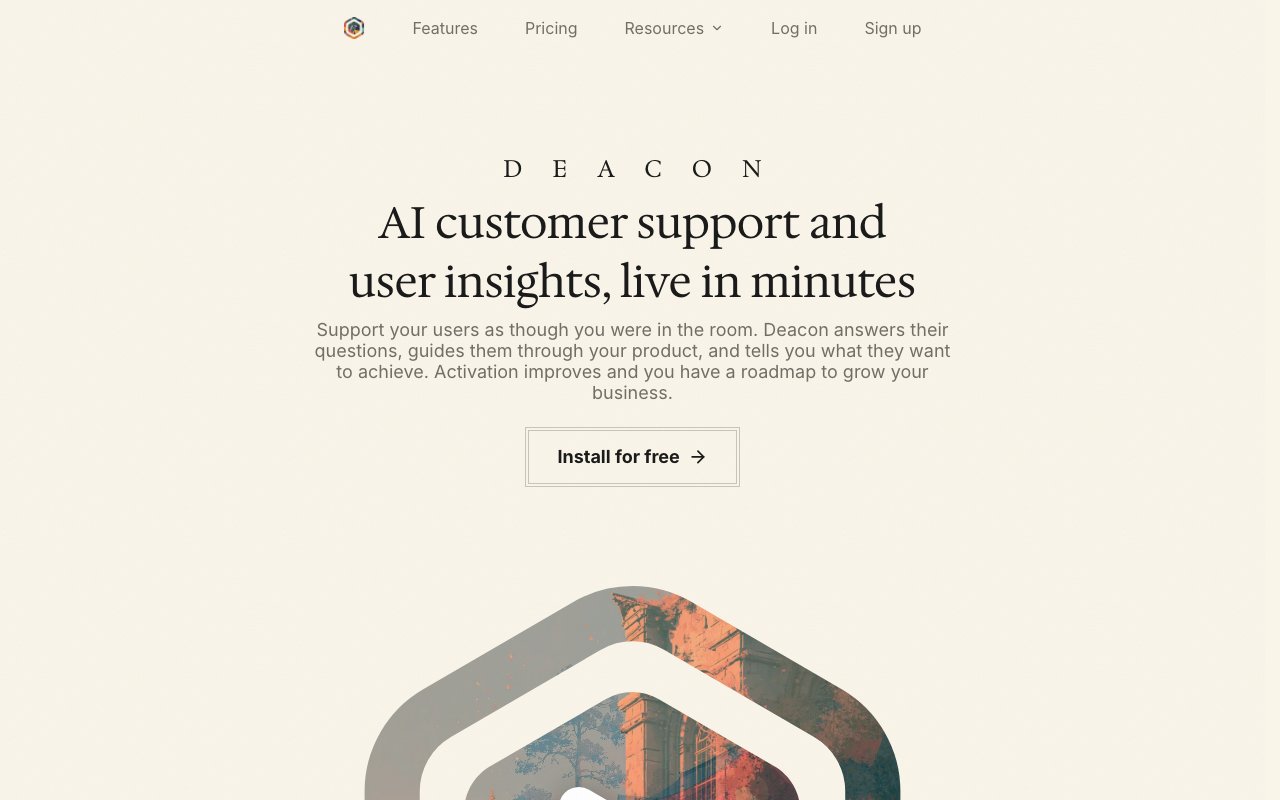
About Deacon
Deacon is an AI customer support agent that lives inside your software product and answers user questions in plain language, at any hour, without a helpdesk stack behind it. It comes from HeyDeacon Limited and is pitched at software companies that want to support users as though someone were in the room with them, even when nobody is. Instead of routing people to a ticket queue or a static FAQ, the agent sits in the app itself and handles the conversation where the confusion actually happens. The name splits neatly too, the company is HeyDeacon, while the agent you actually deploy is just Deacon, and the product treats it more like a colleague than a widget.
The problems it targets are the three quiet failures of early-stage support. Customers can't get an answer the moment they're stuck, so they churn or pile up tickets. Companies miss most of the feedback their users would happily give if anyone were listening. And onboarding feels impersonal, a tour of tooltips rather than a guide. For a solo founder or a small team, the honest answer to all three has usually been to do support personally at the cost of building, or to not do it at all. Deacon's bet is that an embedded agent can cover the bulk of it, so the human hours that remain go where they're actually needed.
Setup is deliberately light. You add a single script snippet to your application, which the site pegs at about five minutes, then configure the agent from a dashboard. It learns your product by ingesting content from URLs, documentation, and videos, so the material you've already written becomes the knowledge base rather than something you rebuild inside yet another tool. From there it answers users conversationally, in their own language, with support for Spanish, French, German, Japanese, Chinese, and more. Because ingestion covers video as well as text, product walkthroughs and demo recordings count as source material too, which suits teams whose best explanations were recorded on a screen share rather than written down.
The design choice that matters most is how it treats accuracy. Answers are validated against the source material to prevent hallucination, and every conversation is logged in full, so you can audit exactly what the agent told your users rather than hoping it behaved. Anyone who has watched a generic chatbot invent a refund policy will understand why that combination, validation plus transparency, is the difference between an agent you can ship and a liability you babysit. The logs double as a review loop, when an answer misses, you can read the exact exchange and fix the underlying content instead of guessing at what went wrong.
Deacon also works the other direction, from users back to you. It guides new users proactively during onboarding instead of waiting to be asked, collects feedback and analytics automatically from its conversations, and flags knowledge gaps where users keep asking things your documentation doesn't answer. That last part quietly turns support traffic into a prioritized list of what to document or fix next, which is the kind of signal small teams usually lose in a ticket pile. The multi-language support compounds the effect, since feedback starts arriving from users you could never have supported manually in Japanese or German, and it all lands in the same dashboard.
The fit is clearest for modern software companies and solo founders or developers who need real support coverage without hiring a support team. If you're a one-person SaaS, the agent is effectively your first support hire, one that has read all your docs and never sleeps. Larger teams can use it to absorb the repetitive first-line questions so humans only see the conversations that genuinely need them. It's also a reasonable fit for products with a global audience and a single-timezone team, where the support gap isn't headcount so much as the sixteen hours a day when nobody is awake.
Pricing is freemium and unusually approachable. There's a free plan with no card required and no time limit, so you can run the agent in production before paying anything. The Starter plan is $50 per month, or $480 per year, and Growth is $150 per month, or $1,440 per year, with the tiers scaling on the volume of answers you need. For a product category where enterprise chat suites start at multiples of that, the posture is clearly aimed at founders who want to try it on real users first and pay only when the answer volume justifies it. The yearly options work out to a 20 percent discount over paying monthly, and the permanent free tier means the upgrade decision gets made on real usage data from your own users rather than a sales call.
Key Features
- In-app conversational AI support
- Answer validation against source material
- Full conversation logging
- Proactive onboarding guidance
- Knowledge gap detection from real questions
- Content ingestion from URLs, docs, and videos
Pros & Cons
What we like
- Free plan with no card and no time limit
- Five-minute setup with a single script snippet
- Answers are validated against your content to curb hallucination
- Turns support conversations into feedback and documentation signals
Room for improvement
- Aimed at SaaS products, not a general helpdesk replacement
- Answer quality depends on how good your existing docs are
- Pricing scales with answer volume, so busy apps outgrow tiers
- Younger product with a smaller track record
Frequently Asked Questions
What is Deacon?
Is Deacon free?
Who is Deacon for?
How does Deacon avoid making things up?
Best For
Featured in
Alternatives to Deacon
Crisp
Multichannel customer messaging platform with a generous free tier

Intercom
Customer service platform with messenger, helpdesk, and AI agent

Probed
Customer chat, feedback, and public roadmaps in one shared space

Zendesk
Enterprise customer service suite for ticketing, chat, and voice
Reviews (0)
Badge builder
Add Deacon to your website
Choose a badge style and size, preview it here, then copy the generated HTML. Badge images are self-contained SVGs and do not require an external script.

<a href="https://toolindex.net/tools/heydeacon?ref=badge" target="_blank" rel="noopener">
  <img src="https://toolindex.net/badge/heydeacon/medium.svg" alt="Deacon - Listed on Tool Index" width="180" height="50" />
</a>How to use the badge
- 1. Pick the style, size, and theme that fit your layout.
- 2. Copy the generated HTML from the code block.
- 3. Paste it into your footer, homepage, or press page.
Standard badge available
The standard listing badge is available now. Score and circle badges are limited to tools currently ranked in the top 10 of a category.
Badge clicks return visitors to this profile with a referral tag so the source remains identifiable.
Related Tools
Probed
Customer chat, feedback, and public roadmaps in one shared space

QuickPing
A dead-simple contact link so customers can message you and you reply from one inbox
Zendesk
Enterprise customer service suite for ticketing, chat, and voice
Crisp
Multichannel customer messaging platform with a generous free tier
Work on Deacon? Request listing access or correction