
IQ Routing
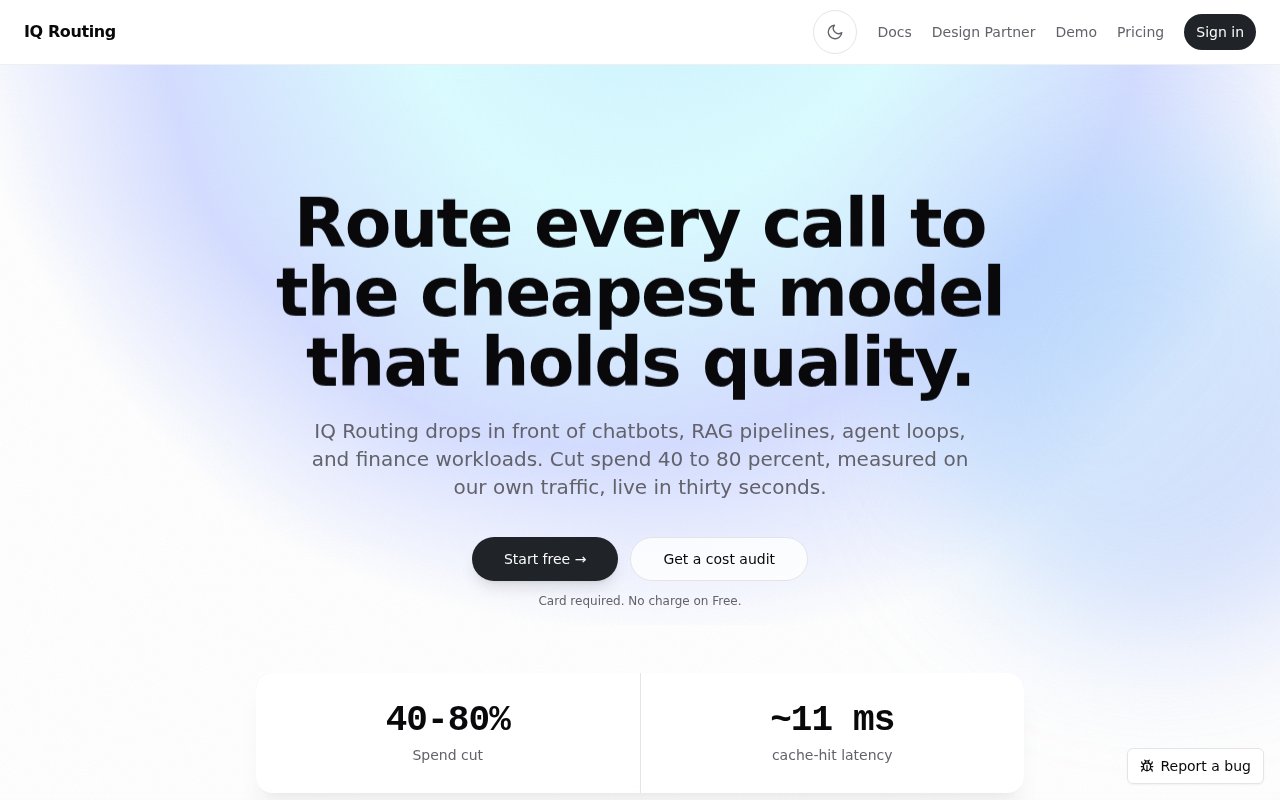
Route each LLM request to the lowest cost model that meets its quality target
Gallery
About IQ Routing
IQ Routing is a gateway that sits between an application and several large language model providers, then chooses a suitable model for each request. It is built for chatbots, retrieval pipelines, agent loops, and other workloads where sending every call to the most capable model wastes money. The product's promise is more specific than simply picking the cheapest endpoint. Its classifier evaluates the difficulty and capability needs of a request, weighs live cost and latency, and routes to the least expensive model that can still meet the configured quality bar. The company reports savings of 40 to 80 percent on its own traffic, so buyers should treat that range as a measured product claim rather than a guaranteed result for every workload.
Integration centers on a compatible gateway URL. An application that already speaks an OpenAI or Anthropic shaped API can point its base URL at IQ Routing while keeping the surrounding code largely unchanged. The service currently supports model families from OpenAI, Anthropic, and Google, and customers bring their own provider keys. That approach leaves upstream model usage on the customer's own accounts while IQ Routing handles classification, selection, fallback, and reporting. It can also stay within a required provider family for tools that lock requests to one ecosystem. Conversation state is retained where needed so a thread can move between model tiers without losing its context.
The router works at both request and agent step level. In a multi-step loop, planning, retrieval, tool use, synthesis, and verification don't all need the same reasoning budget. IQ Routing classifies each step and can reserve a frontier model for the demanding work while assigning routine steps to cheaper variants. Agent sessions group those decisions into one accountable unit with per-turn cost, latency, token counts, and step classifications. A session governor can limit how much reasoning spend a run consumes. This is useful for engineering and finance teams that need to understand not only which model generated a bill, but which team, application, key, or agent step owned the cost.
Cost controls extend beyond routing. The gateway includes a semantic cache that can answer exact repeats and requests with the same meaning without paying the provider a second time. Cache data is isolated by organization. A cost ledger separates input, output, cached, and thinking costs, while team plans add per-team budgets, alerts, access controls, custom routing band maps, and an audit log. The dashboard shows a live request feed, agent sessions, spend, routing decisions, and model usage. Rate and spend limits are enforced before the provider call, and response headers identify whether a burst limit, token limit, daily budget, monthly budget, or key ceiling caused a rejected request.
The security posture is unusually explicit for a young gateway. Provider keys are encrypted at rest, and payload logging is off by default. In the default state the service stores operational metadata such as timestamps, selected model, provider, token counts, latency, cost, and routing decision, but it doesn't retain prompt and completion bodies unless an organization enables that setting. Zero Data Retention is available on every plan. When enabled, request and response bodies can't be persisted, though cost metadata is still recorded and stateful conversations remain temporarily available with a time limit. Buyers should read those boundaries carefully because the gateway necessarily sits on a sensitive path between their applications and model vendors.
IQ Routing fits teams with enough LLM traffic for model selection and allocation to matter. A small prototype making a few calls may not benefit much beyond one endpoint and a cache. A production agent, internal assistant, or multi-team AI platform has more to gain from per-step routing, auditable spend, and controls tied to teams and keys. It also suits organizations that want to keep their own provider relationships instead of buying marked-up model usage through an aggregator. The tradeoff is another service in the request path and a current provider roster limited to OpenAI, Anthropic, and Google. There is no public self-hosted distribution, although enterprise customers can arrange an on-premises or private cloud deployment.
The hosted Free plan costs nothing and supports bring your own keys, the three current providers, semantic caching, email support, and up to 240 requests per minute. It requires a card on file but the site says there is no charge on Free. Team costs $70 per month with no annual plan and raises the request limit while adding budgets, alerting, organization controls, custom band maps, audit history, and priority email support. Enterprise uses a custom annual contract for higher limits, dedicated support, private deployment options, and a security evidence pack. That makes the service freemium, with a functional gateway at no subscription cost and paid governance for teams whose traffic and accountability requirements have grown.
Key Features
- Adaptive LLM model routing
- Multi-provider gateway endpoint
- Semantic response caching
- Per-team cost controls
- Agent session tracking
- Zero Data Retention mode
Pros & Cons
What we like
- Routes individual agent steps by capability and cost
- Works with existing OpenAI and Anthropic shaped clients
- Keeps upstream usage on customer owned provider keys
- Makes routing decisions and spend visible in one ledger
Room for improvement
- Free accounts still require a card on file
- Current provider support covers only three vendors
- No public self-hosted distribution is available
- Team billing has no annual plan
Frequently Asked Questions
What is IQ Routing?
Which model providers does IQ Routing support?
Is IQ Routing free?
Does IQ Routing store prompts?
Best For
Featured in
Alternatives to IQ Routing

Kevin Gabeci
Solo developer building web apps, cozy browser games, and AI creator toolkits.

SoloDevStack
A solo developer blog built on head-to-head tool comparisons, 580+ posts deep.

Codedex
A gamified, story-driven platform that teaches Python, web dev, and more like an RPG quest
Vibe Built
Building real apps with agentic AI. What worked, what broke, what shipped.
Reviews (0)
Badge builder
Add IQ Routing to your website
Choose a badge style and size, preview it here, then copy the generated HTML. Badge images are self-contained SVGs and do not require an external script.

<a href="https://toolindex.net/tools/iq-routing?ref=badge" target="_blank" rel="noopener">
  <img src="https://toolindex.net/badge/iq-routing/medium.svg" alt="IQ Routing - Listed on Tool Index" width="180" height="50" />
</a>How to use the badge
- 1. Pick the style, size, and theme that fit your layout.
- 2. Copy the generated HTML from the code block.
- 3. Paste it into your footer, homepage, or press page.
Standard badge available
The standard listing badge is available now. Score and circle badges are limited to tools currently ranked in the top 10 of a category.
Badge clicks return visitors to this profile with a referral tag so the source remains identifiable.
Related Tools
Kevin Gabeci
Solo developer building web apps, cozy browser games, and AI creator toolkits.

Coolify
Self-hostable, open source alternative to Heroku and Netlify

Warp
The modern terminal reimagined with AI and collaboration

Bolt.new
Prompt-to-deployed full-stack app inside the browser
Work on IQ Routing? Request listing access or correction