
Lettertrace
MIT-licensed self-hosted monitoring for how often ChatGPT, Claude, and Gemini mention your brand
Gallery
About Lettertrace
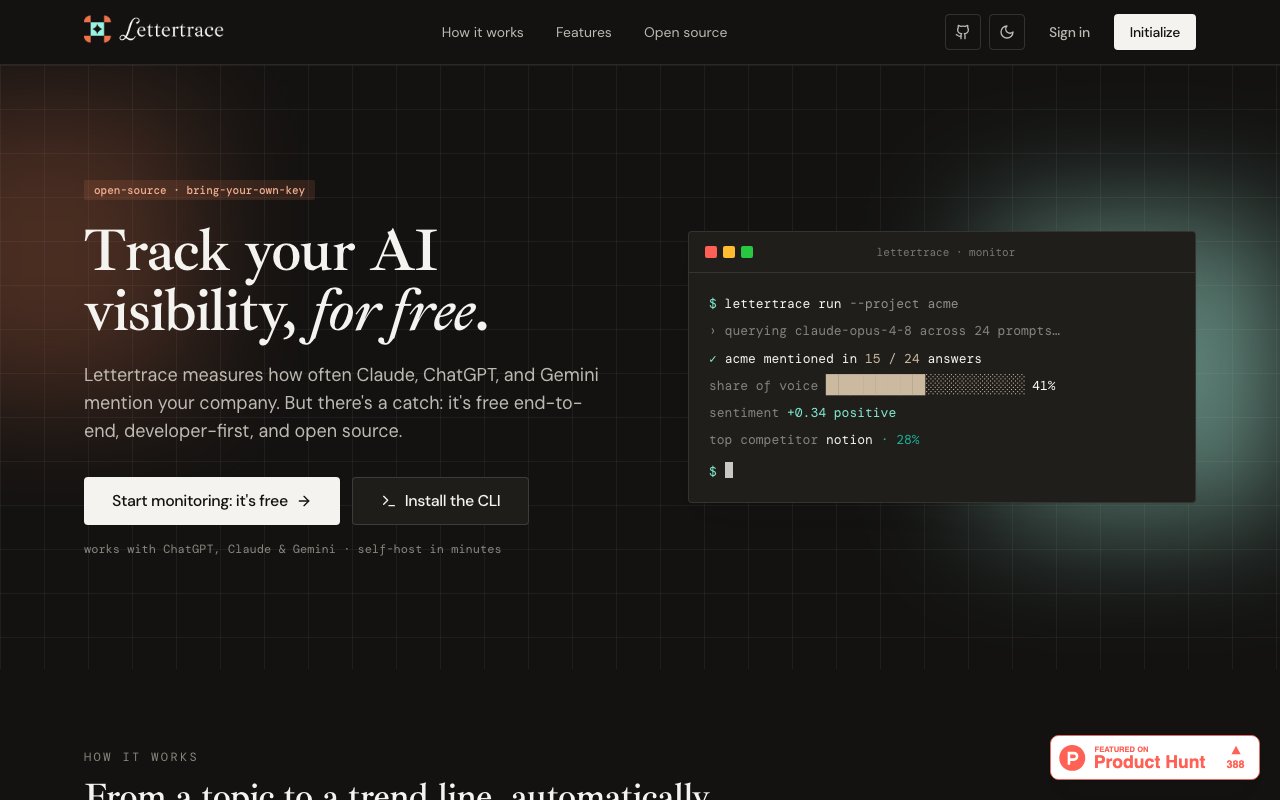
Lettertrace is an open-source platform for monitoring how AI assistants talk about your brand. It runs your topics through Claude, ChatGPT, Gemini, and Google AI Overviews, then measures how often your company actually comes up, how it's framed, and how you stack up against competitors. The question it answers is simple, when a customer asks an AI for a recommendation in your category, are you in the answer. The whole thing is MIT licensed and self-hosted, so instead of paying a SaaS subscription for AI visibility data, you run the stack yourself and keep everything on your own infrastructure.
The problem is new but growing fast. A meaningful share of product discovery now happens inside AI chat windows rather than search results pages, and when someone asks an assistant for the best CRM for startups, the brands named in that answer win attention that never shows up in any analytics tool. Companies that have done search engine optimization for years suddenly have no idea whether the models mention them at all. Traditional rank trackers can't see inside these answers, and the models themselves offer no reporting, so the only way to know is to ask them, systematically and repeatedly. The discipline forming around this goes by AEO or GEO, answer and generative engine optimization, and Lettertrace is tooling for it.
The workflow starts with a topic. You give it something like best CRM for startups, and the system generates dozens of natural prompt variations automatically, since real users phrase the same question a hundred different ways. That generation step is the part that's tedious to replicate by hand, because meaningful coverage means asking each model the same question many ways and normalizing the answers. Lettertrace then queries the models and turns the responses into metrics, a visibility percentage for your brand, share of voice against competitors, and sentiment on each mention. Sentiment matters here because being mentioned as a cautionary tale is worse than not being mentioned at all. You can track five or more competing brands, so the output isn't just whether you appear but who's appearing instead of you.
One-off snapshots are nearly useless for this kind of measurement, so Lettertrace is built around trend lines. Runs can be scheduled daily or weekly and the results accumulate into a series you can actually act on, whether that's watching a competitor overtake you on a topic or checking if a content push moved your visibility over a quarter. Because models get updated and their answers drift, the trend view also catches changes you didn't cause, like a model revision that quietly dropped you from an answer you used to own.
The architecture is bring-your-own-key. You plug in your own Anthropic, OpenAI, and Google API keys, they're encrypted at rest, and per the project they never leave your infrastructure. Data lands in your own Supabase instance, so there's no vendor database holding your competitive research and no lock-in to escape later. The direct consequence is cost transparency, you pay the model providers for exactly the queries you run, with no markup and no per-seat pricing layered on top. It also means the tool scales down gracefully, a founder tracking one brand on a weekly schedule spends pennies, while an agency running daily checks across a client roster pays only for what those runs consume.
It's aimed at the people already doing this work by hand, SEO and content teams extending into AI visibility, founders who want to know whether assistants recommend their product, and agencies that need brand-level reporting without a per-client SaaS bill. It also suits in-house teams who'd rather run one more container than sign one more vendor agreement. The technical bar is real though, you're deploying an application and wiring up Supabase and API keys, so a marketing team without engineering support will find a hosted commercial tool easier. For teams with a developer available, the project pitches setup as a matter of minutes.
What separates it from the growing crowd of AI visibility trackers is the licensing and the posture. Most competitors are closed SaaS products with monthly subscriptions and your data on their servers. Lettertrace is MIT licensed, and the project's own framing is to fork it, self-host it, and make it yours. There's no paid tier at all, the software is free end-to-end, the code is public on GitHub, and your only running cost is the model API usage you'd be paying for anyway. For a category this young, having a solid open-source reference implementation you can inspect and extend is valuable in itself.
Key Features
- Brand tracking across four AI answer surfaces
- Automated prompt generation from a topic
- Share of voice and sentiment scoring
- Competitor benchmarking for multiple brands
- Bring-your-own-key with encrypted storage
- Scheduled daily or weekly trend runs
Pros & Cons
What we like
- Completely free and MIT licensed
- API keys and data stay on your own infrastructure
- Covers Claude, ChatGPT, Gemini, and Google AI Overviews
- Builds trend lines instead of one-off snapshots
Room for improvement
- Self-hosting requires technical setup
- You pay the underlying model API costs yourself
- Storage is tied to Supabase
- No managed cloud option for non-technical teams
Frequently Asked Questions
What is Lettertrace?
Is Lettertrace free?
Do I need my own API keys?
Who is Lettertrace for?
Best For
Featured in
Alternatives to Lettertrace

Moz Pro
SEO toolset with keyword research, site audits, link analysis, and the well-known Domain Authority and Page Authority metrics.
Frase
AI-assisted SEO content tool that turns SERP research into briefs, outlines, and optimized drafts inside one editor.

Rank Compound
SEO content that compounds. What actually moved rankings, measured, with the failures shown.
Postdex
An exclusive marketplace for finished, human-made articles. Every piece sells once.
Reviews (0)
Badge builder
Add Lettertrace to your website
Choose a badge style and size, preview it here, then copy the generated HTML. Badge images are self-contained SVGs and do not require an external script.

<a href="https://toolindex.net/tools/lettertrace?ref=badge" target="_blank" rel="noopener">
  <img src="https://toolindex.net/badge/lettertrace/medium.svg" alt="Lettertrace - Listed on Tool Index" width="180" height="50" />
</a>How to use the badge
- 1. Pick the style, size, and theme that fit your layout.
- 2. Copy the generated HTML from the code block.
- 3. Paste it into your footer, homepage, or press page.
Standard badge available
The standard listing badge is available now. Score and circle badges are limited to tools currently ranked in the top 10 of a category.
Badge clicks return visitors to this profile with a referral tag so the source remains identifiable.
Related Tools

SEOdata.dev
Simple API for keyword search volume, CPC, and competition data
Frase
AI-assisted SEO content tool that turns SERP research into briefs, outlines, and optimized drafts inside one editor.

Surfer SEO
Content optimization tool that scores drafts in real time against the top-ranking pages for any target keyword.

Screaming Frog SEO Spider
Desktop website crawler trusted by SEO professionals for technical audits, broken link checks, and structured data analysis.
Work on Lettertrace? Request listing access or correction