
Rank Compound

Rank Compound

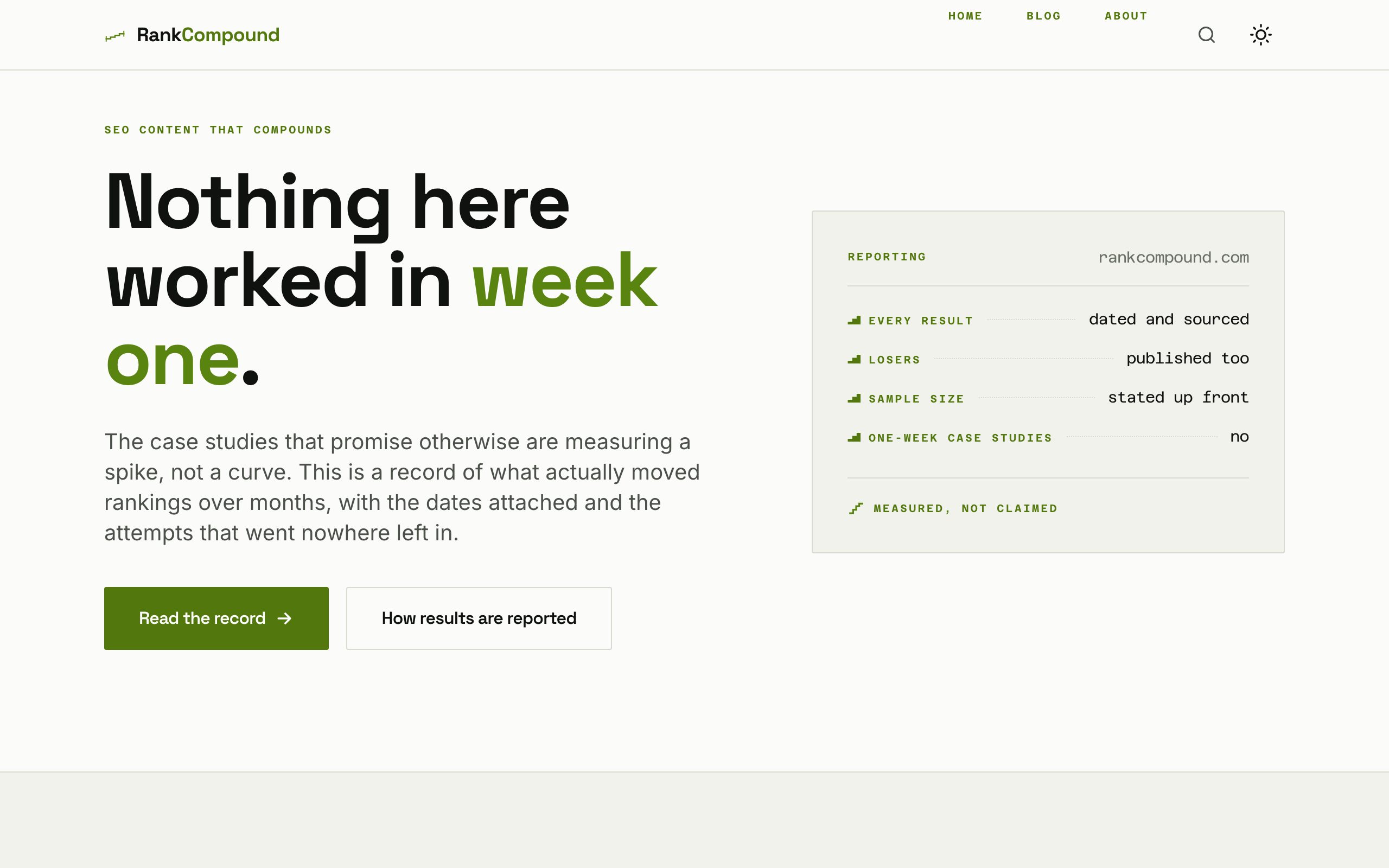
SEO content that compounds. What actually moved rankings, measured, with the failures shown.

Gallery
About Rank Compound

Rank Compound is a blog that publishes case studies about SEO content performance. The focus is on documenting what actually moved search rankings over months, not weeks, with explicit attention to experiments that failed alongside the ones that worked. Each post includes publication dates, stated sample sizes, and enough methodology detail that readers can assess whether the findings apply to their own situation. The approach is deliberately anti-hype in a space where most content exists to sell courses, services, or tools rather than share honest data.

The problem it tackles is the gap between SEO marketing claims and reality. The industry is full of case studies that cherry-pick one-week ranking spikes, omit sample sizes, and conveniently forget to mention the ten experiments that went nowhere before one finally hit. Twitter threads go viral claiming massive traffic gains from a single technique, but the details are always thin enough that you cannot replicate the result or verify it was real. Rank Compound positions itself against that culture by showing the full picture, losses included. The tagline captures the philosophy: nothing here worked in week one. The implication is that SEO is slower and less predictable than the hype suggests, and the site exists to document that reality.

The content follows a consistent structure that makes case studies useful rather than anecdotal. Each post identifies what was tested, over what timeframe, with how many pages or posts in the sample, and what the actual ranking changes were. Failed experiments get the same treatment as successes, complete with analysis of why they might have failed and what the data suggests about where to look next. The site does not claim secrets or proprietary techniques that only work for the author. It documents observable changes in search performance and offers interpretations of what drove them, while acknowledging uncertainty where the data is ambiguous. That humility about conclusions is rare in SEO content, where confidence often correlates inversely with actual evidence.

The target audience is SEO professionals and content strategists who are tired of inflated claims. If you have spent time trying to replicate tactics from viral threads only to see no results, the measured approach here offers a counterweight. The site assumes readers understand the basics of search optimization and content strategy and writes at a level that respects that knowledge rather than oversimplifying for a general audience. There are no beginner tutorials explaining what keywords are. The content is aimed at practitioners who already know how to do SEO and want grounded data on what is actually working in the current algorithm environment.

Rank Compound is free to read. The site is built on Astro and does not appear to have a paid tier for the content itself. The value proposition is the case study archive, which you can browse without creating an account, subscribing to anything, or paying for access. There is no gated premium section or newsletter upgrade pushing for a subscription. The absence of aggressive monetization supports the editorial positioning, though it also means the site is likely a passion project or portfolio piece rather than a primary business.

What distinguishes Rank Compound is the editorial stance. Most SEO content is produced to sell services, courses, or tools, which creates an incentive to exaggerate results and hide failures. Showing only successes makes the author look competent and makes their offering seem more valuable. Rank Compound inverts that by leading with what did not work. The site states explicitly that it shows losers alongside winners, which is unusual enough in the space to be a selling point in itself. Whether that commitment holds depends on ongoing editorial discipline, but the positioning is clear and the execution so far matches the promise.

The site is useful for practitioners who want grounded data on what moves rankings in practice. It will not give you shortcuts or hacks. It will not promise results in a week. It will give you documented experiments with outcomes you can compare against your own data, including the experiments that failed. If your approach to SEO involves testing and measurement rather than following trends, the case studies here provide a reference point that is harder to find elsewhere. The willingness to publish failures makes the successes more credible, and the methodology transparency lets you judge whether the findings apply to your domain.

Key Features

  • SEO case studies with dated results
  • Failed experiments published alongside wins
  • Sample sizes stated upfront
  • Cost breakdowns for AI in SEO
  • RSS feed for new posts
  • Methodology explained on about page

Pros & Cons

What we like

  • Publishes failures, not just successes
  • Every result dated and sourced
  • No paywall or email gate
  • Focuses on long-term compounding over quick wins

Room for improvement

  • Archive is still small
  • No newsletter signup yet
  • Covers a narrow SEO niche
  • Single author, so publishing pace depends on one person

Frequently Asked Questions

What is Rank Compound?
Rank Compound is an SEO blog that documents what actually improved search rankings over time, with every result dated and sample sizes stated. It publishes failures alongside wins, which is rare in SEO content.
Is Rank Compound free?
Yes. All posts are free to read with no paywall, no email gate, and no premium tier. There is an RSS feed if you want to follow new posts.
Who is Rank Compound for?
SEO practitioners and content strategists who want grounded data on what works, not hype. It assumes you already know the basics and writes to that level.
How often does Rank Compound publish?
The site has several recent posts from July 2026, but there is no stated schedule. It is a single author project, so cadence varies.

Best For

Finding SEO tactics that actually moved rankingsLearning what AI for SEO really costsStudying experiments that failed and whyGetting grounded data before investing in a content strategy

Featured in

Alternatives to Rank Compound

View all

Reviews (0)

No reviews yet

Be the first to share your experience with Rank Compound

Sign in to write a review

Badge builder

Add Rank Compound to your website

Choose a badge style and size, preview it here, then copy the generated HTML. Badge images are self-contained SVGs and do not require an external script.

Rank Compound badge preview
<a href="https://toolindex.net/tools/rankcompound?ref=badge" target="_blank" rel="noopener">
  <img src="https://toolindex.net/badge/rankcompound/medium.svg" alt="Rank Compound - Listed on Tool Index" width="180" height="50" />
</a>

How to use the badge

  1. 1. Pick the style, size, and theme that fit your layout.
  2. 2. Copy the generated HTML from the code block.
  3. 3. Paste it into your footer, homepage, or press page.

Score badge available

Rank Compound qualifies for the score and circle badges based on its current top-10 positionin SEO Tools.

Badge clicks return visitors to this profile with a referral tag so the source remains identifiable.