License Compatibility Checker
Check directional software license compatibility with a transparent rule engine
Gallery
About License Compatibility Checker
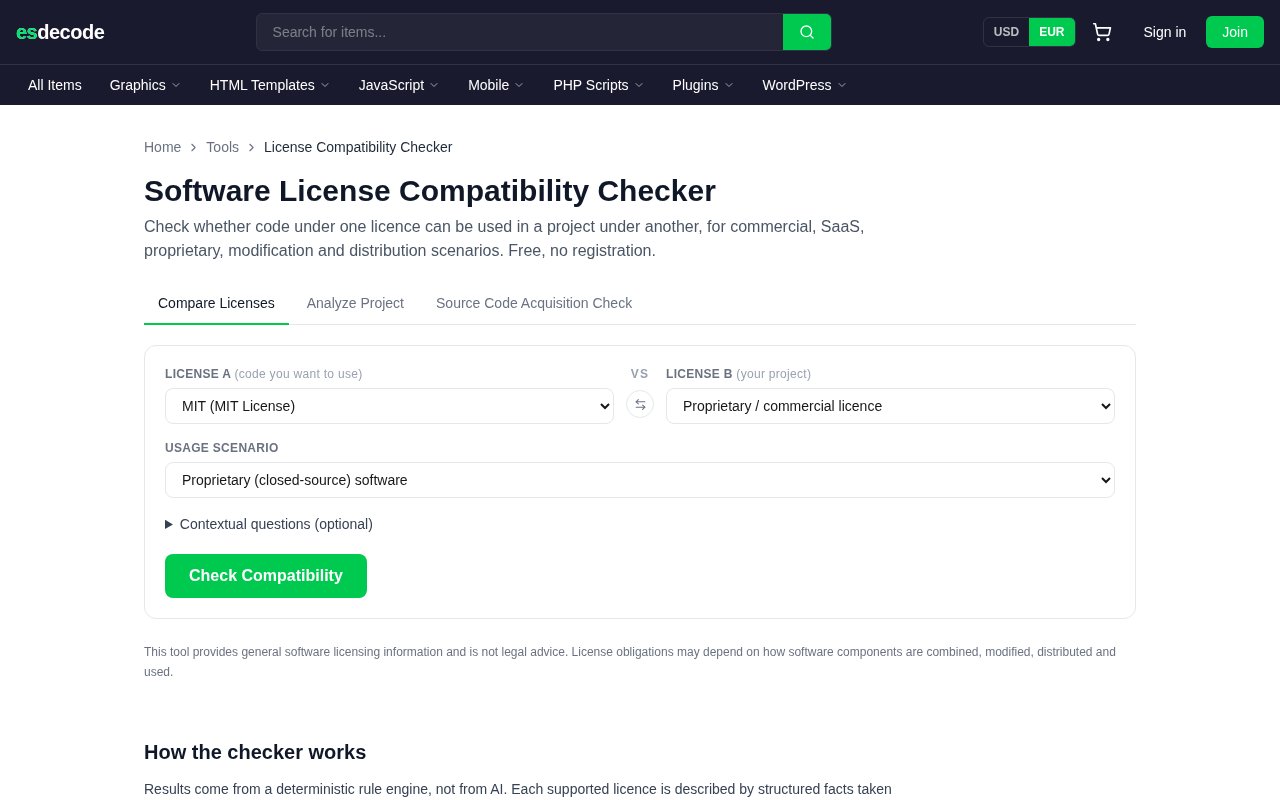
License Compatibility Checker is a free web tool for assessing whether code under one software license can be used in a project under another. It treats compatibility as a directional question because bringing MIT code into a GPL project isn't the same as bringing GPL code into an MIT project. A user selects the license on the incoming code, the license of the destination project, and an intended usage scenario. Optional questions cover distribution, network access, modification, whether the finished product stays closed source, and how the code is combined. The result is a structured assessment of likely compatibility, conditions, conflicts, obligations, and points that need human review.
The checker uses a deterministic rules engine rather than a language model. Its license definitions contain structured facts about copyleft strength, source disclosure, attribution, patent terms, network use, and other dimensions. ESDecode says those facts are drawn from SPDX, the Open Source Initiative, the GNU Project, license stewards, and official texts. When a rule applies, the output exposes its identifier rather than presenting an unexplained verdict. Possible headline results include generally compatible, compatible with conditions, potential conflict, likely incompatible, manual review required, and unknown. This vocabulary is intentionally cautious and keeps uncertainty visible when the engine can't identify a license or safely generalize custom terms.
Context is important to the result. The engine distinguishes scenarios such as dependency use, source inclusion, modification, binary or source distribution, commercial and proprietary software, software as a service, internal use, resale, white labeling, and source code acquisition. It can also account for dynamic linking, static linking, direct source inclusion, or operation as a separate program. These details matter most with strong, weak, file level, and network copyleft licenses. The web form surfaces the core questions without making a visitor write code. Developers who need automation can install the underlying TypeScript and Node.js package and call the same compatibility logic from their own tooling.
The open-source package supports 21 defined license values, including common permissive families, GNU licenses, MPL, EPL, CDDL, AGPL, public domain equivalents, several source available licenses, proprietary terms, and unknown or custom cases. It normalizes common aliases and understands GNU version forms such as only or later. Beyond pairwise checks, the library includes analyzers for projects containing several licenses and for source code acquisition risk. It can parse license declarations from some Node.js and Composer manifest formats, report risk sections, and produce questions for a buyer to ask a code seller. Results can separate areas such as commercial use, modification, distribution, source disclosure, attribution, patents, copyleft, network use, and proprietary use. The package is framework independent, fully typed, published as an ES module, and has no runtime dependencies.
Transparency is its strongest advantage, but it also defines the limits. The engine reasons from declared license terms and the context a user supplies. It can't see how code is actually linked, confirm copyright ownership, interpret extra permissions hidden in a file header, or replace review of a proprietary agreement. License exceptions, dual license choices, and LicenseRef identifiers are treated as custom rather than confidently evaluated. Registry based dependency resolution isn't included, and some lockfile formats provide little or no license data. Content licenses are mostly outside scope. The project also notes that published foundation positions can still be treated differently by courts in different jurisdictions.
The hosted checker can be used without a displayed price, and the complete engine is available under the MIT license. That makes it useful for an early engineering or procurement screen, a repeatable CI adjacent check, or an educational comparison before a team reads the actual license text. It is not legal advice, and the maintainers explicitly recommend qualified review for ambiguous or high risk situations. Teams should therefore treat its output as a traceable starting point rather than a legal clearance certificate. Within that role, it offers more useful detail than a flat compatibility table because it combines direction, distribution model, integration method, obligations, source links, and stable rule identifiers in one result.
Key Features
- Directional license compatibility checks
- Deterministic rules with identifiers
- Scenario and integration context
- Twenty-one supported license values
- Multi-license project analysis
- Open-source TypeScript package
Pros & Cons
What we like
- Explains which rules produced each assessment
- Keeps unknown and custom terms visibly uncertain
- Covers distribution, network use, and modification context
- Offers both a web form and reusable library
Room for improvement
- Supports a focused set of 21 license values
- Custom terms and exceptions require manual review
- Registry based dependency resolution is not included
- Results are general information rather than legal advice
Frequently Asked Questions
What does License Compatibility Checker do?
Does the checker use AI?
Is License Compatibility Checker open source?
Can its result replace legal advice?
Best For
Featured in
Alternatives to License Compatibility Checker

Kevin Gabeci
Solo developer building web apps, cozy browser games, and AI creator toolkits.

SoloDevStack
A solo developer blog built on head-to-head tool comparisons, 580+ posts deep.

Codedex
A gamified, story-driven platform that teaches Python, web dev, and more like an RPG quest

Vibe Built
Building real apps with agentic AI. What worked, what broke, what shipped.
Reviews (0)
No reviews yet
Be the first to share your experience with License Compatibility Checker
Sign in to write a reviewBadge builder
Add License Compatibility Checker to your website
Choose a badge style and size, preview it here, then copy the generated HTML. Badge images are self-contained SVGs and do not require an external script.

<a href="https://toolindex.net/tools/license-compatibility-checker?ref=badge" target="_blank" rel="noopener">
  <img src="https://toolindex.net/badge/license-compatibility-checker/medium.svg" alt="License Compatibility Checker - Listed on Tool Index" width="180" height="50" />
</a>How to use the badge
- 1. Pick the style, size, and theme that fit your layout.
- 2. Copy the generated HTML from the code block.
- 3. Paste it into your footer, homepage, or press page.
Standard badge available
The standard listing badge is available now. Score and circle badges are limited to tools currently ranked in the top 10 of a category.
Badge clicks return visitors to this profile with a referral tag so the source remains identifiable.
Related Tools
Kevin Gabeci
Solo developer building web apps, cozy browser games, and AI creator toolkits.
Coolify
Self-hostable, open source alternative to Heroku and Netlify

Warp
The modern terminal reimagined with AI and collaboration

Bolt.new
Prompt-to-deployed full-stack app inside the browser
Work on License Compatibility Checker? Request a listing correction