
linear.gratis
Free open-source client-facing feedback forms and public roadmaps for Linear
Gallery
About linear.gratis
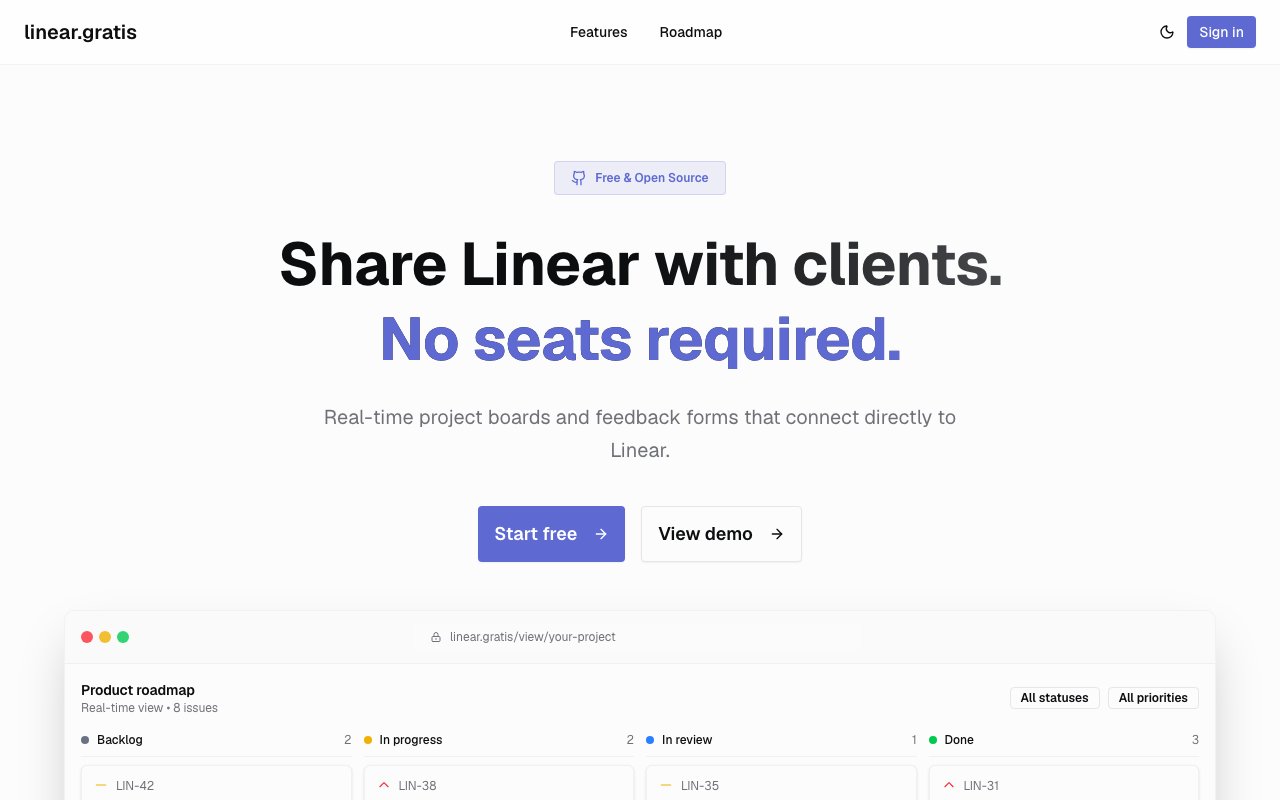
linear.gratis is a free, open-source way to add customer-facing features on top of Linear, the issue tracker that many product teams already run their work in. Linear is excellent for the team's internal view, but out of the box it doesn't give you much to point customers and stakeholders at. linear.gratis fills that gap with intake forms, public issue views, and public roadmaps that all read and write straight back into your own Linear workspace, so the feedback layer and the work layer stay in one place instead of drifting apart in two different tools.
The problem it solves shows up the moment you want to collect feedback. You can ask customers to email you, or you can pay for a separate feedback portal, and then you're stuck copying requests into Linear by hand or paying a monthly fee just to keep the two systems in sync. linear.gratis removes that middle step. A request submitted through one of its forms creates a Linear customer and a Linear issue directly, so what a user reports lands as a real, trackable item where your team already triages everything else. Because those requests are tied to customers rather than being loose tickets, you can also see who asked for what and let that inform how you prioritise.
The intake forms are the first of three public surfaces. The second is public views, where you take a filtered set of Linear issues and share them on a page so customers or stakeholders can follow specific work without being invited into your workspace or seeing anything you haven't chosen to expose. That's useful for keeping a client updated on their project, for letting a wider audience watch progress on a particular feature area, or for giving a sales team a link they can send without worrying about leaking the rest of the backlog.
The third surface is the public roadmap. It goes beyond a static list, supporting voting and comments so the people using your product can tell you what matters most and weigh in on what you've planned. When you need more control over who sees it, a roadmap can be password protected or set to expire, which is handy for sharing an early plan with a single customer or a private beta group rather than the whole internet.
All three surfaces can be dressed up to look like part of your product rather than a bolted-on tool. You can put forms, views, and roadmaps on a custom domain and brand the pages with your own logo, colours, favicon, and footer settings. The result reads as a native extension of your site, which matters when you're asking customers to trust the page enough to leave real feedback on it, and it keeps the experience consistent instead of bouncing people out to something that clearly belongs to a different company.
For most teams the appeal is that nobody has to change how they already work. The engineers keep living in Linear, moving issues through the same statuses and cycles they always have, while customers interact with the forms, views, and roadmaps out front. There's no second inbox to babysit and no weekly export-and-import dance, because the two sides are just looking at the same underlying data from different angles.
It's aimed squarely at teams that have already committed to Linear and don't want to add a paid portal just to collect requests or show progress. If you're a small product team, an indie studio, or a startup that treats Linear as the source of truth, this opens a customer-facing window onto that work without another subscription or another system to reconcile. Because everything is backed by your workspace, the issues, customers, and statuses all still belong to Linear, and linear.gratis is simply the presentation and intake layer wrapped around them.
Where it stands apart is the pricing and the openness. It bills itself as 100% free forever, positioned as an open-source alternative to hosted tools like SteelSync and Lindie that charge for the same customer request and roadmap features. The code lives on GitHub under curiousgeorgios/linear-gratis, so you can read exactly how it works, run the hosted version if you just want it working, or clone it and host it yourself when you'd rather keep everything on your own infrastructure. The trade-offs are the ones you'd expect from a young open-source project, a smaller community and fewer polished edges than the commercial options, plus the fact that it's only useful if Linear is already your tracker. There's also a little setup up front, since you connect your workspace and decide which issues each public view or roadmap should surface before you point customers at it. For a team that fits, though, the price and the openness are hard to argue with, and there's very little downside to trying it since you can wire it to a workspace and tear it down again without paying anyone.
Key Features
- Customer request intake forms
- Public filtered Linear issue views
- Public roadmaps with voting and comments
- Custom domains and branded portals
- Backed by your own Linear workspace
- Self-hostable and open source
Pros & Cons
What we like
- 100% free with no subscription or usage limits
- Open source and self-hostable on your own infra
- Turns Linear into a customer-facing portal
- Custom domains and branding included at no cost
Room for improvement
- Only useful if you already run Linear
- Younger project with a smaller community
- Requires setup and a Linear workspace
- Fewer polish features than paid alternatives
Frequently Asked Questions
What is linear.gratis?
Is linear.gratis free?
Who is linear.gratis for?
How is it different from SteelSync or Lindie?
Best For
Featured in
Alternatives to linear.gratis

1Lookup
Real-time data verification API for phone, email, IP, and domain validation to fight fraud

Plannotator
Review and annotate your AI coding agent's plans and diffs before they ship

Codedex
A gamified, story-driven platform that teaches Python, web dev, and more like an RPG quest

Davit
Native macOS UI for Apple's container platform on Apple silicon
Reviews (9)
Solid daily driver
Started using linear.gratis casually, now it is pinned in my dock. The core workflow is smooth once you are set up. Found it works best for publishing a filtered issue view for stakeholders. Recommending it to people in a similar spot.
Genuinely impressed
Three months of linear.gratis later, here is what holds up. What stands out is how it handles customer request intake forms. Found it works best for sharing a public product roadmap with voting. No regrets so far.
Does the job, a few gripes
linear.gratis solves a real problem for me without making a fuss about it. Got real value out of public roadmaps with voting and comments. The interface stays out of my way, which I appreciate. It would be a five if not for fewer polish features than paid alternatives. Recommending it to people in a similar spot.
Genuinely impressed
Hadn't planned on switching, but linear.gratis was hard to ignore. Their take on public filtered linear issue views is genuinely good. Found it works best for collecting client feature requests straight into linear. It earns its place in my stack.
Good, with a few caveats
Started using linear.gratis casually, now it is pinned in my dock. Their take on turns linear into a customer-facing portal is genuinely good. The catch is requires setup and a linear workspace. Would sign up again without thinking twice.
Two months in, no regrets
Three months of linear.gratis later, here is what holds up. Where it really wins is public filtered linear issue views. It has shaved real time off my week. Mostly using it for collecting client feature requests straight into linear. Worth it for what I get out of it.
It just works
Picked linear.gratis for the price, stayed for the quality. It slotted into my routine without much fuss. The output quality holds up better than I expected. It fits well for sharing a public product roadmap with voting. Would sign up again without thinking twice.
Exactly what I needed
Picked linear.gratis for the price, stayed for the quality. Where it really wins is custom domains and branding included at no cost. It slotted into my routine without much fuss. Hard to imagine going back to my old setup.
Recommended without reservation
Found linear.gratis on a Show HN thread and I am glad I clicked. The public roadmaps with voting and comments is more useful than I expected. Mostly using it for running a branded feedback portal for free.
Badge builder
Add linear.gratis to your website
Choose a badge style and size, preview it here, then copy the generated HTML. Badge images are self-contained SVGs and do not require an external script.

<a href="https://toolindex.net/tools/linear-gratis?ref=badge" target="_blank" rel="noopener">
  <img src="https://toolindex.net/badge/linear-gratis/medium.svg" alt="linear.gratis - Listed on Tool Index" width="180" height="50" />
</a>How to use the badge
- 1. Pick the style, size, and theme that fit your layout.
- 2. Copy the generated HTML from the code block.
- 3. Paste it into your footer, homepage, or press page.
Standard badge available
The standard listing badge is available now. Score and circle badges are limited to tools currently ranked in the top 10 of a category.
Badge clicks return visitors to this profile with a referral tag so the source remains identifiable.
Related Tools

Kevin Gabeci
Solo developer building web apps, cozy browser games, and AI creator toolkits.

Coolify
Self-hostable, open source alternative to Heroku and Netlify

Warp
The modern terminal reimagined with AI and collaboration

Bolt.new
Prompt-to-deployed full-stack app inside the browser
Work on linear.gratis? Request listing access or correction