
LLM Gateway
Unified API for routing requests across 40+ language model providers with automatic failover
Gallery
About LLM Gateway
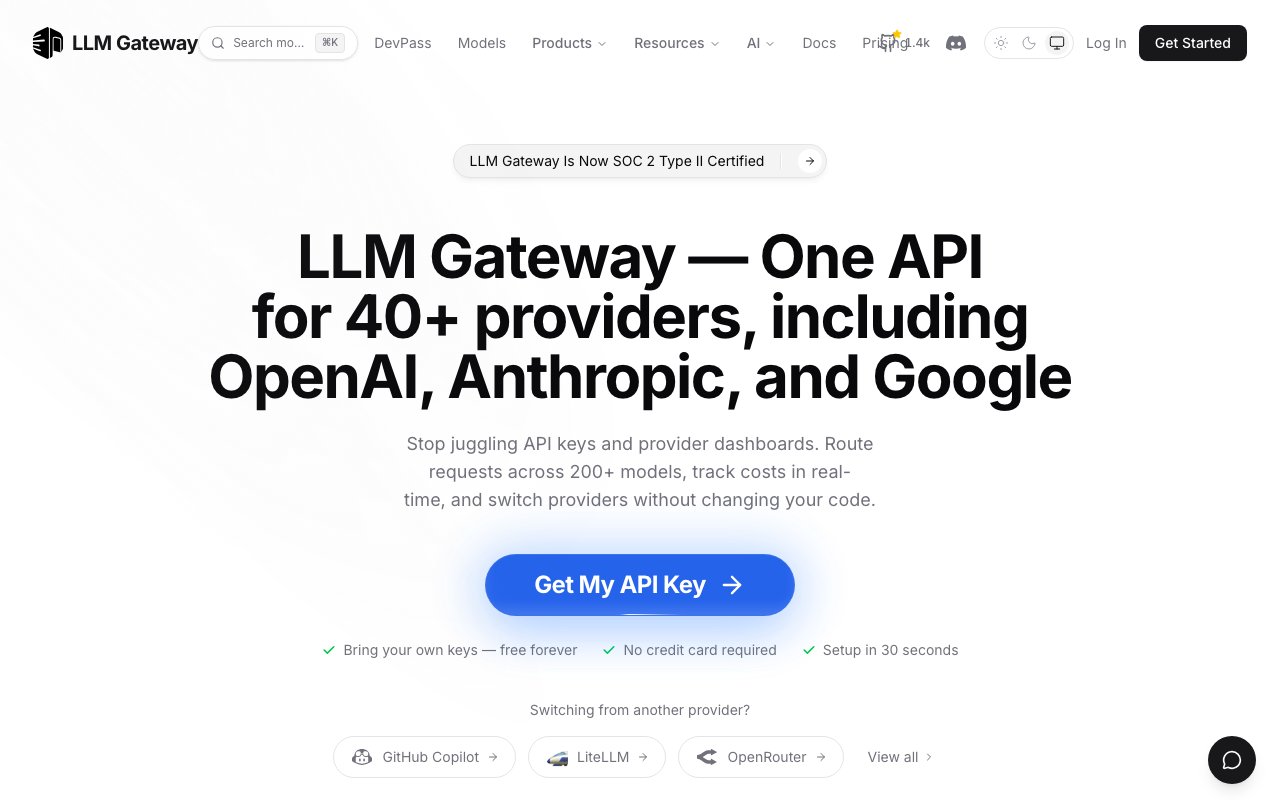
LLM Gateway is a routing layer that sits between your application and the dozens of language model providers you might want to use. Instead of integrating with OpenAI, Anthropic, Google, and others separately, maintaining different SDKs and juggling credentials across dashboards, you point your existing OpenAI SDK at LLM Gateway and gain access to over 200 models from more than 40 providers through a single endpoint. The integration is minimal. You change your base URL, keep your existing code, and everything else works the way it did before. The difference is that now you can switch models or providers without touching your application logic. This matters when you want to test a new model against your production workload, or when you need to route around an outage without scrambling to rewrite code.
The problem it solves is both practical and financial. Managing multiple API keys, dashboards, and billing accounts across providers is overhead that grows with every new model you want to test. When OpenAI releases a new version, you need to update your integration. When Anthropic changes their API, you need to handle that separately. When you want to compare Claude against GPT-4 against Gemini on your actual workload, you need three different setups. LLM Gateway collapses all of that into one integration point. More critically, when one provider goes down, your application typically goes down with it. LLM Gateway routes requests to healthy providers in real time and fails over automatically when something breaks. The math they cite is that individual providers average around 94% uptime, which sounds fine until you calculate that it works out to roughly 22 days of downtime per year. By combining providers through a routing layer, aggregate uptime climbs to 99.9999%, which is less than a minute of downtime annually. For applications where uptime matters, this is the difference between a minor incident and a major outage.
Beyond reliability, the dashboard gives you cost and performance visibility that would otherwise require stitching together data from every provider. You can compare latency, token usage, and spending across models over rolling seven or thirty day windows. The analytics surface which models are costing you the most, which are responding fastest, and where your spend is concentrated. For teams running production workloads, this kind of visibility usually requires building internal tooling. Here it comes built in. There are guardrails that catch prompt injection attempts and flag personally identifiable information before requests leave your system. These guardrails run on every request, which means you get baseline security without writing custom validation logic. For teams that need compliance records, audit logs track every request with the detail that enterprise security reviews expect.
Deployment is flexible in a way that matters for different kinds of organizations. You can use the managed cloud version, which handles infrastructure and scaling for you. Or you can self-host the entire thing on your own infrastructure under an AGPLv3 license at no cost. Self-hosting means your requests never touch a third party, which matters if you are working with sensitive data, operating in a regulated environment, or simply prefer to keep everything in house. The open source option is a genuine full product, not a limited community edition missing the features that make the paid version useful. You get the same routing, analytics, and guardrails whether you pay or self-host. This is a meaningful distinction from competitors that gate features behind paid tiers or offer stripped-down community editions.
Pricing on the managed side works a few ways. You can buy credits with a 5% fee on top of the underlying provider rates, which is the simplest path if you do not want to manage your own keys. Or you can bring your own API keys and route through LLM Gateway for free, paying only what the providers charge directly. The bring-your-own-keys approach means there is no markup on model costs, just free routing and analytics. Enterprise plans add custom SLAs, dedicated infrastructure, and volume discounts for organizations running at scale. The company is SOC 2 Type II certified, which checks the compliance box for larger organizations that cannot adopt tools without that audit trail.
LLM Gateway fits developers and teams building AI applications who do not want to be locked into a single provider and who value the ability to switch models or providers without rewriting integration code. It also appeals to anyone who has been burned by provider outages and wants automatic failover without building it themselves. The product adds new models within 48 hours of their public launch, so you are not waiting weeks to experiment with the latest release from any vendor. If a new model drops and you want to test it against your production workload, you can do that the next day without writing new integration code. The combination of free BYOK routing, full-featured self-hosting, and rapid model support makes it a practical choice for teams that want flexibility without the overhead of managing multiple provider integrations directly.
Key Features
- Unified API for 200+ models across 40+ providers
- Automatic failover to healthy providers
- Real time cost and latency analytics
- Self-hosted option under AGPLv3 license
- Prompt injection and PII guardrails
- Enterprise audit logging and SOC 2 certification
Pros & Cons
What we like
- Single integration replaces dozens of provider setups
- Full self-hosting option with no feature restrictions
- Bring your own keys means no markup on provider rates
- New models added within 48 hours of launch
Room for improvement
- 5% fee on credits if not using your own API keys
- Self-hosting requires infrastructure management
- Reliance on a routing layer adds a dependency
- Dashboard learning curve for teams new to multi-provider setups
Frequently Asked Questions
What is LLM Gateway?
Is LLM Gateway free?
Can I self-host LLM Gateway?
Who is LLM Gateway for?
Best For
Featured in
Alternatives to LLM Gateway
View all
Reviews (8)
Exactly what I needed
Found LLM Gateway on a Show HN thread and I am glad I clicked. The automatic failover to healthy providers is more useful than I expected. Setup was painless and I was productive the same day. Found it works best for routing ai requests across multiple providers through one endpoint. Worth it for what I get out of it.
Finally something that fits
Tried LLM Gateway on a side project first, then rolled it out everywhere. Where it really wins is enterprise audit logging and soc 2 certification. Glad I made the switch.
Exactly what I needed
Hadn't planned on switching, but LLM Gateway was hard to ignore. Their take on unified api for 200+ models across 40+ providers is genuinely good. It has shaved real time off my week.
Powerful once it clicks
Tried LLM Gateway on a side project first, then rolled it out everywhere. The defaults are sensible, so I was not fighting settings on day one. Mostly using it for comparing model performance and cost across vendors. It would be a five if not for self-hosting requires infrastructure management. Glad I made the switch.
Two months in, no regrets
Hadn't planned on switching, but LLM Gateway was hard to ignore. Their take on new models added within 48 hours of launch is genuinely good. Support actually answered when I had a question, which surprised me.
Decent with some rough edges
Hadn't planned on switching, but LLM Gateway was hard to ignore. Got real value out of bring your own keys means no markup on provider rates. Mostly using it for routing ai requests across multiple providers through one endpoint. One thing that bugs me is self-hosting requires infrastructure management. Worth it for what I get out of it.
Recommended without reservation
Found LLM Gateway on a Show HN thread and I am glad I clicked. Support actually answered when I had a question, which surprised me. The defaults are sensible, so I was not fighting settings on day one. Would sign up again without thinking twice.
Powerful once it clicks
Hadn't planned on switching, but LLM Gateway was hard to ignore. The prompt injection and pii guardrails is more useful than I expected. It does what it says, which is rarer than it should be. One thing that bugs me is self-hosting requires infrastructure management. Hard to imagine going back to my old setup.
Badge builder
Add LLM Gateway to your website
Choose a badge style and size, preview it here, then copy the generated HTML. Badge images are self-contained SVGs and do not require an external script.

<a href="https://toolindex.net/tools/llmgateway?ref=badge" target="_blank" rel="noopener">
  <img src="https://toolindex.net/badge/llmgateway/medium.svg" alt="LLM Gateway - Listed on Tool Index" width="180" height="50" />
</a>How to use the badge
- 1. Pick the style, size, and theme that fit your layout.
- 2. Copy the generated HTML from the code block.
- 3. Paste it into your footer, homepage, or press page.
Standard badge available
The standard listing badge is available now. Score and circle badges are limited to tools currently ranked in the top 10 of a category.
Badge clicks return visitors to this profile with a referral tag so the source remains identifiable.
Related Tools

Apatero AI
The creator studio for AI image, video, audio, 3D, and avatars, now at apatero.ai.
Kevin Gabeci Toolkits
Seven AI toolkits for writing books, making music, cutting video, and building agents.

Warp
The modern terminal reimagined with AI and collaboration

Bolt.new
Prompt-to-deployed full-stack app inside the browser
Work on LLM Gateway? Request listing access or correction