Makra
Web extraction for AI agents that learns a page layout once and reuses it instead of re-running a model
Gallery
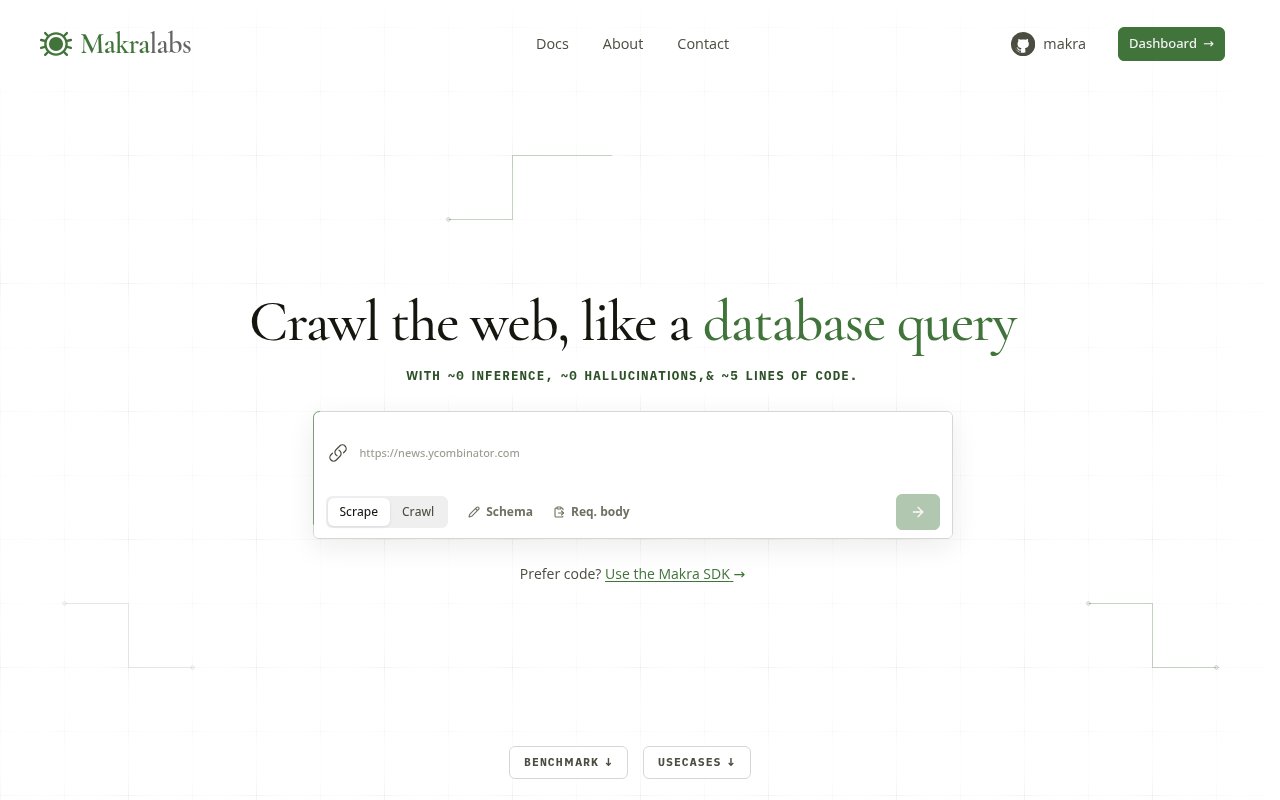
About Makra
Makra is a web data extraction service built for AI agents and the developers who wire them up. You give it a URL and a schema that names the fields you want, and it returns structured JSON, with no CSS selectors, no XPath and no DOM spelunking. Makra Labs describes it as a memory layer between the web and your agents, and the phrase is a fair summary of the design. It learns how a page is put together once and remembers, so the next hundred pages that share the layout don't need a model call each. The problem it goes after is the cost curve of AI scraping. Handing every page to a large language model and asking for the fields works, but it's slow, it's expensive at volume, and the model can hallucinate a value that was never on the page. Hand-written scrapers are cheap to run but break the moment a site changes its markup, and someone has to notice and fix them. Makra sits between those two failure modes by confining model inference to structural learning and repair rather than spending it on every extraction.
The mechanics are split into a cold path and a warm path. On a cold visit the AI maps the page layout, works out where each requested field lives, and stores those structural bindings as a learned page-class model. On later visits the service reads the live HTML through the stored map without repeating inference, checks algorithmically that the map still covers the rendered page, and uses a model-driven visual verification to confirm the extracted values. When a site drifts, coverage drops, and Makra scopes relearning to the uncovered structure instead of starting over. Returned values stay as strings read from the document, which is how it keeps invented data out of the output. It renders JavaScript pages, follows pagination up to a page limit you set, handles infinite scroll and linked pages, and can discover a page's schema for you when you don't yet know what's on it.
In practice you use it through the Python SDK, the JavaScript SDK or the dashboard. Both SDKs are MIT licensed on GitHub, take an API key from the dashboard, and offer blocking calls for scripts, streamed progress for live updates, and deferred runs for queues and background workers. Schemas support nested objects and lists. There's a web playground for trying an extraction before writing code, and the docs cover reliability, idempotency, quality validation and drift in the depth you'd want before putting it in production. The SDK is at version 0.0.4 beta, so expect the surface to keep moving for a while.
The production guidance is unusually specific for a beta. Requests are bounded by limits on body size, unique URLs, hosts, query depth, browser capacity, page work and model spend, and a query with too many leaves is truncated and reported as a warning rather than silently clipped. The service rejects local hosts, IP literals, credentials embedded in URLs, unsupported ports and malformed hosts, and the docs cover idempotent retries so a re-run doesn't double bill or duplicate rows. Deferred runs are the path for large jobs, with progress you can poll or stream, and the repo ships a language-neutral API specification alongside the SDKs plus a local playground for testing against a gateway. Python needs 3.9 or later and Node 18 or later.
It's for developers building agents or pipelines that need fresh structured data from public sites at volume. The site lists price and product monitoring, competitive intelligence, go-to-market signals like hiring and funding, talent tracking, supplier discovery and change monitoring as the jobs it has in mind. It's deliberately read-only. There's no action language for clicks and forms, it won't drive login flows or accept your cookies, and it refuses CAPTCHAs and access-denied pages, so interactive automation stays with a browser automation tool. The URL rules tell you the same thing from the other side, since it's built for the public web and nothing else.
Where it differs from a cached crawl is that what it stores is reusable comprehension rather than a page snapshot. A layout learned for title and price may already contain the bindings needed for a later request about reviews or availability, so the second question is cheap and the data is still live. The site's own cost comparison puts a single-page extraction at roughly $0.19 against $0.95 to $1.16 for the alternatives it names, and a 400 page run at $4.38 against $36.28 for Exa and $47.50 for Firecrawl. Those are the vendor's numbers, so treat them as a claim to test on your own pages rather than a settled fact.
Access is paid and metered. Billing is credit-based, each run carries a hold against your balance and can end in a budget exhausted state, and the docs advise persisting the usage and billing fields each run reports rather than hard-coding prices. No public price list or free allowance is published on the site, so signing up for a dashboard key is the way to see actual numbers. Questions go to ping@makralabs.org, and the code and community live on GitHub and X.
Key Features
- Schema-driven extraction without selectors
- Learned page maps reused across visits
- Structural and visual verification
- Python and JavaScript SDKs, MIT licensed
- Streaming and deferred run modes
- Pagination and schema discovery
Pros & Cons
What we like
- No selectors to write or maintain
- Model inference only on learning and repair, so repeat pages are cheap
- Values are read from the page, not generated
- Open SDKs with production-grade docs
Room for improvement
- Read-only, so logins, clicks and forms are out of scope
- No public price list or free allowance on the site
- SDK is still in beta at version 0.0.4
- Cost comparisons are the vendor's own benchmarks
Frequently Asked Questions
What is Makra?
Is Makra free?
How is Makra different from a scraper or Firecrawl?
Can Makra log in or click through a site?
Best For
Featured in
Alternatives to Makra

Kevin Gabeci
Solo developer building web apps, cozy browser games, and AI creator toolkits.

SoloDevStack
A solo developer blog built on head-to-head tool comparisons, 580+ posts deep.

Codedex
A gamified, story-driven platform that teaches Python, web dev, and more like an RPG quest
Vibe Built
Building real apps with agentic AI. What worked, what broke, what shipped.
Reviews (0)
Badge builder
Add Makra to your website
Choose a badge style and size, preview it here, then copy the generated HTML. Badge images are self-contained SVGs and do not require an external script.

<a href="https://toolindex.net/tools/makra?ref=badge" target="_blank" rel="noopener">
  <img src="https://toolindex.net/badge/makra/medium.svg" alt="Makra - Listed on Tool Index" width="180" height="50" />
</a>How to use the badge
- 1. Pick the style, size, and theme that fit your layout.
- 2. Copy the generated HTML from the code block.
- 3. Paste it into your footer, homepage, or press page.
Standard badge available
The standard listing badge is available now. Score and circle badges are limited to tools currently ranked in the top 10 of a category.
Badge clicks return visitors to this profile with a referral tag so the source remains identifiable.
Related Tools
Kevin Gabeci
Solo developer building web apps, cozy browser games, and AI creator toolkits.
Coolify
Self-hostable, open source alternative to Heroku and Netlify

Warp
The modern terminal reimagined with AI and collaboration

Bolt.new
Prompt-to-deployed full-stack app inside the browser
Work on Makra? Request listing access or correction