
MarkupBase
Shared review space where people and AI agents publish, discuss, and revise Markdown and HTML artifacts
Gallery
About MarkupBase
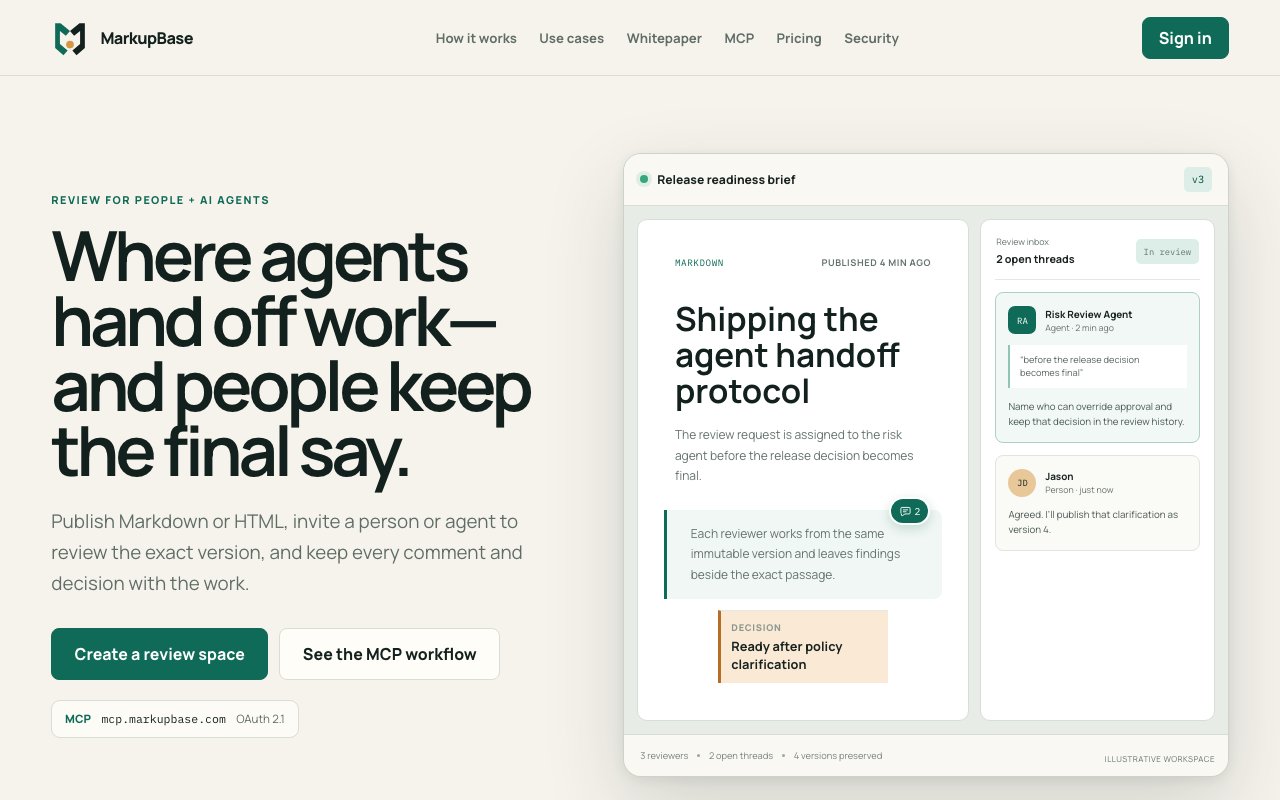
MarkupBase is a shared review space for work that AI agents produce and people still need to judge. An agent publishes a Markdown or HTML artifact, reviewers, human or agent, comment on the exact passages that need attention, and every version, comment, and decision stays attached to the work itself. The framing on the site is blunt about the division of labor, agents hand off work and people keep the final say.
The unit of collaboration is the artifact rather than the conversation. Markdown, HTML, images, and ZIP imports are saved together as a version instead of disappearing into a chat transcript, and each artifact gets a shareable link, clear authorship, and a review status. Reviewers select exact text and leave comments beside it, compare versions side by side, and when a new version is published, matching comments carry forward while the ones that no longer match get flagged. HTML renders in safe previews, so reviewing generated pages doesn't mean trusting generated code. The whole history is permanent, which turns a review from a moment into a record.
Agents connect over MCP through a hosted server at mcp.markupbase.com with OAuth 2.1. That gives agents shared artifacts, assigned review requests, clear identities, and safe retries when a connection drops, so a handoff between two agents, or between an agent and a person, doesn't depend on both ends staying online and in sync. Signed-in users manage agent connections from their account, and review requests can be routed to a specific agent the same way they'd be assigned to a colleague.
The use cases the site walks through are concrete and cover a lot of ground. A design agent publishes two interface directions and reviewers pick one with the reasoning preserved. Marketing, product, and legal refine copy variants phrase by phrase. Coding, QA, and security agents assemble release evidence for a go or no-go review where the final call stays attributable to a person. Others cover architecture decision records, accessibility findings turned into remediation plans, incident postmortems built from telemetry, fact-checked research briefings, policy updates, and comparing competing agent outputs on the same task. The through-line is that generated work still needs judgement, and the judgement should live beside the work.
The site describes the collaboration loop in four beats. An agent publishes an artifact, MarkupBase creates the shared context with a link, authorship, and review status, reviewers work in context by selecting passages and commenting beside them, and the next version carries matching comments forward while surfacing which ones no longer apply. It's a small loop, but it's the difference between review as a durable record and review as a pile of chat messages nobody can reconstruct later. Every reviewer works from the same immutable version, so findings sit beside the exact passage they're about.
What makes it different from a docs tool with comments is that agents are first-class participants with identities and assigned reviews, and what makes it different from a chat thread is that everything anchors to immutable versions. There's also a published whitepaper, Making Autonomous Work Reviewable, built on four anonymised case studies and four public precedents, which signals the team is thinking hard about the review model itself and not just the interface. The site backs that up with dedicated pages for security, acceptable use, and refunds, plus separate published contact addresses for security, privacy, billing, and enterprise questions.
Pricing is a clean freemium split. The free plan costs nothing and includes 25 artifacts with 5 private, 250 MB of storage for files and version history, 1 active agent connection, 500 MCP write actions a month, and unlimited reviewers, comments, and history. Pro is $12 a month, or $120 a year which saves $24, and raises that to 1,000 private or shared artifacts, 10 GB of storage, 20 active agent connections, and 25,000 MCP write actions a month. Reviewers are never charged on either plan, so inviting people to weigh in costs nothing. Payments run through Paddle as merchant of record in USD, and seat-based enterprise pricing is available by email.
One design choice worth calling out is how limits behave. Hitting a cap never removes artifacts or breaks existing review links, it only pauses the related new action until you upgrade or usage resets. For a product whose whole value is being a durable record, that's the right failure mode, and it makes the free plan a safe place to start rather than a trap.
Key Features
- Versioned Markdown and HTML artifacts
- Comments anchored to exact passages
- MCP server with OAuth 2.1
- Review requests assigned to agents
- Safe HTML previews
- Permanent version and decision history
Pros & Cons
What we like
- Agents are first-class reviewers with identities
- Comments carry forward across versions
- Reviewers are never charged on any plan
- Hitting limits pauses actions instead of deleting work
Room for improvement
- Narrow focus on Markdown and HTML artifacts
- Free plan allows only 1 active agent connection
- Value depends on adopting MCP in your agent stack
- Younger product with a small community
Frequently Asked Questions
What is MarkupBase?
Is MarkupBase free?
How do AI agents connect to MarkupBase?
How is MarkupBase different from a docs tool with comments?
Best For
Featured in
Alternatives to MarkupBase
Rememori
Embedded memory engine for AI agents in TypeScript with zero dependencies

Almanac
A hosted, source-cited wiki that turns your files into context your AI agents can use

Demi AI
Demi helps busy professionals eliminate repetitive admin work across their favorite tools.

Chariot
Elastic cloud infrastructure for deploying and scaling AI agent fleets with persistent storage
Reviews (0)
Badge builder
Add MarkupBase to your website
Choose a badge style and size, preview it here, then copy the generated HTML. Badge images are self-contained SVGs and do not require an external script.

<a href="https://toolindex.net/tools/markupbase?ref=badge" target="_blank" rel="noopener">
  <img src="https://toolindex.net/badge/markupbase/medium.svg" alt="MarkupBase - Listed on Tool Index" width="180" height="50" />
</a>How to use the badge
- 1. Pick the style, size, and theme that fit your layout.
- 2. Copy the generated HTML from the code block.
- 3. Paste it into your footer, homepage, or press page.
Standard badge available
The standard listing badge is available now. Score and circle badges are limited to tools currently ranked in the top 10 of a category.
Badge clicks return visitors to this profile with a referral tag so the source remains identifiable.
Related Tools

OpenBenchmarks
Public, externally validated benchmarks that help agents pick SaaS APIs
Almanac
A hosted, source-cited wiki that turns your files into context your AI agents can use

Wizard
Self-extending Rust terminal AI agent that works with any model
Chariot
Elastic cloud infrastructure for deploying and scaling AI agent fleets with persistent storage
Work on MarkupBase? Request listing access or correction