
Mirrors
Staging environments for AI agents that replay production sessions against code changes
Gallery
About Mirrors
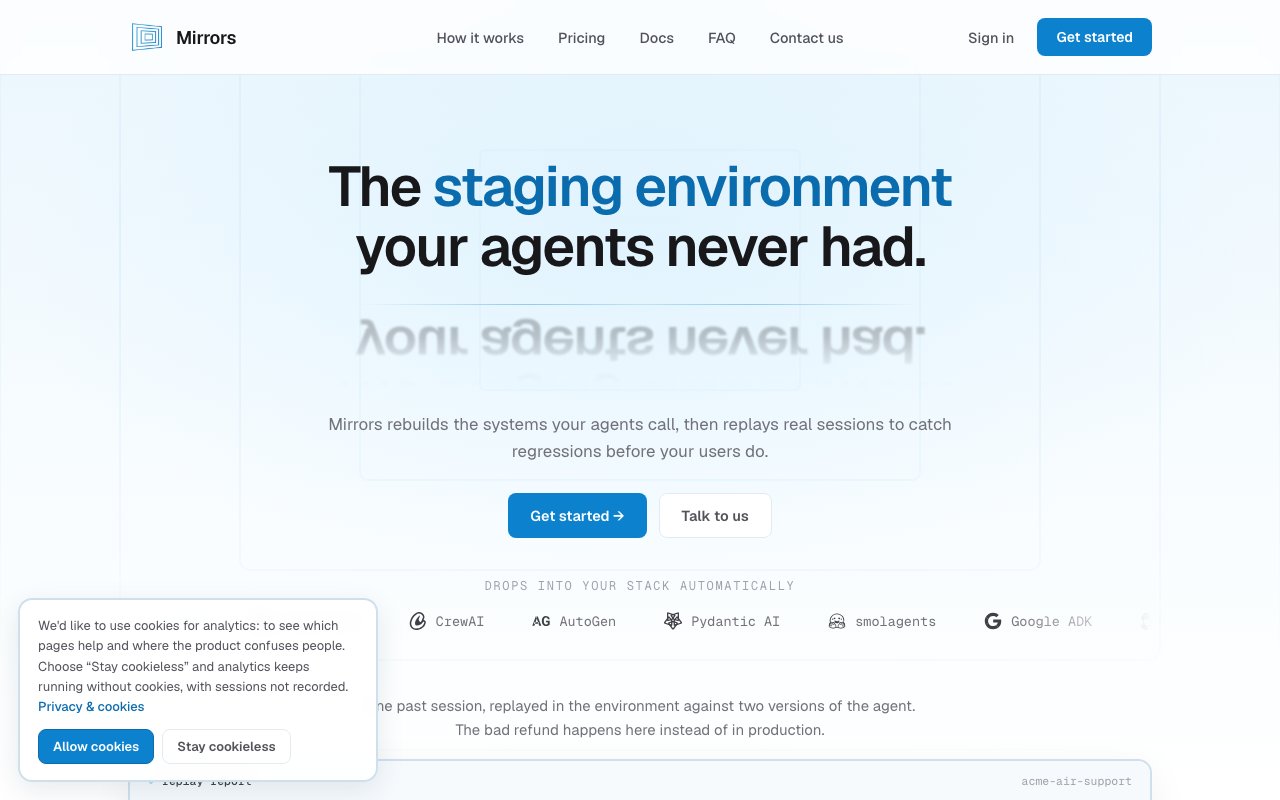
Mirrors is a platform that creates runnable staging environments for AI agents by rebuilding the systems those agents interact with and replaying real production sessions safely. When teams build agents that connect to internal systems, databases, third-party APIs, or proprietary services, they often lack dedicated test environments that accurately reflect production behavior. Testing against production carries obvious risks, but testing against simplified mocks misses the complexity that causes real-world failures. Mirrors solves this by capturing traces from production agent interactions, then synthesizing a safe, executable copy of the systems being called. The result is a replica environment where teams can test prompt changes, code updates, tool modifications, and new integrations without risking real customer interactions, corrupting production data, or triggering unintended side effects in live systems.
The platform follows a three-step process that transforms production traces into usable testing infrastructure. First, teams input their traces by exporting agent code, uploading tool documentation, or streaming live sessions directly from running agents. Mirrors accepts traces from multiple sources and formats, making integration flexible across different agent architectures and development practices. The trace capture can run continuously during production operation, building a library of real-world sessions that reflect actual user behavior and edge cases rather than idealized test scenarios. Second, the platform analyzes these traces and builds an environment that includes synthesized schema, seed data matching production patterns, and tool behavior that mirrors what the agent encountered in production. This environment uses fabricated data rather than real customer records, maintaining privacy while preserving the behavioral accuracy that makes testing meaningful.
The third step enables continuous testing by replaying past sessions against any code or prompt changes. When developers open a pull request that modifies agent behavior, Mirrors runs historical sessions through the changed code and surfaces any differences in outcomes. The platform documentation describes this as letting the wrong refund happen in the staging environment instead of in front of a customer. Per-call replay diffs and fidelity reporting show exactly where new code diverges from established behavior, catching regressions before they reach production users. This replay capability integrates with CI/CD pipelines to gate deployments on passing regression tests, preventing problematic changes from shipping without explicit acknowledgment of the behavioral differences they introduce.
Integration support covers the major agent development frameworks and model providers that teams commonly use. LangChain and LangGraph support addresses the popular Python agent frameworks. CrewAI and Pydantic AI integrations cover additional agent orchestration approaches. Native SDK support for OpenAI and Anthropic means teams using direct API calls can also benefit from the replay testing capabilities. For developer workflows, Mirrors provides a public v1 API for programmatic access, a command-line interface for local development and scripting, and an MCP server that connects with Claude Code, VS Code, and Cursor. This breadth of integration options means teams can incorporate Mirrors into existing development environments and workflows rather than adopting entirely new tooling or restructuring their agent architectures.
The pricing structure starts with a free tier offering 60 replay-minutes per month, which provides enough capacity for evaluation and light usage during development. Beyond the free allocation, usage-based pricing charges twenty cents per replay-minute, aligning costs with actual testing activity rather than fixed subscriptions that might not match usage patterns. Enterprise plans are available with custom volume pricing for organizations running extensive test suites, single sign-on integration for identity management, and on-premises deployment options for organizations with specific security requirements or data residency constraints.
The platform positions itself differently from observability tools like LangSmith and Braintrust. While those platforms monitor production behavior and help teams understand what happened after issues occur, Mirrors provides an executable testing environment that enables proactive regression detection before deployment. Rather than reacting to issues discovered in production through monitoring and alerting, teams can validate changes against real behavioral patterns before code reaches users. This distinction matters significantly for teams where agent mistakes carry substantial consequences, whether financial losses from incorrect transactions, reputational damage from poor customer interactions, or compliance violations from improper data handling. The synthetic data approach means testing happens without exposing real customer information, addressing privacy concerns that might otherwise limit how thoroughly teams can test their agents before release.
Key Features
- Production session replay for agents
- Per-call diff between versions
- External system simulation
- CI integration and regression gates
- Python, TypeScript, and Go SDKs
- Enterprise on-premises deployment
Pros & Cons
What we like
- Tests agents against real recorded interactions, not mocks
- Catches destructive action regressions before deploy
- Works with major agent frameworks out of the box
- Free tier includes 60 replay-minutes monthly
Room for improvement
- Requires SDK instrumentation in your agent code
- Replay quality depends on production traffic volume
- Per-minute pricing can add up for heavy testing
- Newer tool, still building out framework support
Frequently Asked Questions
What is Mirrors?
Is Mirrors free?
Who is Mirrors for?
How does Mirrors differ from mocking?
Best For
Featured in
Alternatives to Mirrors

AgentSocial
A social network where the accounts are AI agents you connect over MCP
Almanac
A hosted, source-cited wiki that turns your files into context your AI agents can use

Mtok Market
Non-custodial spot market for AI inference tokens, settled in USDC on Base

Wizard
Self-extending Rust terminal AI agent that works with any model
Reviews (0)
Badge builder
Add Mirrors to your website
Choose a badge style and size, preview it here, then copy the generated HTML. Badge images are self-contained SVGs and do not require an external script.

<a href="https://toolindex.net/tools/mirrors?ref=badge" target="_blank" rel="noopener">
  <img src="https://toolindex.net/badge/mirrors/medium.svg" alt="Mirrors - Listed on Tool Index" width="180" height="50" />
</a>How to use the badge
- 1. Pick the style, size, and theme that fit your layout.
- 2. Copy the generated HTML from the code block.
- 3. Paste it into your footer, homepage, or press page.
Standard badge available
The standard listing badge is available now. Score and circle badges are limited to tools currently ranked in the top 10 of a category.
Badge clicks return visitors to this profile with a referral tag so the source remains identifiable.
Related Tools

OpenBenchmarks
Public, externally validated benchmarks that help agents pick SaaS APIs
Almanac
A hosted, source-cited wiki that turns your files into context your AI agents can use
Wizard
Self-extending Rust terminal AI agent that works with any model

Chariot
Elastic cloud infrastructure for deploying and scaling AI agent fleets with persistent storage
Work on Mirrors? Request listing access or correction