
Murph
AI health assistant that runs self-experiments and group challenges with your wearable data
Gallery
About Murph
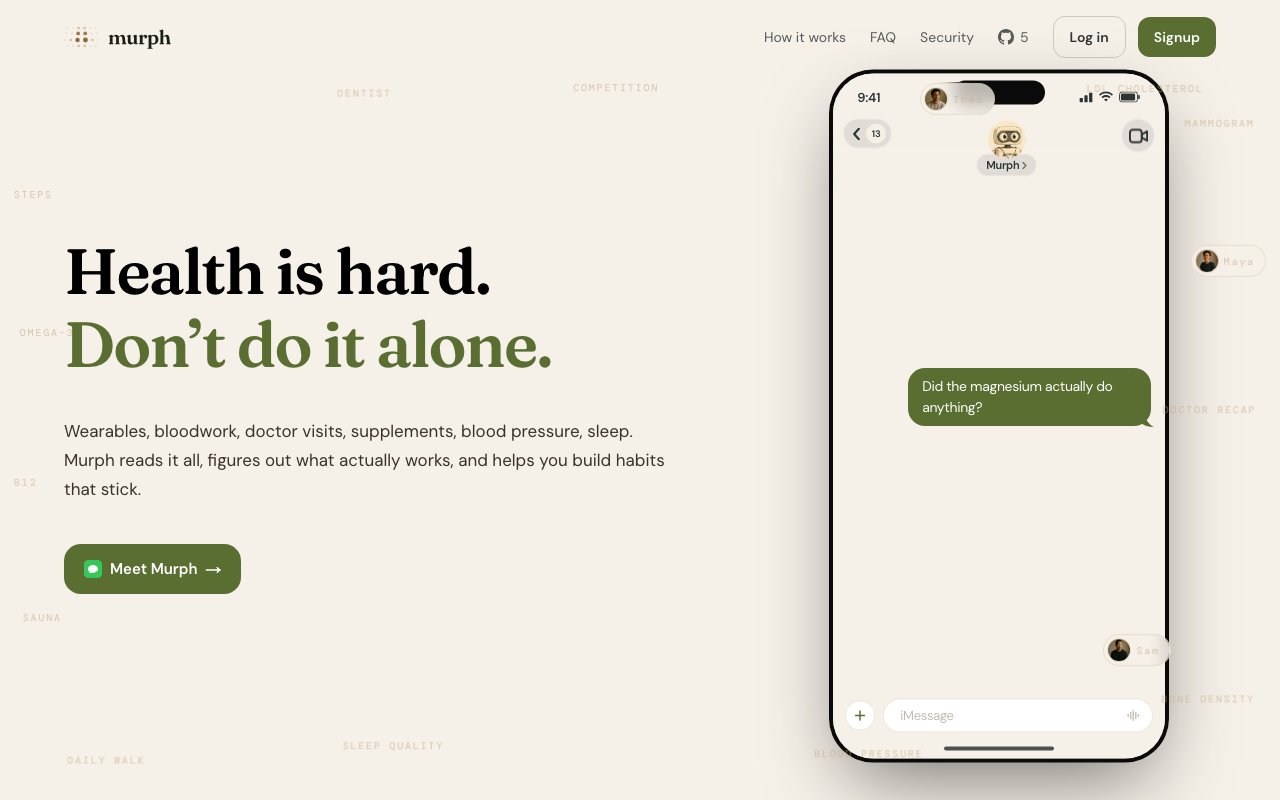
Murph is a personal health AI that helps you figure out what actually works for your body by running structured experiments and tracking results through your wearable data. You connect a device like an Oura ring, WHOOP band, Garmin watch, Apple Watch, or Fitbit, pick an experiment from the library, and Murph texts you updates as it collects baseline data, runs the active phase, and compares before and after results. The premise is that generic health advice rarely accounts for individual variation, and the only way to know if an intervention works for you is to measure it against your own data.
The experiment library covers six domains: sleep, recovery, nutrition, supplements, exercise, and breathwork. There are over 40 experiments to choose from, each grounded in published research. You are not just tracking habits passively. You are running something closer to an n-of-1 trial where your wearable serves as the measurement instrument. Want to test whether magnesium glycinate actually deepens your sleep? Murph baselines you for a week, has you take the supplement during the active phase, then shows you the percentage change in deep sleep compared to your own starting point. The same structure applies to protocols for cold exposure, fasting windows, meditation frequency, and dozens of other interventions that people talk about but rarely measure.
The AI handles the tedious work that makes most self-tracking fall apart. It sets the schedule so you do not have to remember when baseline ends and intervention begins. It sends reminders to log what you need to log. It watches your data as it comes in from your wearable. And it summarizes results in plain language when the experiment concludes, so you get a before and after comparison tied to your own biology instead of someone else's anecdote or a population average. If the results are ambiguous because the effect is small or the data is noisy, Murph will say so. If the effect is clear, you have numbers to back it up the next time someone asks why you are taking that supplement.
Beyond solo experiments, Murph supports group challenges. You start a health competition with friends in your group chat, and the app sets fair baselines across different devices, keeps score through the duration, nudges anyone who falls behind, and declares a winner at the end. This adds a social accountability layer that most health trackers lack. Solo tracking often loses momentum after the novelty fades. Having friends competing or collaborating gives you a reason to keep going even when you would otherwise forget to check your dashboard.
Other features round out the offering for people who want their wearable data to do more than sit in an app. Bloodwork analysis tracks lab results over time and flags trends worth asking your doctor about, turning annual physicals into a longitudinal dataset. Daily readouts pull overnight data from your wearable and summarize what matters that morning. Habit building anchors new behaviors to routines you already have, with reminders that ease off as the habit takes hold. Administrative help includes booking appointments, ordering supplements, and scheduling doctor recaps. There is even a weekly family newsletter feature for households tracking health together.
Communication happens over iMessage, Telegram, or email. There is no dedicated app to download. Everything lives in your messaging client, which simplifies onboarding but means the interface is conversational rather than visual. You ask questions, get responses, and receive proactive updates as experiments progress. If you prefer dashboards and charts over text messages, that is a tradeoff to consider. The flip side is that you never have to open another app to check your status.
Privacy is a stated priority. Data is encrypted at rest and explicitly never used to train AI models. The entire codebase is open source under Apache 2.0, and you can self-host if you want full control over where your health data lives. For everyone else, the hosted version runs at eight dollars a month with no contract and full data export whenever you want. You are not locked in, and you are not the product.
The target audience is quantified-self enthusiasts, biohackers, and anyone curious enough to test interventions instead of just hoping they work. If you already own a wearable and find yourself glancing at dashboards without knowing what to do with the numbers, Murph offers a structured way to turn that data into decisions. It is not a replacement for medical care and is clear about that. It is a tool for people who want to run personal experiments with a bit more rigor than guesswork.
The main limitation is the dependency on wearable devices. If you do not have an Oura, WHOOP, Garmin, Apple Watch, or Fitbit, most experiments will not work because there is no data to baseline. The service also starts at eight dollars a month with no free tier, so there is a cost barrier even to try it out and see if the interface suits you. For people already invested in the wearable ecosystem and willing to pay for something that makes productive use of their data, Murph fills a gap that few other tools address.
Key Features
- Structured self-experiments with baseline tracking
- Group health challenges with fair scoring
- Integration with Oura, WHOOP, Garmin, Apple Health, Fitbit
- Bloodwork analysis and trend flagging
- Conversational AI via iMessage, Telegram, or email
- Open source and self-hostable under Apache 2.0
Pros & Cons
What we like
- Turns generic health advice into personalized data points
- Group challenges add social accountability
- No app needed, works through messaging platforms
- Open source with self-hosting option for privacy
Room for improvement
- Requires a wearable device for most experiments
- No free tier, eight dollars a month from the start
- Messaging-only interface may feel limited
- Not a substitute for medical advice or diagnosis
Frequently Asked Questions
What is Murph?
How much does Murph cost?
What wearables does Murph support?
Is Murph open source?
Best For
Featured in
Alternatives to Murph
View all
Reviews (7)
Decent with some rough edges
Murph solves a real problem for me without making a fuss about it. Got real value out of turns generic health advice into personalized data points. The interface stays out of my way, which I appreciate. It would be a five if not for not a substitute for medical advice or diagnosis. Worth it for what I get out of it.
Genuinely impressed
Three months of Murph later, here is what holds up. The no app needed, works through messaging platforms is more useful than I expected. Performance has been steady even when I lean on it hard. Worth it for what I get out of it.
Genuinely impressed
Three months of Murph later, here is what holds up. Support actually answered when I had a question, which surprised me. Performance has been steady even when I lean on it hard. Worth it for what I get out of it.
It just works
Started using Murph casually, now it is pinned in my dock. Support actually answered when I had a question, which surprised me. It fits well for testing whether a sleep supplement actually improves your deep sleep. No regrets so far.
Two months in, no regrets
Came to Murph after getting frustrated with what I had before. Got real value out of group challenges add social accountability. Mostly using it for building a morning routine anchored to existing habits. It earns its place in my stack.
Pulled its weight from week one
Came to Murph after getting frustrated with what I had before. The open source with self-hosting option for privacy is more useful than I expected. The defaults are sensible, so I was not fighting settings on day one. Would sign up again without thinking twice.
Solid daily driver
Found Murph on a Show HN thread and I am glad I clicked. Their take on bloodwork analysis and trend flagging is genuinely good. Support actually answered when I had a question, which surprised me. Found it works best for testing whether a sleep supplement actually improves your deep sleep. Hard to imagine going back to my old setup.
Badge builder
Add Murph to your website
Choose a badge style and size, preview it here, then copy the generated HTML. Badge images are self-contained SVGs and do not require an external script.

<a href="https://toolindex.net/tools/murph?ref=badge" target="_blank" rel="noopener">
  <img src="https://toolindex.net/badge/murph/medium.svg" alt="Murph - Listed on Tool Index" width="180" height="50" />
</a>How to use the badge
- 1. Pick the style, size, and theme that fit your layout.
- 2. Copy the generated HTML from the code block.
- 3. Paste it into your footer, homepage, or press page.
Standard badge available
The standard listing badge is available now. Score and circle badges are limited to tools currently ranked in the top 10 of a category.
Badge clicks return visitors to this profile with a referral tag so the source remains identifiable.
Related Tools
Apatero AI
The creator studio for AI image, video, audio, 3D, and avatars, now at apatero.ai.
Kevin Gabeci Toolkits
Seven AI toolkits for writing books, making music, cutting video, and building agents.

Warp
The modern terminal reimagined with AI and collaboration

Bolt.new
Prompt-to-deployed full-stack app inside the browser
Work on Murph? Request listing access or correction