
N3MO
Automated PR review that maps code dependencies and calculates the blast radius of every change
Gallery
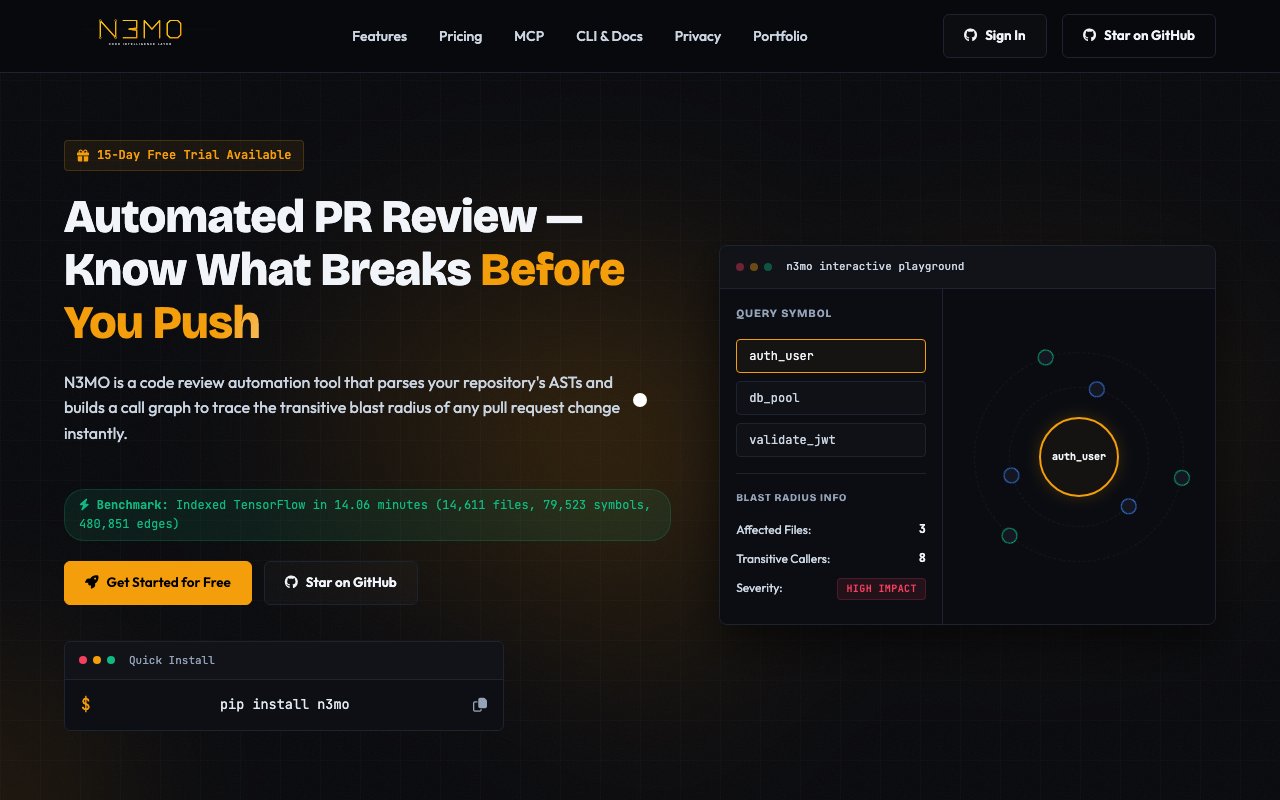
About N3MO
N3MO is a code review automation platform that analyzes pull requests to identify potential breaking changes before they reach production. The tool parses repository ASTs and builds a call graph to trace what it calls the transitive blast radius of any code change, revealing both direct and indirect downstream impacts across service layers. For engineering teams working on complex codebases, this kind of automated impact analysis can prevent the all too common scenario where a seemingly minor change breaks something three layers deep that nobody thought to check. The traditional approach of relying on institutional knowledge or hoping the test suite catches everything has obvious failure modes, particularly as teams grow and original authors leave. What worked when three people knew the entire codebase falls apart at scale.
The core technology works by recursively tracing function call chains to arbitrary depths. When a developer opens a pull request, N3MO intercepts the GitHub webhook, analyzes the changed code, and posts an impact report as a PR comment within about two seconds of submission. The report classifies affected dependencies by severity, giving reviewers a mathematical proof of what the change actually touches rather than relying on tribal knowledge or manual code archaeology. The system supports 27 languages through GitHub's Tree-sitter parser, with particularly deep semantic analysis for Python, JavaScript, TypeScript, and Java. Multi language repositories work fine since the call graph connects functions regardless of which language they're written in, which matters for shops running polyglot stacks where a TypeScript frontend calls a Python backend through a Go API gateway.
Staff engineers managing legacy monoliths will find the dependency mapping especially valuable when planning refactors. Instead of spending hours tracing call paths manually or discovering broken integrations after deployment, teams can see the full impact surface before approving any merge. The tool also functions as a Model Context Protocol server, which means AI coding tools like Cursor, Claude Desktop, and Windsurf can query it for deterministic code structure context rather than relying on fuzzy vector embeddings. This makes it useful not just for human reviewers but for autonomous coding agents that need reliable knowledge graphs to reason about changes. The MCP integration essentially gives AI tools a structured understanding of your codebase that goes beyond what context window stuffing can provide, enabling smarter suggestions that account for downstream consequences.
N3MO uses repository based pricing rather than per seat licensing, which changes the economics for larger teams significantly. The Standard tier runs nineteen dollars monthly for one repository up to thirty thousand lines of code. Pro costs sixty nine dollars monthly for three repositories up to three hundred thousand lines and includes a fifteen day free trial so you can evaluate the tool on your actual codebase before committing. Team tiers scale from one hundred ninety nine dollars for five repositories and a million lines of code up to three hundred ninety nine dollars for seven repositories and three and a half million lines. Enterprise agreements cover unlimited repositories and lines with custom pricing. Crucially, unlimited team members can access indexed repositories without additional licenses, so adding reviewers or giving the whole engineering org access never increases cost. That model encourages broad adoption rather than restricting access to a few expensive seats, which defeats the purpose of a tool meant to improve review quality across the team.
Privacy gets serious attention in the architecture. SaaS deployments analyze code in memory on ephemeral runners without storing source files, addressing concerns about sending proprietary code to third party services. Nothing persists after analysis completes. Enterprise customers can run the entire system on premises within their VPC for complete isolation from any external infrastructure. The team has benchmarked performance by successfully indexing TensorFlow's fourteen thousand plus files and nearly half a million call graph edges in roughly fourteen minutes, demonstrating that the tool scales to very large real world codebases without crawling. A local CLI tool provides interactive dependency graphs and impact query capabilities for developers who prefer working outside the browser or need offline access to their code structure. The combination of speed, depth, and team friendly pricing positions N3MO as infrastructure for shops where code review has become a bottleneck, where breaking changes slip through more often than leadership would like to admit, or where the bus factor on critical systems makes automated dependency knowledge essential rather than optional.
Key Features
- Transitive blast radius analysis across call chains
- Multi-language support via Tree-sitter for 27 languages
- GitHub PR comments with impact reports
- MCP server for AI coding assistants
- Local CLI with Docker-based AST indexing
- Repository-based pricing for unlimited team access
Pros & Cons
What we like
- Shows indirect impacts that standard reviews miss
- Posts impact reports to PRs in about two seconds
- Integrates with AI agents via MCP for deterministic context
- Self-hosted option keeps code inside your network
Room for improvement
- Deepest support limited to Python, JS, TS, and Java
- Requires GitHub integration or local Docker setup
- Younger product with a smaller community
- Pricing can climb quickly for large multi-repo teams
Frequently Asked Questions
What is N3MO?
How does N3MO handle code privacy?
Is N3MO free?
What languages does N3MO support?
Best For
Featured in
Alternatives to N3MO

Kevin Gabeci
Solo developer building web apps, cozy browser games, and AI creator toolkits.

SoloDevStack
A solo developer blog built on head-to-head tool comparisons, 580+ posts deep.

Codedex
A gamified, story-driven platform that teaches Python, web dev, and more like an RPG quest
Vibe Built
Building real apps with agentic AI. What worked, what broke, what shipped.
Reviews (0)
Badge builder
Add N3MO to your website
Choose a badge style and size, preview it here, then copy the generated HTML. Badge images are self-contained SVGs and do not require an external script.

<a href="https://toolindex.net/tools/n3mo?ref=badge" target="_blank" rel="noopener">
  <img src="https://toolindex.net/badge/n3mo/medium.svg" alt="N3MO - Listed on Tool Index" width="180" height="50" />
</a>How to use the badge
- 1. Pick the style, size, and theme that fit your layout.
- 2. Copy the generated HTML from the code block.
- 3. Paste it into your footer, homepage, or press page.
Standard badge available
The standard listing badge is available now. Score and circle badges are limited to tools currently ranked in the top 10 of a category.
Badge clicks return visitors to this profile with a referral tag so the source remains identifiable.
Related Tools
Kevin Gabeci
Solo developer building web apps, cozy browser games, and AI creator toolkits.

Coolify
Self-hostable, open source alternative to Heroku and Netlify

Warp
The modern terminal reimagined with AI and collaboration

Bolt.new
Prompt-to-deployed full-stack app inside the browser
Work on N3MO? Request listing access or correction