
OpenWebSearch
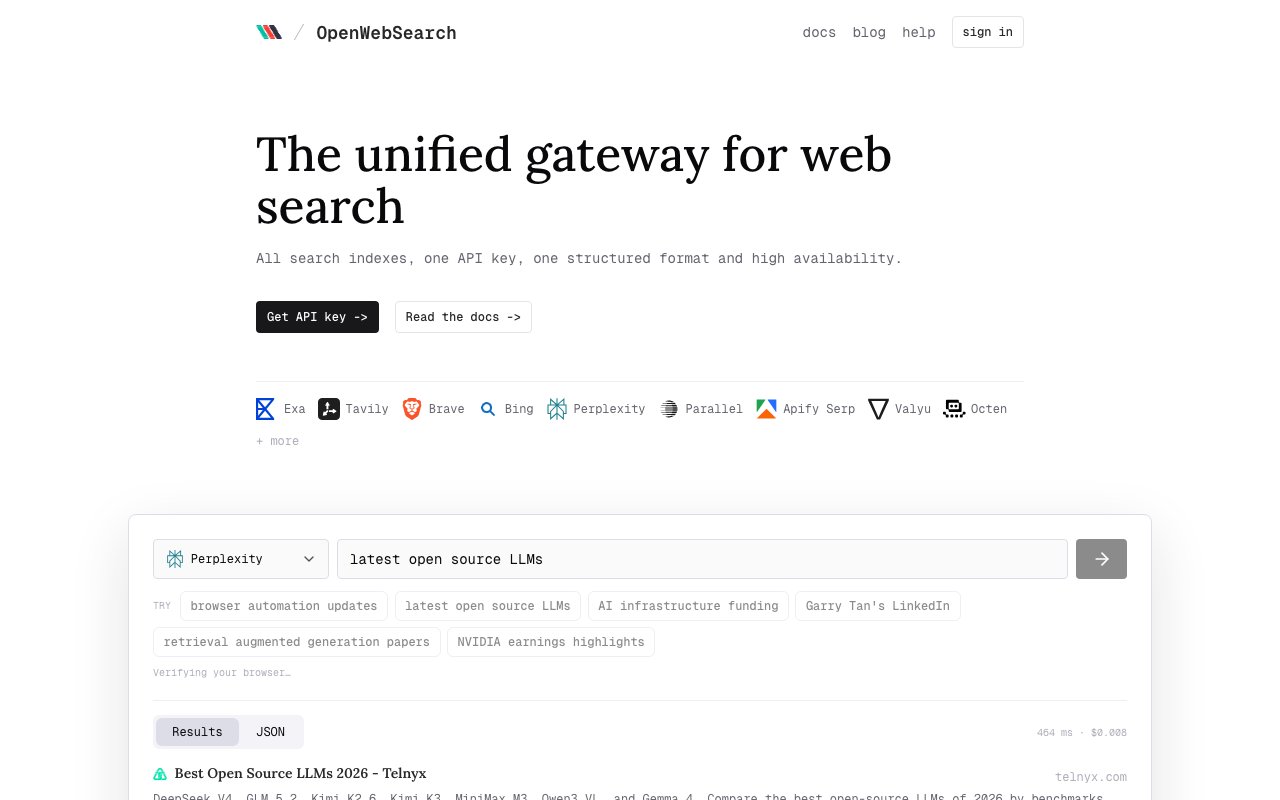
Unified API that routes queries to multiple web search providers with normalized results
Gallery
About OpenWebSearch
OpenWebSearch is a unified API gateway that routes web search queries to multiple providers through a single integration point. Instead of wiring up separate connections to Exa, Brave, Perplexity, Tavily, Apify, Parallel, Valyu, and others, you authenticate once with OpenWebSearch and send queries through their endpoint. The gateway normalizes the responses into a consistent format regardless of which underlying search index actually handled the request. The result is that you can swap providers by changing a single field in your request rather than rewriting your integration code.
The problem this solves becomes obvious once you've built anything that needs web search results. Each provider has its own API shape, its own authentication method, its own response structure, and its own pricing model. If you want to compare results between Exa and Brave, you need to build two integrations and normalize the outputs yourself. If one provider has an outage or you decide their quality doesn't meet your needs, switching means more development work. OpenWebSearch absorbs that complexity into the gateway layer so your application only talks to one API and the provider becomes a configuration choice rather than an architecture decision.
Every response comes back in the same normalized format with title, URL, snippet, and content fields. This consistency is particularly valuable for RAG pipelines and AI agents that need to feed search results into downstream processing. You don't have to write per-provider adapters or handle different field names and structures depending on which index returned the data. The response also includes usage and cost metadata so you can track exactly what each query cost without checking multiple dashboards or waiting for monthly billing reconciliation.
Automatic failover is built into the routing logic. You specify an ordered list of providers, and if your primary choice fails or degrades, the gateway automatically routes to the next provider on your list. This reduces downtime risk when you're building production systems that depend on search availability. The runtime endpoint reports which providers are currently available and any limits that apply, so you can make routing decisions programmatically based on real-time conditions rather than hoping your primary choice stays healthy.
Pricing follows a prepaid credit model rather than a monthly subscription. You purchase credits once and spend them across any provider on the platform. There's a five percent platform fee on credit purchases, which is how OpenWebSearch makes money on top of passing through provider costs. Per-request pricing ranges from about a dollar fifty to thirty dollars per thousand requests depending on which index you use. Providers with richer data or more sophisticated ranking tend to cost more, so you can optimize for cost or quality depending on your use case. There's no additional markup on individual searches beyond the credit cost, and no minimum commitment.
Privacy handling is explicit. Query text passes through the gateway but isn't retained. Only request metadata needed for billing gets stored, specifically the request ID, provider used, cost, and latency. If data retention matters to your compliance requirements, this is the kind of detail worth knowing. OpenWebSearch also supports web scraping capabilities through its parent platform, Interfaze AI, if you need full page content extraction rather than just search result snippets.
The target audience is developers building AI agents, retrieval-augmented generation pipelines, research automation, and any application that needs grounded web data. If you've been testing multiple search APIs and want a single integration that lets you swap between them without code changes, this is the abstraction layer that handles that routing. The output format is deliberately structured for RAG workflows, where you're feeding context windows to a language model and need clean, consistent input data.
Access is pay-as-you-go with no monthly commitment. For enterprise needs or volume pricing, sales contact is available through Interfaze AI. Most developers can start with a credit purchase and never need a sales conversation, which suits the typical pattern of testing a few queries before committing to a workflow. The tradeoff is that there's no free tier for experimentation, so you're buying credits before you see results. Providers like Bing and Octen are listed as coming soon, which suggests the supported provider list is still expanding.
Key Features
- Unified API key across multiple search providers
- Normalized response format for all results
- Automatic provider fallback on failure
- Per-request cost reporting in each response
- Zero query or result data retention
- RAG-ready output structure
Pros & Cons
What we like
- Swap providers by changing one field, not rewriting code
- Consistent response format simplifies parsing
- Built-in fallback reduces downtime risk
- Pay-as-you-go with no monthly subscription
Room for improvement
- Five percent platform fee on credit purchases
- Depends on upstream provider availability
- No free tier for testing before buying credits
- Focused on web search, not other data sources
Frequently Asked Questions
What is OpenWebSearch?
How much does it cost?
Does OpenWebSearch store my queries?
Who is it for?
Best For
Featured in
Alternatives to OpenWebSearch

Kevin Gabeci
Solo developer building web apps, cozy browser games, and AI creator toolkits.

SoloDevStack
A solo developer blog built on head-to-head tool comparisons, 580+ posts deep.

Codedex
A gamified, story-driven platform that teaches Python, web dev, and more like an RPG quest
Vibe Built
Building real apps with agentic AI. What worked, what broke, what shipped.
Reviews (0)
Badge builder
Add OpenWebSearch to your website
Choose a badge style and size, preview it here, then copy the generated HTML. Badge images are self-contained SVGs and do not require an external script.

<a href="https://toolindex.net/tools/openwebsearch?ref=badge" target="_blank" rel="noopener">
  <img src="https://toolindex.net/badge/openwebsearch/medium.svg" alt="OpenWebSearch - Listed on Tool Index" width="180" height="50" />
</a>How to use the badge
- 1. Pick the style, size, and theme that fit your layout.
- 2. Copy the generated HTML from the code block.
- 3. Paste it into your footer, homepage, or press page.
Standard badge available
The standard listing badge is available now. Score and circle badges are limited to tools currently ranked in the top 10 of a category.
Badge clicks return visitors to this profile with a referral tag so the source remains identifiable.
Related Tools
Kevin Gabeci
Solo developer building web apps, cozy browser games, and AI creator toolkits.

Coolify
Self-hostable, open source alternative to Heroku and Netlify

Warp
The modern terminal reimagined with AI and collaboration

Bolt.new
Prompt-to-deployed full-stack app inside the browser
Work on OpenWebSearch? Request listing access or correction