OutageDeck
Track 172 cloud and SaaS vendor status feeds in one dashboard with instant outage alerts
Gallery
About OutageDeck
OutageDeck is a status aggregation platform that pulls together the official status feeds of 172 cloud and SaaS providers into a single view. When your app depends on AWS, Stripe, OpenAI, GitHub, and half a dozen other services, debugging an outage means opening twelve browser tabs and squinting at twelve different status pages. OutageDeck does that scanning for you every ten minutes and tells you whether the problem is yours or theirs. The list of tracked vendors spans cloud infrastructure like AWS, Azure, Google Cloud, and DigitalOcean, development tools like GitHub, GitLab, and Docker, AI services like OpenAI, Anthropic, and Replicate, communications platforms like Slack, Twilio, and Discord, databases like MongoDB Atlas, Snowflake, and Neo4j, plus analytics and monitoring tools like Datadog, New Relic, and Grafana. If a major SaaS or cloud provider publishes a status feed, chances are OutageDeck is already reading it.
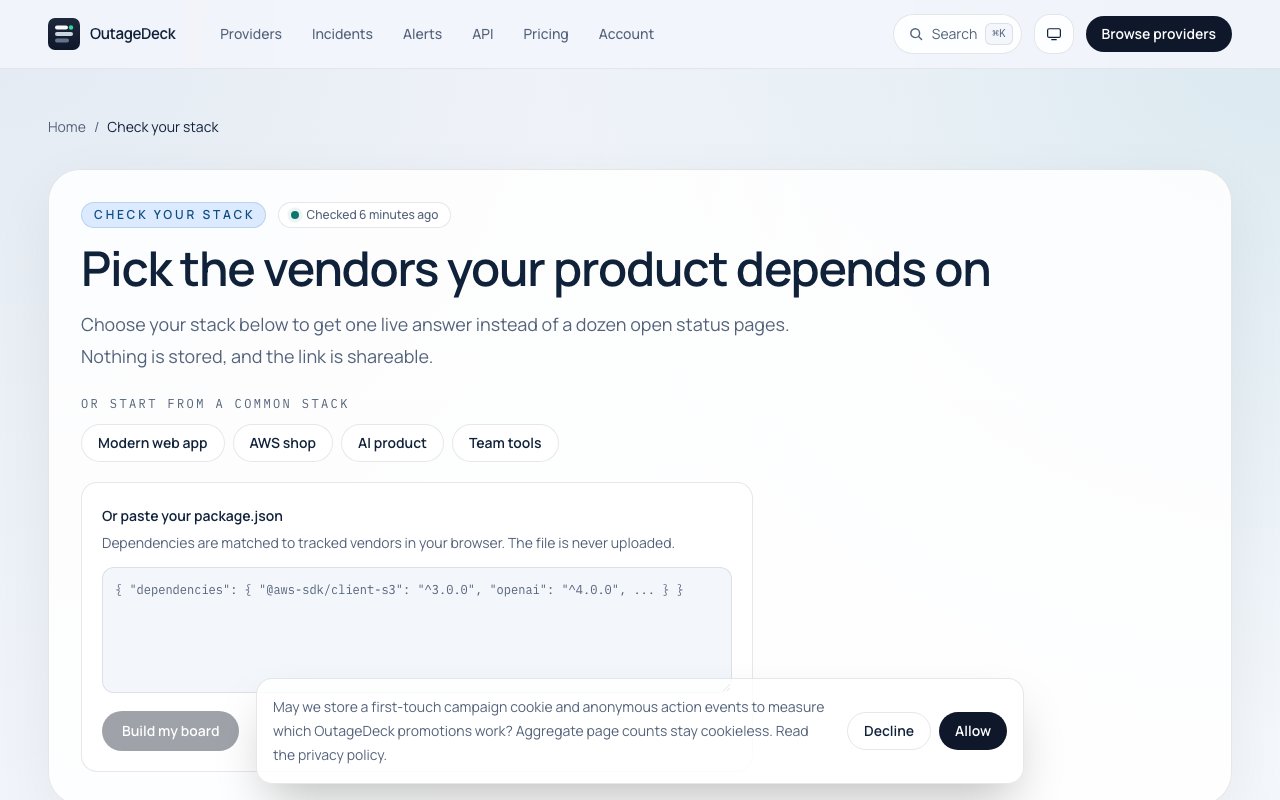
The core workflow is simple. You pick the vendors your product relies on, up to twelve for a quick stack check, and OutageDeck shows their current status side by side. The selections are shareable via URL but nothing is stored permanently unless you create an account. Pre-built templates cover common setups like a modern web app stack with Vercel, Supabase, GitHub, and Cloudflare, an AWS-heavy deployment, an AI product stack relying on inference APIs, or a team collaboration setup. Developers can also paste a package.json and let the platform match dependencies to tracked vendors automatically. That feature alone saves the manual work of figuring out which status pages matter for your codebase.
Beyond the dashboard, OutageDeck offers a public JSON API with anonymous access at 120 requests per hour and authenticated access up to 5,000 requests per hour on higher plans. There is also an MCP server designed for AI coding agents, so tools like Claude Code or Cursor can query vendor status mid-task before wasting time debugging code that is not actually broken. Embeddable status badges let teams surface vendor health in README files, wikis, or internal dashboards. An incident RSS feed provides real-time updates, and the platform archives past incidents so you can look back at what went down and when. That historical record is useful for post-mortems and for spotting patterns in which vendors tend to have issues at the same time.
Paid plans unlock alerts over Slack, Teams, Discord, webhooks, and email, with rules that let you specify which vendors and severity levels should ping which channels. Custom provider tracking lets you add internal services or niche vendors the platform does not cover out of the box, including authenticated feeds for private status pages. The Business tier supports multiple API keys with custom quotas, which suits agencies or MSPs managing many client stacks and distributing access to their own teams.
The service fits DevOps teams, incident responders, and developers who manage multi-vendor stacks. If you have ever wasted half an hour wondering whether your code is broken or Cloudflare is having a bad day, this is the gap it closes. Agencies and MSPs managing many client stacks can use the higher tiers to monitor dozens of custom endpoints and get hands-on onboarding support. Even solo developers benefit from the free tier, which covers email alerts for five providers and read-only API access with no card required.
Where OutageDeck stands apart from generic uptime monitors is focus. It is not pinging your servers. It is reading what each vendor says about themselves and presenting that in a single place, with history and alerts layered on top. That means you get the official story without building scrapers yourself, and you can point a finger at the right vendor faster. The MCP server integration is particularly forward-looking, letting AI coding agents check vendor health programmatically rather than relying on a human to remember to look.
Pricing starts at free, which covers email alerts for up to five providers plus read-only API access at 120 requests per hour. Starter at $19 per month adds Slack, Teams, Discord, and webhook alerts with five alert rules, two custom providers, and an API key at 1,000 requests per hour. Pro at $49 per month bumps that to twenty alert rules, ten custom providers including authenticated feeds, 5,000 requests per hour, and priority integration support. Business at $199 per month targets agencies with fifty alert rules, thirty custom providers, multiple API keys with custom quotas, and hands-on onboarding. Annual billing at $190, $490, or $1,990 per year knocks two months off each tier. A fourteen-day money-back guarantee applies to every paid plan, and Paddle handles payments including VAT and sales tax.
Key Features
- Unified dashboard for 172 vendor status feeds
- Package.json dependency matching
- Slack, Teams, Discord, and webhook alerts
- Public JSON API and MCP server
- Embeddable status badges for README files
- Custom provider tracking for internal services
Pros & Cons
What we like
- Consolidates 172 official vendor feeds in one view
- Free tier covers email alerts for up to five providers
- API and MCP server let agents query status programmatically
- Package.json import auto-maps dependencies to tracked vendors
Room for improvement
- Status data refreshes roughly every ten minutes, not real-time
- Stack check limited to twelve vendors at once
- Custom provider tracking only available on paid plans
- Focused on SaaS status, not general uptime monitoring
Frequently Asked Questions
What is OutageDeck?
Is OutageDeck free?
Who is OutageDeck for?
How often does OutageDeck update status?
Best For
Featured in
Alternatives to OutageDeck

Kevin Gabeci
Solo developer building web apps, cozy browser games, and AI creator toolkits.

SoloDevStack
A solo developer blog built on head-to-head tool comparisons, 580+ posts deep.

Codedex
A gamified, story-driven platform that teaches Python, web dev, and more like an RPG quest
Vibe Built
Building real apps with agentic AI. What worked, what broke, what shipped.
Our take
Tool Index Editorial · Oct 2026· 4.0/5
OutageDeck puts the official status feeds for 180 cloud and SaaS providers into one board, with shareable stack views, package.json matching, history, badges, RSS, an API, and alerts. We found the no-account stack check immediately useful for separating a vendor incident from an application bug. The free plan includes email alerts for five providers and anonymous API access.
It polls official feeds about every ten minutes, so it can only be as fast and candid as the vendors it watches. It is not a replacement for monitoring a team's own services, and the quick board tops out at 12 providers. Paid alerting starts at $19 per month, with $49 Pro adding more rules, private feeds, and a higher API quota. As a dependency-status layer alongside real observability, it earns its place.
Editorial opinion from the Tool Index team, written from the public product pages. Not a user review.
Reviews (0)
Badge builder
Add OutageDeck to your website
Choose a badge style and size, preview it here, then copy the generated HTML. Badge images are self-contained SVGs and do not require an external script.

<a href="https://toolindex.net/tools/outagedeck?ref=badge" target="_blank" rel="noopener">
  <img src="https://toolindex.net/badge/outagedeck/medium.svg" alt="OutageDeck - Listed on Tool Index" width="180" height="50" />
</a>How to use the badge
- 1. Pick the style, size, and theme that fit your layout.
- 2. Copy the generated HTML from the code block.
- 3. Paste it into your footer, homepage, or press page.
Standard badge available
The standard listing badge is available now. Score and circle badges are limited to tools currently ranked in the top 10 of a category.
Badge clicks return visitors to this profile with a referral tag so the source remains identifiable.
Related Tools
Kevin Gabeci
Solo developer building web apps, cozy browser games, and AI creator toolkits.
Coolify
Self-hostable, open source alternative to Heroku and Netlify

Warp
The modern terminal reimagined with AI and collaboration

Bolt.new
Prompt-to-deployed full-stack app inside the browser
Work on OutageDeck? Request listing access or correction