
Pairel
A production-ready Compose dating app template with reusable Kotlin components
Gallery
About Pairel
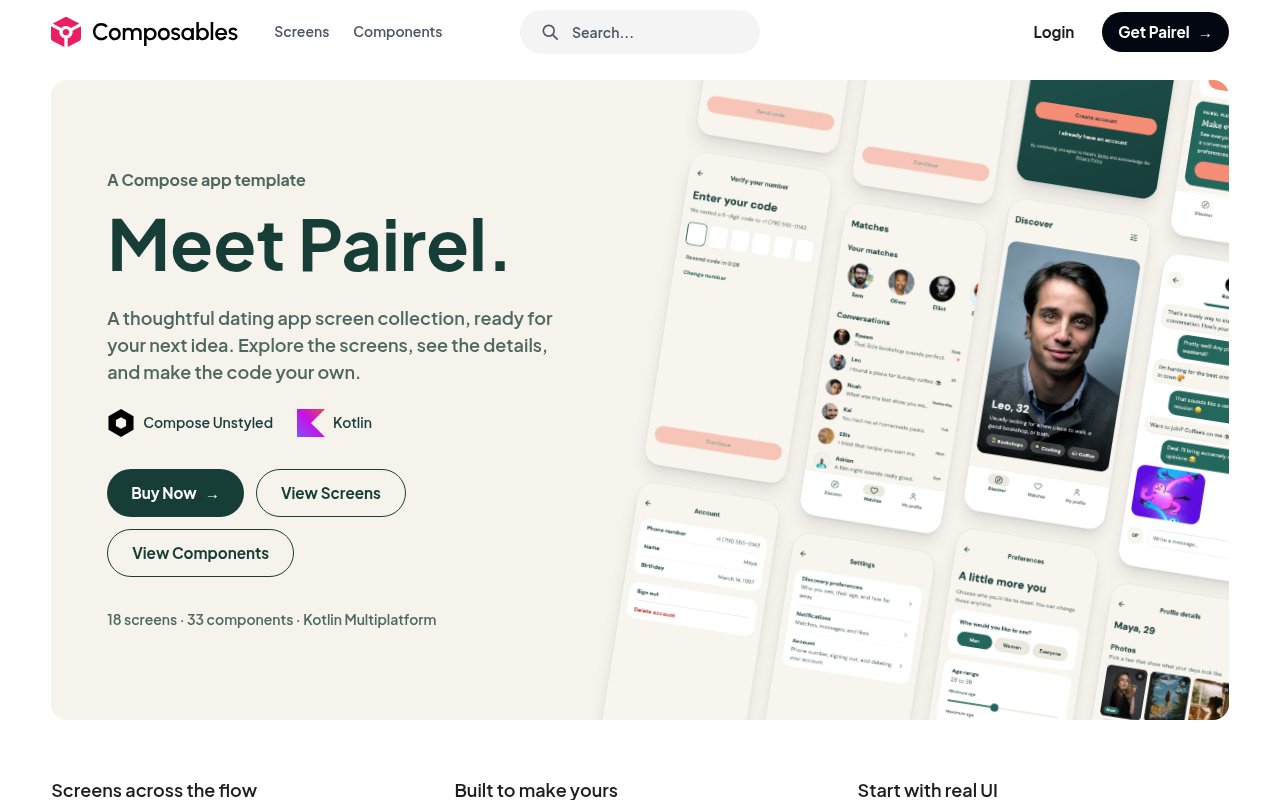
Pairel is a paid app template for developers who want a substantial starting point for a dating or social discovery product built with Compose. It packages 18 screens and 33 reusable components into a coherent Kotlin Multiplatform collection, covering the product flow from onboarding and profile creation through discovery, matching, conversations, membership, notifications, and account settings. The value isn't a generic mood board or a folder of disconnected snippets. It is editable source designed to give a real native app project a working visual foundation while leaving product logic and branding in the buyer's hands. That is a material head start.
The collection tackles the slow, repetitive part of mobile product work. A dating experience needs far more than a profile card. It needs phone verification, preference controls, profile editing, match views, chat, subscription surfaces, settings, and the small controls that make those screens feel related. Pairel brings those pieces together under a shared theme, with mock content and navigation callbacks so developers can inspect the flow and connect it to their own services. Every screen can also be browsed on the site before purchase, which makes it easier to judge coverage and visual fit before committing.
The component set reaches below whole screens. It includes app bars, buttons, cards, checkboxes, chips, dialogs, drawers, dropdown menus, text fields, sliders, tab groups, tooltips, sheets, progress indicators, and other common interface pieces. Because the original Compose source is included, teams can change colors, typography, spacing, behavior, and structure rather than treating the design as a fixed export. Kotlin Multiplatform support also gives the template relevance beyond a single Android screen mockup, though buyers still need to integrate their own data, authentication, messaging, payments, moderation, analytics, and backend services.
Pairel fits an independent developer validating a mobile idea, a product team replacing rough prototypes with credible native screens, or an agency that needs to accelerate a client build. It is especially practical when the intended product shares the same broad interaction patterns as dating, matchmaking, member discovery, or profile-led communities. Teams with an established design system may use it more selectively, borrowing individual screens or controls rather than adopting the complete visual language. Developers should still expect normal engineering work around state, navigation, accessibility, testing, platform behavior, and third-party dependencies.
Its clearest distinction is scope paired with inspectability. The public catalog exposes the 18 screens by flow and the 33 components by interface type, so the purchase isn't a vague promise of a starter kit. The screens are intended to work together, and the license allows modification and use in unlimited personal, commercial, and client applications. A paid license is tied to the developers who access the material, not to customers who use a finished app. The license does not allow redistribution as another template, component collection, design kit, or app builder, and third-party assets remain subject to their own terms.
The template should be evaluated as a head start, not a substitute for product design decisions. A buyer gets a consistent reference implementation and can keep, restyle, or remove each piece, but the resulting app still needs a distinct brand and careful choices about safety, privacy, accessibility, and user trust. Dating products in particular depend on reporting, moderation, consent, location handling, and secure account controls that sit outside a visual template. Pairel's public materials promise the interface source rather than those operational systems, which keeps the offer clear but also defines where the team's work begins.
Access is paid through a one-time purchase. The Pro license costs $79 for one developer, while the $199 Team license covers up to five developers in the purchasing organization. Both include the full Pairel app template, individual screens, components, source files, a commercial license, and future Pairel updates without an automatic renewal. Free materials on Composables have narrower noncommercial terms and should not be confused with the paid Pairel package. There is no broad free tier for the full template and the seller does not offer discretionary refunds, so reviewing the public screen and component catalog first is sensible.
Key Features
- 18 connected app screens
- 33 reusable Compose components
- Original Kotlin source files
- Shared theme and styling
- Mock content and callbacks
- Commercial project license
Pros & Cons
What we like
- Covers a complete dating app flow
- Source is editable and reusable
- Public previews clarify what is included
- One-time purchase includes future updates
Room for improvement
- Focused on dating and profile-led products
- Backend services require separate implementation
- No free tier for the full template
- Developer seats are licensed individually
Frequently Asked Questions
What is Pairel?
Is Pairel a complete working dating service?
Can Pairel be used in commercial and client apps?
How much does Pairel cost?
Best For
Featured in
Alternatives to Pairel
View all
Kevin Gabeci
Solo developer building web apps, cozy browser games, and AI creator toolkits.

SoloDevStack
A solo developer blog built on head-to-head tool comparisons, 580+ posts deep.

Codedex
A gamified, story-driven platform that teaches Python, web dev, and more like an RPG quest

Vibe Built
Building real apps with agentic AI. What worked, what broke, what shipped.
Our take
Tool Index Editorial · Oct 2026· 3.5/5
Composables turns focused Jetpack Compose examples into interactive previews that can be shared or embedded in documentation. We found the code, rendered result, build output, dependency catalog, and Maven Central search well aligned with the needs of library authors and educators. Readers can switch between code, preview, and split views without setting up Android Studio.
The service is free with unlimited previews, though saving and sharing require an account. Its scope is deliberately narrow and it won't replace a full Android project environment. Embedded demos also depend on a script hosted by Composables, which may not suit strict security policies or long term archival needs. Within those bounds, it solves a real documentation problem cleanly.
Editorial opinion from the Tool Index team, written from the public product pages. Not a user review.
Reviews (0)
Badge builder
Add Pairel to your website
Choose a badge style and size, preview it here, then copy the generated HTML. Badge images are self-contained SVGs and do not require an external script.

<a href="https://toolindex.net/tools/pairel?ref=badge" target="_blank" rel="noopener">
  <img src="https://toolindex.net/badge/pairel/medium.svg" alt="Pairel - Listed on Tool Index" width="180" height="50" />
</a>How to use the badge
- 1. Pick the style, size, and theme that fit your layout.
- 2. Copy the generated HTML from the code block.
- 3. Paste it into your footer, homepage, or press page.
Standard badge available
The standard listing badge is available now. Score and circle badges are limited to tools currently ranked in the top 10 of a category.
Badge clicks return visitors to this profile with a referral tag so the source remains identifiable.
Related Tools
Kevin Gabeci
Solo developer building web apps, cozy browser games, and AI creator toolkits.

Coolify
Self-hostable, open source alternative to Heroku and Netlify

Warp
The modern terminal reimagined with AI and collaboration

Bolt.new
Prompt-to-deployed full-stack app inside the browser
Work on Pairel? Request listing access or correction