
Piyaz
Shared workspace that keeps your team and AI coding agents aligned as software projects grow
Gallery
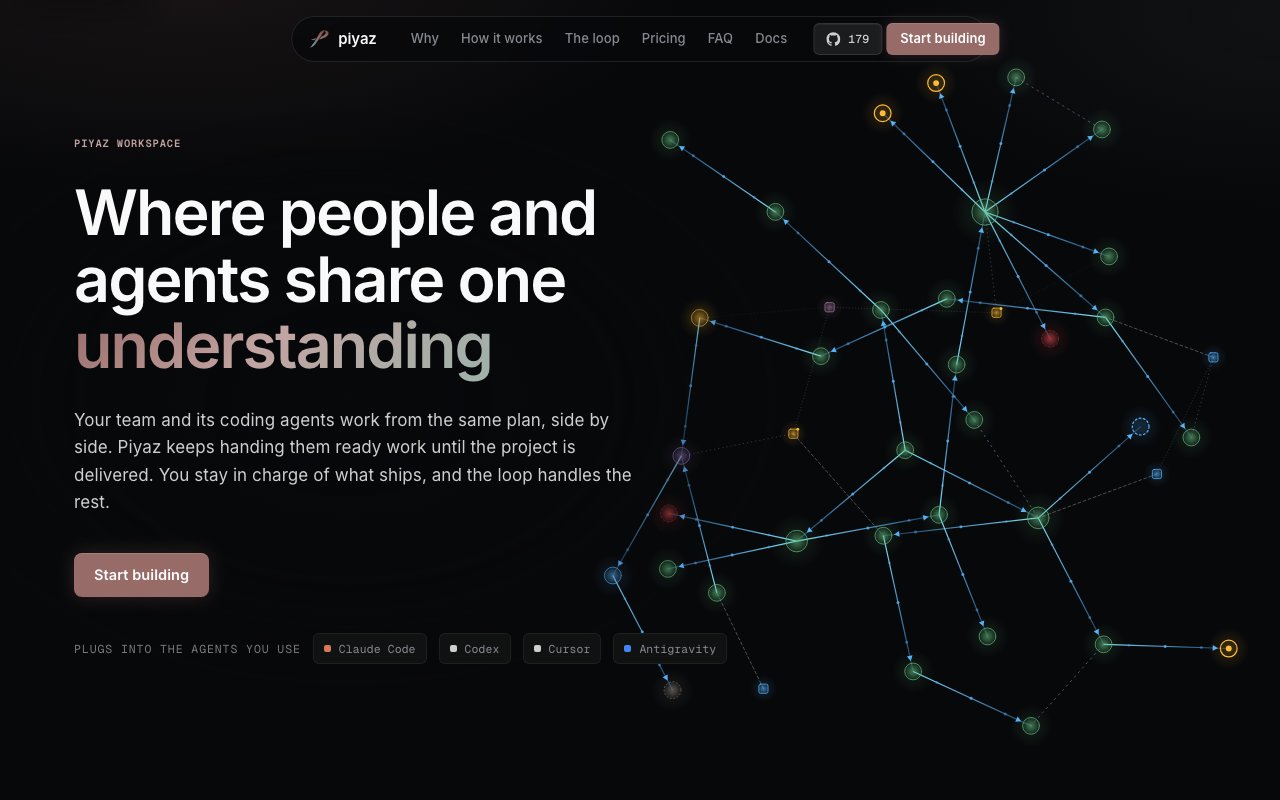
About Piyaz
Piyaz is a collaborative workspace for teams that use AI coding agents. The problem it tackles is context drift. When multiple people and multiple agents work on the same codebase, decisions get lost between sessions, agents redo or undo each other's work, and the project plan lives only in someone's head. Piyaz keeps that context persistent and shared so everyone, human or agent, sees the same briefs, the same decisions, and the same definition of done. The platform functions as a bridge between human developers and the AI tools they direct, maintaining structure that would otherwise evaporate when a conversation window closes. If you have ever restarted a Claude Code session and watched it redo work from yesterday because it had no memory of what was already finished, this is the problem Piyaz exists to solve.
Each task in Piyaz carries its own structured brief that includes scope, dependencies, decision history, and what counts as complete. Agents read the brief before they start, and updates flow back into the record so the next session picks up where the last one left off. That continuity prevents the common failure mode where an agent spends an hour redoing work that was already done in a previous session because it had no memory of it. The platform breaks projects into clear, interdependent pieces and ensures that a person and an agent never land on the same task at the same time, enabling parallel execution only for independent work. When tasks do depend on each other, the dependency graph makes that explicit so agents do not start work before prerequisites are done.
The platform also maintains a shared knowledge base split into three layers. Guidance contains rules that always apply, like coding standards, architectural constraints, or domain terminology. References hold decision details and domain knowledge that agents pull when needed, such as why a particular library was chosen or how a certain edge case should be handled. Learnings capture patterns agents discover during execution, like a better approach to a recurring problem or a gotcha that caused a failed build. Agents can propose additions to the knowledge base, but humans must approve before anything becomes permanent. That approval gate keeps the system from drifting based on one agent's misunderstanding or hallucination.
The workflow moves through a four-step loop that Piyaz calls The Loop. Planning defines the work pieces and their dependencies. Execution assigns tasks to agents or humans. Review evaluates results against the brief and flags anything that fell short. Fixes address the gaps. In Claude Code, a Composer feature can run the entire cycle autonomously while humans retain final approval authority over what ships to production. That balance lets teams benefit from autonomous execution without losing control over outcomes. The human approval gate is the hard stop that keeps agents from shipping broken code or architectural mistakes without oversight.
Agents integrate through the Model Context Protocol, so Claude Code, Codex, Cursor, and Antigravity can all connect to the same project. Piyaz provides no inference itself. You bring your own models, and the platform handles coordination, context, and knowledge surfacing. It does not require dedicated API keys beyond what your agents already use. The workspace is hosted at app.piyaz.ai with no installation needed, and self-hosting is available since the codebase is open source under AGPL-3.0. That open-source status matters for teams that need to run sensitive projects on their own infrastructure or want to audit the code before trusting it with their project context.
The service fits development teams using AI assistants who need more structure than a chat window provides. If you have tried running multiple agents on the same project and found them stepping on each other or duplicating effort, this is the gap it closes. It also helps teams that rotate members frequently or onboard new contributors who need to absorb past decisions quickly. The structured briefs and knowledge base serve as institutional memory that survives turnover. New agents or humans can read the context and start contributing without a long verbal onboarding.
Where Piyaz differs from generic task boards or project management tools is the agent-native design. Briefs are structured so agents can parse them programmatically, not just humans scanning text. The knowledge base is surfaced through MCP rather than copied into prompts, which keeps context current without manual intervention. That makes the coordination between humans and agents systematic rather than ad hoc. You are not just writing tickets for humans and hoping agents figure them out. You are writing structured context that agents consume directly.
The platform is currently in beta and entirely free, with all features included. Paid plans are planned but no pricing or timeline has been announced. There is no freemium gate or artificial limitation during the beta period. Everything from workspace management to team collaboration to MCP integrations is available at no cost. For teams already using AI coding agents and feeling the pain of context loss, Piyaz offers a structured way to solve it without building custom tooling from scratch.
Key Features
- Structured task briefs with scope and dependencies
- Shared knowledge base for agents and humans
- Model Context Protocol integration
- Composer for autonomous planning and review
- Decision history tied to each task
- Open source under AGPL-3.0
Pros & Cons
What we like
- Prevents agents from undoing each other's work
- Free beta with all features included
- Open source and self-hostable
- Integrates with Claude Code, Codex, Cursor, and Antigravity
Room for improvement
- Beta product with no paid support tier yet
- No inference included, bring your own models
- Learning curve for teams new to agent workflows
- Paid pricing not yet announced
Frequently Asked Questions
What is Piyaz?
Is Piyaz free?
Which AI agents does Piyaz support?
Who is Piyaz for?
Best For
Featured in
Alternatives to Piyaz

Kevin Gabeci
Solo developer building web apps, cozy browser games, and AI creator toolkits.

SoloDevStack
A solo developer blog built on head-to-head tool comparisons, 580+ posts deep.

Codedex
A gamified, story-driven platform that teaches Python, web dev, and more like an RPG quest
Vibe Built
Building real apps with agentic AI. What worked, what broke, what shipped.
Reviews (0)
Badge builder
Add Piyaz to your website
Choose a badge style and size, preview it here, then copy the generated HTML. Badge images are self-contained SVGs and do not require an external script.

<a href="https://toolindex.net/tools/piyaz?ref=badge" target="_blank" rel="noopener">
  <img src="https://toolindex.net/badge/piyaz/medium.svg" alt="Piyaz - Listed on Tool Index" width="180" height="50" />
</a>How to use the badge
- 1. Pick the style, size, and theme that fit your layout.
- 2. Copy the generated HTML from the code block.
- 3. Paste it into your footer, homepage, or press page.
Standard badge available
The standard listing badge is available now. Score and circle badges are limited to tools currently ranked in the top 10 of a category.
Badge clicks return visitors to this profile with a referral tag so the source remains identifiable.
Related Tools
Kevin Gabeci
Solo developer building web apps, cozy browser games, and AI creator toolkits.
Coolify
Self-hostable, open source alternative to Heroku and Netlify

Warp
The modern terminal reimagined with AI and collaboration

Bolt.new
Prompt-to-deployed full-stack app inside the browser
Work on Piyaz? Request listing access or correction