
Polygres
Postgres for the agent era with native graph and vector search in one instance
Gallery
About Polygres
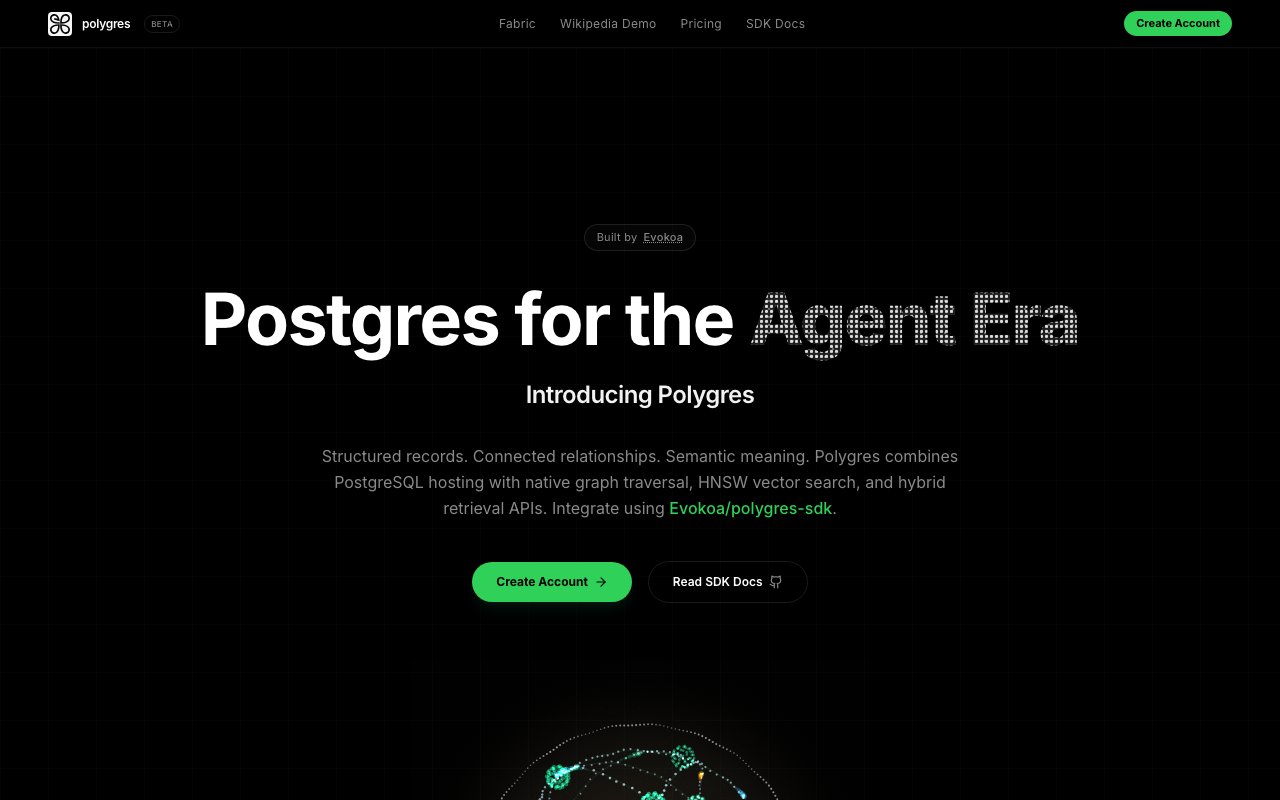
Polygres is Postgres built for the agent era, bundling a full PostgreSQL 17 database with native graph and vector search so retrieval-heavy applications can run against one system instead of three. Rather than gluing a graph database and a vector store onto your relational data and keeping them all in sync, you get relationships, embeddings, and ordinary SQL living side by side in the same Postgres. The idea is that the database an agent reasons over should already understand both connections and meaning, not just rows and columns.
The problem it targets shows up whenever you try to build serious retrieval for an AI application. Your facts live in relational tables, the relationships between entities carry real meaning, and you also want semantic similarity over text, so most teams end up running Postgres plus a graph engine plus a vector database and writing brittle plumbing to reconcile them. Every write has to fan out to three systems, and every read has to stitch their answers back together, which is where bugs and stale data creep in. Polygres folds all three into one instance so the data doesn't have to be copied across systems that drift apart over time.
It works by combining two extensions on top of standard Postgres. pgGraph adds native relationship modeling and graph traversal, so you can follow connections between entities without hand-writing the recursive SQL those queries usually demand and without a separate graph server to run. pgVector provides HNSW vector indexing for fast similarity search with scalar filtering, so semantic lookups stay quick even at scale and you can still constrain them with ordinary WHERE clauses. Because both live in the same database, a single query can walk relationships and rank by embedding similarity together in one pass.
The headline capability is hybrid retrieval. You can blend a graph traversal and a vector search in one query and get back results with a weighted score that combines graph proximity and semantic similarity. That means an agent can ask for the things most closely related to a starting point and most similar in meaning at once, and have the ranking handled inside the database rather than reassembled in application code afterward. Tuning the weights lets you lean more on structure or more on meaning depending on the question, without changing where the data lives.
There's more than one way in. A Python SDK published as polygres-sdk covers programmatic use, an HTTP REST API suits anything that speaks JSON, and because it's still Postgres underneath, ordinary Postgres-compatible clients and plain SQL work too. That mix makes it approachable whether you're wiring it into an agent framework, calling it from a backend service, or just poking at it from a SQL console to see how a query behaves. Nothing forces you to adopt a new query language you don't already know.
It's aimed at developers and teams building AI agents and retrieval-augmented apps that need to reason over structured relationships as well as unstructured text. Anyone who has watched a vector-only setup miss obvious relational context, or a graph-only setup ignore semantic nearness, is the target audience. Keeping everything in Postgres also means the operational knowledge, backups, and tooling a team already has still apply, so there's no new database to learn to run in production alongside everything else.
A concrete way to picture it is an agent that needs memory with structure. The entities it tracks, the people, documents, and events, have real relationships worth following, and the text attached to them is worth searching by meaning. With Polygres those two needs land in the same place, so a lookup can start from a known entity, walk out to what's connected, and rank the neighborhood by how semantically close each item is to the question. Pulling that off across a separate graph database and vector store means keeping two indexes in sync and merging their results by hand, which is precisely the plumbing this is trying to delete. Because the whole thing is standard Postgres with two extensions, the same instance still serves ordinary relational queries for the rest of your application.
Polygres is open source and permanently free to self-host, with pgGraph and pgVector running on your own Postgres instance and the code available on GitHub. A managed cloud sits alongside it for teams that would rather not operate it, and during the beta that managed tier is free and comes with fifty dollars in credits. Paid plans start at five dollars a month for individuals and ninety-nine a month for production teams with higher limits, priority support, and guaranteed uptime, with custom enterprise pricing above that. The project is still in beta and actively looking for design partners, so it's early, but the self-hostable core means you're never locked into the hosted path.
Key Features
- PostgreSQL 17 with graph and vector
- pgGraph native relationship traversal
- pgVector HNSW similarity search
- Hybrid graph-plus-vector weighted ranking
- Python SDK, REST API, and SQL
- Self-hosted or managed cloud
Pros & Cons
What we like
- Graph, vector, and SQL in one Postgres instance
- Open source and permanently free to self-host
- Hybrid queries ranked inside the database
- Works with existing Postgres clients and tooling
Room for improvement
- Still in beta and looking for design partners
- Managed cloud pricing is early and may change
- Value depends on how relational your data already is
- Younger project with a smaller community
Frequently Asked Questions
What is Polygres?
Is Polygres open source?
Is Polygres free?
Who is Polygres for?
Best For
Featured in
Alternatives to Polygres
MongoDB Atlas
The fully-managed cloud version of MongoDB with built-in search, vector search, time series, and serverless tiers.

Neon
Serverless Postgres with database branching, scale-to-zero compute, and a generous free tier.

Airtable
Spreadsheet-database hybrid with linked records, multiple views, automations, and an interface designer for internal apps.

DataExpert.io Academy
Live and self-paced academy that trains you for real data engineering and AI jobs
Reviews (11)
It just works
Found Polygres on a Show HN thread and I am glad I clicked. What stands out is how it handles python sdk, rest api, and sql. It does what it says, which is rarer than it should be. It fits well for consolidating a graph store and vector store into postgres.
Exactly what I needed
Polygres has quietly become part of my daily flow. Their take on self-hosted or managed cloud is genuinely good. It handles the boring parts so I can focus on the work that matters. No regrets so far.
Pulled its weight from week one
Have been running Polygres for a while, here is where I land. Got real value out of postgresql 17 with graph and vector.
Genuinely impressed
Hadn't planned on switching, but Polygres was hard to ignore. Their take on hybrid graph-plus-vector weighted ranking is genuinely good. No regrets so far.
Decent with some rough edges
Tried Polygres on a side project first, then rolled it out everywhere. Their take on python sdk, rest api, and sql is genuinely good. Setup was painless and I was productive the same day. Mostly using it for building graphrag retrieval over a postgres database. It would be a five if not for managed cloud pricing is early and may change. Glad I made the switch.
Quietly excellent
Tried Polygres on a side project first, then rolled it out everywhere. Their take on pggraph native relationship traversal is genuinely good. It slotted into my routine without much fuss. It fits well for consolidating a graph store and vector store into postgres. Easy yes for anyone weighing the same trade offs.
Finally something that fits
Three months of Polygres later, here is what holds up. Where it really wins is graph, vector, and sql in one postgres instance. The interface stays out of my way, which I appreciate. Mostly using it for blending relationship and semantic search in one query. Recommending it to people in a similar spot.
Recommended without reservation
Found Polygres on a Show HN thread and I am glad I clicked. Got real value out of works with existing postgres clients and tooling. Mostly using it for building graphrag retrieval over a postgres database. Hard to imagine going back to my old setup.
Pulled its weight from week one
Found Polygres on a Show HN thread and I am glad I clicked. Got real value out of works with existing postgres clients and tooling. What stands out is how little babysitting it needs. Found it works best for backing an ai agent's memory with structured data. Would sign up again without thinking twice.
Two months in, no regrets
Picked Polygres for the price, stayed for the quality. Their take on python sdk, rest api, and sql is genuinely good. Found it works best for blending relationship and semantic search in one query.
Finally something that fits
Three months of Polygres later, here is what holds up. It just works, day after day, without surprises.
Badge builder
Add Polygres to your website
Choose a badge style and size, preview it here, then copy the generated HTML. Badge images are self-contained SVGs and do not require an external script.

<a href="https://toolindex.net/tools/polygres?ref=badge" target="_blank" rel="noopener">
  <img src="https://toolindex.net/badge/polygres/medium.svg" alt="Polygres - Listed on Tool Index" width="180" height="50" />
</a>How to use the badge
- 1. Pick the style, size, and theme that fit your layout.
- 2. Copy the generated HTML from the code block.
- 3. Paste it into your footer, homepage, or press page.
Standard badge available
The standard listing badge is available now. Score and circle badges are limited to tools currently ranked in the top 10 of a category.
Badge clicks return visitors to this profile with a referral tag so the source remains identifiable.
Related Tools

Supabase
The open source Firebase alternative

Sleep Suivour
Track your sleep, improve your rest

Upstash
Serverless Redis, Kafka, and QStash for modern applications
PlanetScale
Serverless MySQL platform with branching and zero-downtime migrations
Work on Polygres? Request listing access or correction