
Posecode
Open source movement format that represents human motion as inspectable, editable text code
Gallery
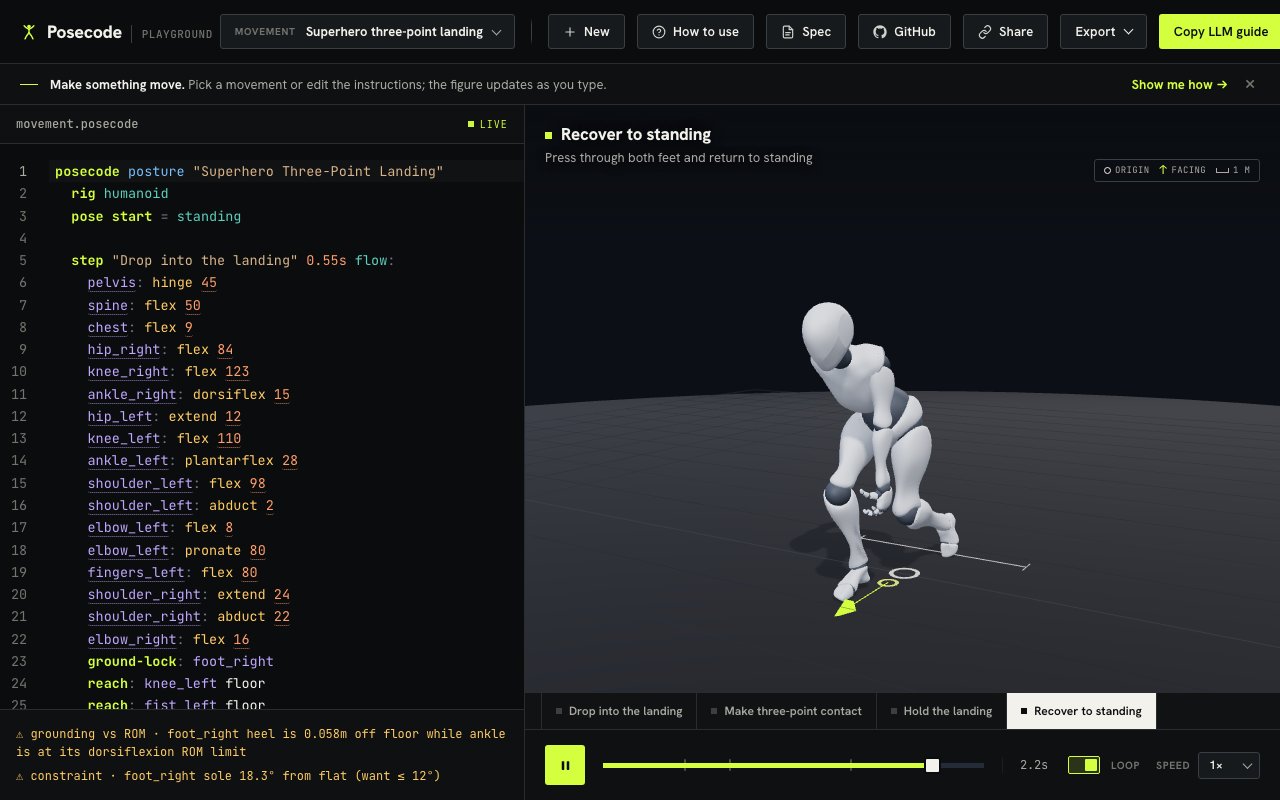
About Posecode
Posecode is an open source format that represents human movement as readable, editable text. Instead of wrestling with keyframes and timelines in traditional animation software, you describe motion through structured commands that look more like code than a visual timeline. The format covers everything from joint rotations to ground contacts, letting you specify exactly how a humanoid figure should move at each phase of an animation. It's designed for anyone who thinks better in text than in mouse clicks, which turns out to be a lot of developers building games, fitness apps, and interactive experiences that need precise control over character motion without the overhead of learning full 3D animation packages.
The core idea is that movement shouldn't be locked inside proprietary file formats or trapped in complex visual editors that require specialized training to operate. With Posecode, you write commands like hinge rotations with degree values, reach targets for limb positions, and timing phases measured in seconds. A simple line might read pelvis hinge 45 to apply a rotation, or you might define an entire walking cycle through a series of timed steps with ground locks to keep feet planted at the right moments. The syntax stays human readable, so you can actually diff changes in version control and collaborate on animations the same way you collaborate on code. Pull requests and code reviews work naturally because the motion data isn't hidden in binary blobs that only specialized software can interpret.
The web based playground at posecode.org lets you write and preview animations in real time without installing anything. You edit the source on one side of the screen while a 3D humanoid figure renders your movements on the other, updating immediately as you type. Playback controls let you adjust speed and scrub through the timeline to fine tune timing before committing to an export. When the animation looks right, you can export to BVH for Blender and other traditional animation tools, or to glTF and GLB for web pipelines and game engines. This dual export path means the same source file works whether you're building a web app in Three.js or rigging characters in a desktop application. You aren't locked into one ecosystem just because you chose a particular text format.
The platform includes a movement library with preset animations spanning fitness routines, rehabilitation exercises, and dance moves that serve as starting points for your own work. Rather than building every animation from scratch, you can pull in an existing motion and modify it to fit your needs, adjusting timing or joint angles while keeping the overall structure intact. There's also an LLM authoring guide for using AI assistants to draft movements from natural language descriptions. You describe what you want in plain English, something like a character stepping forward and raising their right arm, and a language model generates the Posecode syntax as a starting point for refinement. This bridges the gap between having a vision for movement and knowing the technical syntax to express it precisely.
Posecode targets animators who want code level precision without abandoning visual feedback, game developers embedding procedural animations that need to react to player input or physics systems, and teams building fitness or physical therapy applications that require precise, reproducible movement data for instructional purposes. The open source nature means you can inspect every part of the format, contribute to the parser and renderer, and integrate the tooling into your own pipelines without licensing concerns. The GitHub repository includes the full language specification, integration examples across multiple programming environments, and community contributions that extend the core functionality.
What makes Posecode different from standard animation workflows is the emphasis on inspectability and portability across tools and platforms. Traditional motion capture files and animation exports tend to be binary blobs that you can play but not easily read or edit by hand. Here, the entire movement is text that you can search, compare, and manipulate with standard developer tools like grep, sed, and version control diffing. For teams that treat motion as data rather than art assets locked in designer workstations, this approach fits naturally into version controlled, automated build processes where animations need to be tested, validated, and deployed alongside application code.
The playground is freely accessible through the browser with no account required, so you can start experimenting immediately without commitment. The documentation walks through the language specification from basic poses to complex multi phase sequences with branching conditions. Whether you're prototyping a character animation for a side project or building a motion data pipeline for a larger product that needs consistent, auditable movement definitions, Posecode offers a text first approach that keeps your animations transparent, portable, and ready to integrate with modern development workflows.
Key Features
- Text based human movement description language
- Real time 3D preview with constraint checking
- BVH export for Blender and animation tools
- glTF and GLB export for web applications
- Pre built movement library for reference
- LLM compatible format for AI generated motion
Pros & Cons
What we like
- Readable and versionable unlike binary motion formats
- Deterministic output from the same source code
- Exports to standard animation and web formats
- Free web playground for immediate use
Room for improvement
- Requires learning a new domain specific language
- Less intuitive than visual timeline animation tools
- AGPL license applies to some product components
- Smaller ecosystem compared to established motion tools
Frequently Asked Questions
What is Posecode?
Is Posecode free?
What formats can Posecode export to?
Who is Posecode for?
Best For
Featured in
Alternatives to Posecode

Kevin Gabeci
Solo developer building web apps, cozy browser games, and AI creator toolkits.
SoloDevStack
A solo developer blog built on head-to-head tool comparisons, 580+ posts deep.

Codedex
A gamified, story-driven platform that teaches Python, web dev, and more like an RPG quest

Vibe Built
Building real apps with agentic AI. What worked, what broke, what shipped.
Reviews (0)
Badge builder
Add Posecode to your website
Choose a badge style and size, preview it here, then copy the generated HTML. Badge images are self-contained SVGs and do not require an external script.

<a href="https://toolindex.net/tools/posecode?ref=badge" target="_blank" rel="noopener">
  <img src="https://toolindex.net/badge/posecode/medium.svg" alt="Posecode - Listed on Tool Index" width="180" height="50" />
</a>How to use the badge
- 1. Pick the style, size, and theme that fit your layout.
- 2. Copy the generated HTML from the code block.
- 3. Paste it into your footer, homepage, or press page.
Standard badge available
The standard listing badge is available now. Score and circle badges are limited to tools currently ranked in the top 10 of a category.
Badge clicks return visitors to this profile with a referral tag so the source remains identifiable.
Related Tools
Kevin Gabeci
Solo developer building web apps, cozy browser games, and AI creator toolkits.
Coolify
Self-hostable, open source alternative to Heroku and Netlify

Warp
The modern terminal reimagined with AI and collaboration

Bolt.new
Prompt-to-deployed full-stack app inside the browser
Work on Posecode? Request listing access or correction