
PromptDNA
Community library of composable prompt blocks with MCP integration
Gallery
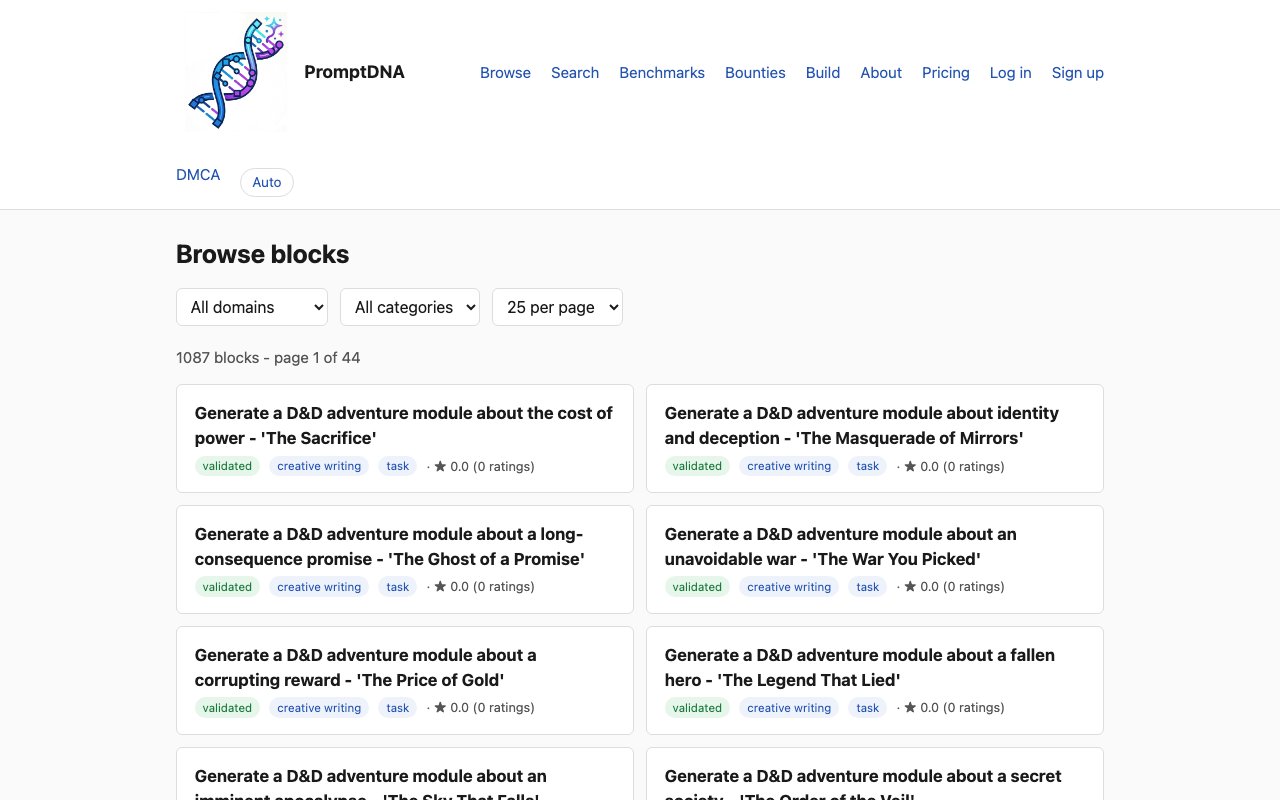
About PromptDNA
PromptDNA is a platform for discovering, sharing, and assembling reusable prompt components. Instead of starting from scratch every time you need to instruct an AI model, you browse a library of curated blocks and combine them into complete prompts. The library spans multiple domains, including creative writing, business, finance, legal, medical, scientific, and software development. Each block serves a specific function, whether it's defining a persona, setting constraints, injecting domain knowledge, or specifying a task. For anyone building prompts regularly, having a searchable repository of validated components saves time and reduces guesswork.
The platform organizes blocks by both domain and category. Domain tags indicate the subject matter, so a block designed for legal document drafting won't clutter results when you're looking for creative writing helpers. Category tags describe what the block does functionally, such as personas that establish how the AI should behave, constraints that limit output format or length, knowledge blocks that inject specific facts, and task blocks that define what the AI should accomplish. This two-axis organization makes it practical to find exactly what you need even as the library grows. Currently, PromptDNA hosts over a thousand validated blocks, with community contributions expanding the collection continuously.
Searching and browsing the library uses a credit system. New users receive fifty unrestricted credits plus fifty submission-only credits without entering payment information. Most read operations, like viewing block details, cost half a credit. Composing prompts from blocks costs five credits, and submitting new blocks costs two credits each. Search itself is free for the first thirty calls per hour, then costs one credit per query. This usage-based model means you pay roughly proportional to how much you interact with the platform. Credits are priced at a tenth of a cent each, and you can buy bundles ranging from five hundred credits for fifty cents up to twenty thousand credits for twenty dollars.
Contributors can earn credits rather than buying them. When you submit a block, community members can rate it. Highly-rated blocks earn you credits over time, and validated blocks, those reviewed and approved by the platform, earn additional rewards. There's also a bounty program where the platform requests specific block types and pays contributors who deliver. This creates an incentive loop where active contributors can use the platform extensively without spending money, while casual users pay small amounts for the value they extract. It's a model that encourages a growing library without requiring everyone to become a contributor.
For developers and AI agents that need programmatic access, PromptDNA offers an alternative payment method using x402 micropayments on the Base network. Agents can pay per API call in USDC without needing an account or pre-purchased credits. This removes friction for automated systems that might otherwise need to manage credit balances or handle authentication tokens. It's a niche feature, but it reflects the platform's assumption that AI agents, not just humans, will be assembling prompts from components.
PromptDNA differs from static prompt libraries by emphasizing modularity and composition. Rather than offering complete prompts that you copy and paste wholesale, it provides building blocks that you combine based on your specific needs. A legal-domain persona block might pair with a constraint block limiting output to bullet points and a task block requesting contract analysis. This composable approach scales better as prompt engineering becomes more sophisticated, since you can mix and match rather than hunting for a single template that fits your exact use case. The trade-off is complexity. You need to understand how blocks interact, and effectiveness varies depending on which AI model you're targeting.
The platform is free to try with the initial credit grant, and costs remain low for light usage. Heavy users or teams building lots of prompts will burn through credits faster, but the pricing stays predictable. PromptDNA suits prompt engineers, developers integrating AI into applications, and content creators who work with language models regularly. If you're only writing occasional one-off prompts, the overhead of learning a new platform might not pay off. For sustained prompt development across multiple projects, having a shared library of modular components provides real value.
Key Features
- Catalog of 1,000+ community prompt blocks
- Domain and category filtering
- MCP protocol for agent integration
- Micropayment support for autonomous agents
- Credit-earning for contributors
- Fork and remix existing blocks
Pros & Cons
What we like
- Modular approach makes prompt reuse practical
- MCP integration lets agents fetch prompts programmatically
- Free credits on signup with no card required
- Contributors can earn credits by sharing quality blocks
Room for improvement
- Blocks are community-contributed and unverified
- Catalog skews toward creative and D&D content
- Micropayment rail requires crypto familiarity
- Smaller community than mainstream prompt libraries
Frequently Asked Questions
What is PromptDNA?
Is PromptDNA free?
Who is PromptDNA for?
Are the prompt blocks verified?
Best For
Featured in
Alternatives to PromptDNA
View all
Reviews (12)
Finally something that fits
Have been running PromptDNA for a while, here is where I land. Where it really wins is domain and category filtering. Easy yes for anyone weighing the same trade offs.
Recommended without reservation
PromptDNA solves a real problem for me without making a fuss about it. The domain and category filtering is more useful than I expected. The core workflow is smooth once you are set up. Mostly using it for sharing and monetizing prompt engineering work.
It just works
Started using PromptDNA casually, now it is pinned in my dock. The free credits on signup with no card required is more useful than I expected. It handles the boring parts so I can focus on the work that matters. It fits well for wiring prompt retrieval into agentic workflows. Worth it for what I get out of it.
Two months in, no regrets
Have been running PromptDNA for a while, here is where I land. What stands out is how it handles modular approach makes prompt reuse practical. It just works, day after day, without surprises. Mostly using it for building reusable prompt templates for ai products. Hard to imagine going back to my old setup.
Decent with some rough edges
PromptDNA solves a real problem for me without making a fuss about it. What stands out is how it handles fork and remix existing blocks. One thing that bugs me is micropayment rail requires crypto familiarity.
Does the job, a few gripes
PromptDNA has quietly become part of my daily flow. Where it really wins is domain and category filtering. Found it works best for wiring prompt retrieval into agentic workflows. One thing that bugs me is micropayment rail requires crypto familiarity. No regrets so far.
Solid daily driver
Three months of PromptDNA later, here is what holds up. The thing I keep coming back to is how reliable it is. It earns its place in my stack.
Worth a look
Started using PromptDNA casually, now it is pinned in my dock. Got real value out of catalog of 1,000+ community prompt blocks. No regrets so far.
Pulled its weight from week one
PromptDNA has quietly become part of my daily flow. Support actually answered when I had a question, which surprised me. The defaults are sensible, so I was not fighting settings on day one. It earns its place in my stack.
Pulled its weight from week one
Hadn't planned on switching, but PromptDNA was hard to ignore. What stands out is how it handles catalog of 1,000+ community prompt blocks.
Finally something that fits
PromptDNA has quietly become part of my daily flow. The thing I keep coming back to is how reliable it is. The interface stays out of my way, which I appreciate. Recommending it to people in a similar spot.
Pulled its weight from week one
Came to PromptDNA after getting frustrated with what I had before. What stands out is how little babysitting it needs. Worth it for what I get out of it.
Badge builder
Add PromptDNA to your website
Choose a badge style and size, preview it here, then copy the generated HTML. Badge images are self-contained SVGs and do not require an external script.

<a href="https://toolindex.net/tools/promptdna?ref=badge" target="_blank" rel="noopener">
  <img src="https://toolindex.net/badge/promptdna/medium.svg" alt="PromptDNA - Listed on Tool Index" width="180" height="50" />
</a>How to use the badge
- 1. Pick the style, size, and theme that fit your layout.
- 2. Copy the generated HTML from the code block.
- 3. Paste it into your footer, homepage, or press page.
Standard badge available
The standard listing badge is available now. Score and circle badges are limited to tools currently ranked in the top 10 of a category.
Badge clicks return visitors to this profile with a referral tag so the source remains identifiable.
Related Tools
Apatero AI
The creator studio for AI image, video, audio, 3D, and avatars, now at apatero.ai.
Kevin Gabeci Toolkits
Seven AI toolkits for writing books, making music, cutting video, and building agents.

Warp
The modern terminal reimagined with AI and collaboration

Bolt.new
Prompt-to-deployed full-stack app inside the browser
Work on PromptDNA? Request listing access or correction