
Rails Baseline
A Rails 8.1 SaaS starter with auth, billing, and teams, documented so coding agents extend it consistently
Gallery
About Rails Baseline
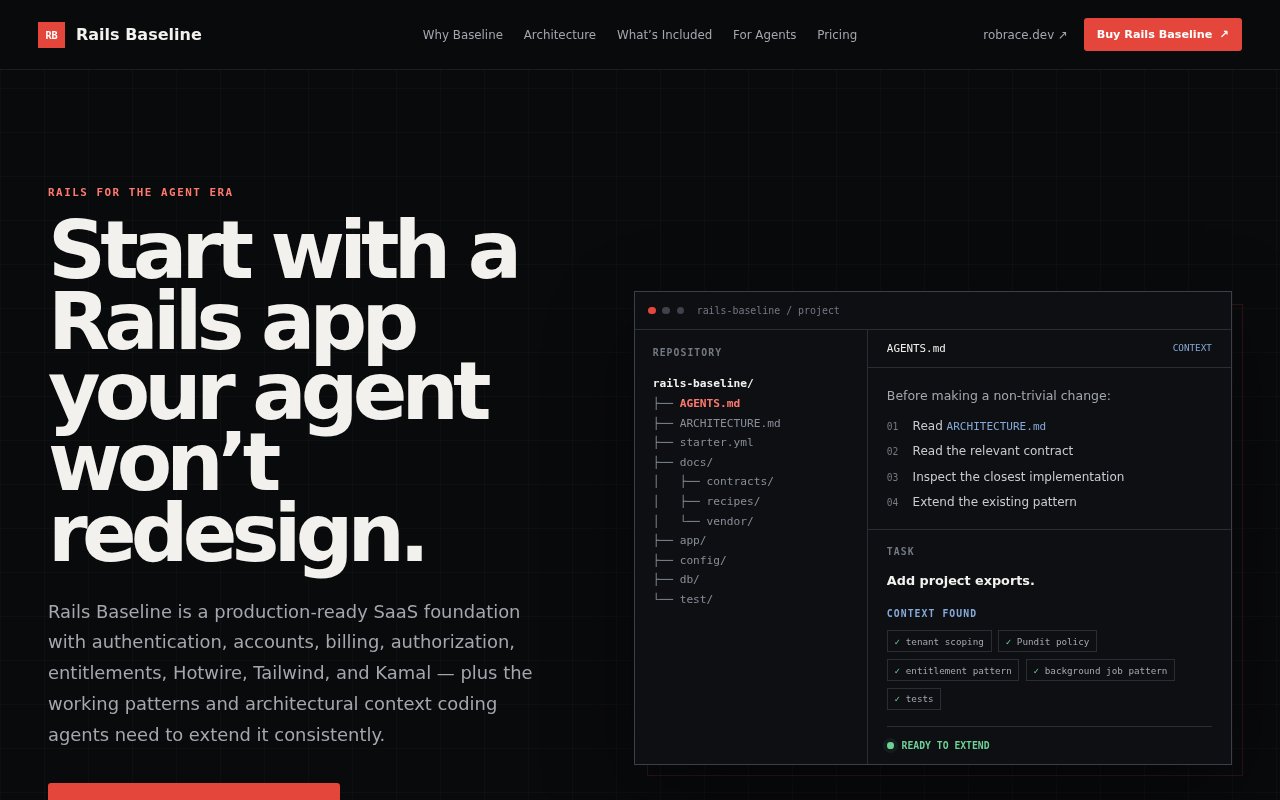
Rails Baseline is a production-ready SaaS starter application built on Rails 8.1, sold as a one-time purchase that gives you the full source repository. It includes the usual primitives a subscription product needs, accounts, roles, billing, background jobs, and deployment, but its distinguishing idea is that it's written and documented so that coding agents like Claude, Codex, and Cursor can extend it consistently, with the architectural decisions spelled out in files where an agent will read them. The author's own summary, a Rails SaaS starter with agent-readable architecture, is a fair one.
The problem it targets is stated plainly in the site's FAQ. Code generation is no longer the expensive part. A blank repository still gives an agent no local precedent, so every feature it adds invents its own patterns, and after a month the codebase has three ways of doing authorisation and two of enqueueing a job. A starter that already embodies a coherent set of decisions, and explains them in files an agent reads, gives both the human and the agent something to copy, which is cheaper than reviewing invented patterns after the fact. It's the same argument for coding standards in a human team, applied to an agent that reads the repository before every task.
What's in the box is broad. Identity and tenancy come from Devise with email confirmation and password recovery, a multi-account architecture, owner, admin, and member roles, and Pundit for authorisation. Billing runs through the Pay gem and Stripe with account-level billing, an entitlements system, and limits enforcement, so product capabilities stay application-owned concepts rather than leaking into Stripe. The frontend is Hotwire, Turbo, Stimulus, and Tailwind CSS, with React available as an optional island rather than a requirement. That means a data-heavy screen can use a component without turning the whole app into a single-page frontend. Operations cover Solid Queue, Solid Cache, and Solid Cable, Mission Control Jobs, audit event logging, Docker and Kamal deployment, and GitHub Actions CI, which is most of what stands between a fresh app and a first paying customer.
The agent-readable layer is what the tagline refers to. The repository ships with an AGENTS.md, an ARCHITECTURE.md, contract definitions, recipe guides for common extensions, and a starter.yml configuration. An agent pointed at the repo can read how tenancy, entitlements, and jobs are meant to work before writing a line, and the recipes give it worked examples to follow. The FAQ is careful to say you don't have to use an agent at all. It's deliberately a normal Rails application, not a framework or an engine, and the same documentation helps a human contributor just as much. It also stresses that parts can be removed or replaced, because the architecture separates foundational concepts from optional capabilities. The contract definitions and starter.yml are the pieces meant to be read before code is written, and the recipes are the pieces meant to be copied.
It's for experienced Rails developers, AI-assisted builders, technical founders, and indie SaaS developers who want a fast start without accepting a pile of code they don't understand. The author is Rob Race, a Rails developer who wrote Build a SaaS App in Rails 8, and the site also offers a free Architecture Checkup tool for existing Rails applications, which is a reasonable way to get a feel for the opinions behind the product before paying for it.
Where it differs from other Rails starter kits is emphasis. The FAQ says it includes the SaaS primitives you'd expect, but the goal is architectural precedent rather than maximising the amount of bundled code, so you won't find every integration under the sun, and that's the point. The caveats are that it's a paid, single-author product with a young 1.x line, that the value depends on you wanting its opinions on Devise, Pay, Hotwire, and Solid Queue, and that the founding license is described as intended for products you own, so agencies building for clients should read the terms first. Rails 8.1 and the Solid stack are recent choices, which keeps the dependencies current but also means the starter tracks a fast-moving framework release.
Access is paid with no free tier. A founding price of $129 applies through the twentieth purchase, and the site showed 17 of 20 founding licenses sold at the time of writing, after which the standard price is $179. The purchase includes current 1.x updates and extension recipes, which reads as though a future 2.x line could be a separate purchase, normal for starter kits but worth knowing. Refunds are available within 14 days only if the product materially differs from its description, prevents reasonable use, or there's a billing error, not for a change of mind or for expecting functionality that wasn't included. No contact email is published on the site, though the author's own site is linked.
Key Features
- Rails 8.1 with Hotwire, Turbo, and Stimulus
- Devise auth with multi-account tenancy
- Pay and Stripe billing with entitlements
- Owner, admin, and member roles with Pundit
- AGENTS.md, ARCHITECTURE.md, and extension recipes
- Solid Queue, Kamal deployment, and GitHub Actions CI
Pros & Cons
What we like
- Architectural decisions are documented where agents read them
- Full source repository, not a framework or engine
- Billing, entitlements, and limits already wired
- Free Architecture Checkup for existing apps
Room for improvement
- No free tier and refunds are limited
- Single-author product on a young 1.x line
- Opinionated stack, less useful if you'd choose differently
- License is scoped to products you own
Frequently Asked Questions
What is Rails Baseline?
How much does Rails Baseline cost?
Do I need to use an AI coding agent?
Does it require React?
Best For
Featured in
Alternatives to Rails Baseline

Kevin Gabeci
Solo developer building web apps, cozy browser games, and AI creator toolkits.

SoloDevStack
A solo developer blog built on head-to-head tool comparisons, 580+ posts deep.

Codedex
A gamified, story-driven platform that teaches Python, web dev, and more like an RPG quest

Vibe Built
Building real apps with agentic AI. What worked, what broke, what shipped.
Reviews (0)
Badge builder
Add Rails Baseline to your website
Choose a badge style and size, preview it here, then copy the generated HTML. Badge images are self-contained SVGs and do not require an external script.

<a href="https://toolindex.net/tools/rails-baseline?ref=badge" target="_blank" rel="noopener">
  <img src="https://toolindex.net/badge/rails-baseline/medium.svg" alt="Rails Baseline - Listed on Tool Index" width="180" height="50" />
</a>How to use the badge
- 1. Pick the style, size, and theme that fit your layout.
- 2. Copy the generated HTML from the code block.
- 3. Paste it into your footer, homepage, or press page.
Standard badge available
The standard listing badge is available now. Score and circle badges are limited to tools currently ranked in the top 10 of a category.
Badge clicks return visitors to this profile with a referral tag so the source remains identifiable.
Related Tools
Kevin Gabeci
Solo developer building web apps, cozy browser games, and AI creator toolkits.

Coolify
Self-hostable, open source alternative to Heroku and Netlify

Warp
The modern terminal reimagined with AI and collaboration

Bolt.new
Prompt-to-deployed full-stack app inside the browser
Work on Rails Baseline? Request listing access or correction