RankSpot
Track whether your brand shows up in AI answers, then publish content to close the gaps
Gallery
About RankSpot
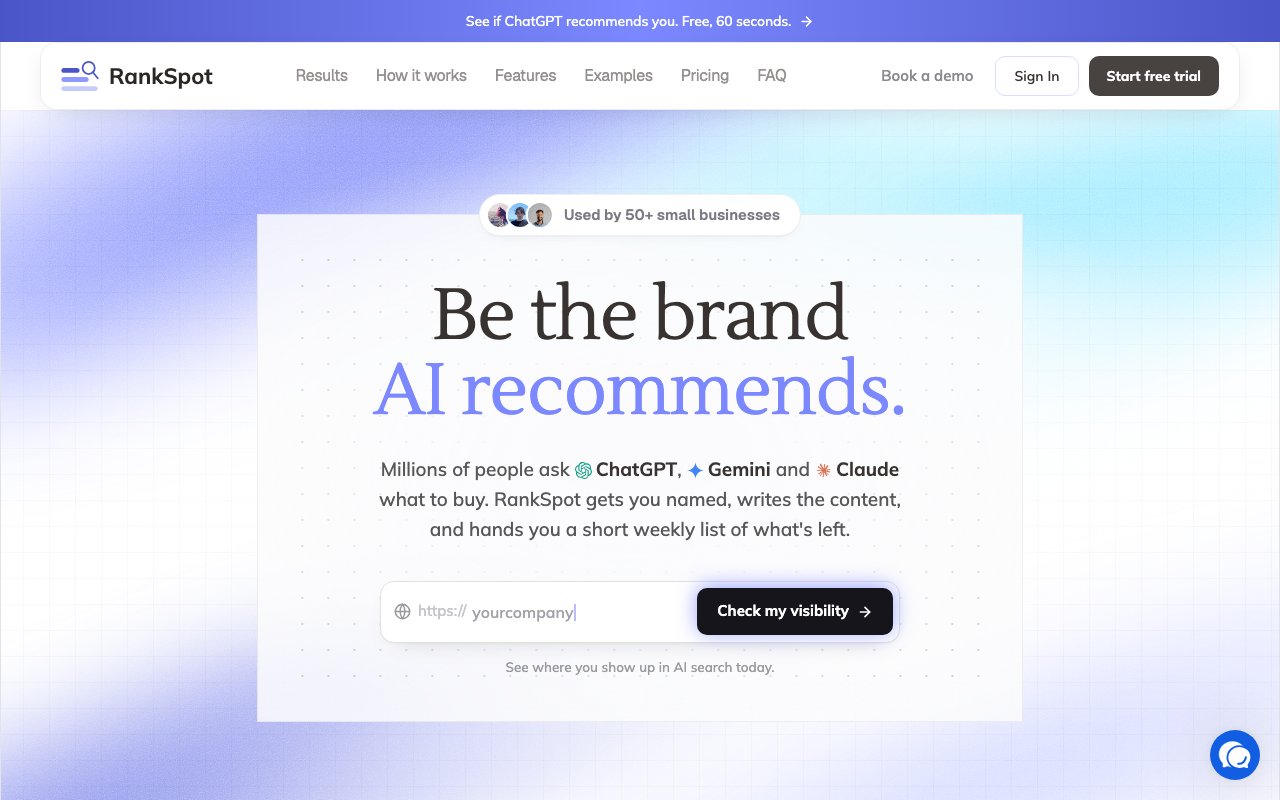
RankSpot is an AI search visibility platform that tracks whether a business gets named in answers from ChatGPT, Claude, Gemini, and Google AI Overviews, then researches and publishes content aimed at the gaps it finds. The premise behind it is that a growing share of buyer research now happens inside a chat window instead of on a results page, and a company can hold a decent Google position while being completely absent from the answer an assistant hands back. Classic rank trackers can't see that, because there's no blue link to measure and no position to record. RankSpot's job is to make that invisible layer legible, by running a set of real buyer questions through the major assistants on a schedule and recording which brands get mentioned and which ones don't.
Setup starts with a website URL. RankSpot reads the niche, works out the questions people actually ask before buying, and runs them across the four platforms to produce a baseline. From there it surfaces the prompts where competitors show up and the business doesn't, which becomes the working gap list for everything that follows. The plan tracks 50 questions across the assistants, watches up to five competitors, and re-measures on a weekly rhythm so progress is something you can point at rather than assume. It also connects to Google Search Console, which puts traditional keyword positions beside the AI mentions in one place instead of leaving them in two separate dashboards. The niche analysis step is what makes the tracked set worth trusting, since a prompt list written by hand tends to reflect what a founder wishes people asked rather than what they actually type. Relevance scoring sits behind the keyword research so the questions stay tied to buying intent instead of drifting toward vanity topics.
The second half of the product is a content engine. RankSpot researches, drafts, and publishes up to thirty articles a month against the questions where visibility is weakest. Drafts land in a built-in editor with a review and approval step, so an operator can rewrite, reject, or wave things through rather than letting a bot post unread. Publishing runs straight into WordPress, Webflow, Shopify, Framer, Wix, and Ghost, with images and internal links added on the way out. Content can be generated in more than a hundred languages, which matters for anyone selling into several markets from a single domain. Because the same system handles research and drafting, an article arrives already pointed at a tracked question rather than at a generic topic, which is what keeps the output tied back to the measurement that justified writing it.
Sitting on top of all that is a weekly priorities list, usually five to ten items covering the work software can't do by itself. Those are the backlink, directory, and forum openings the platform spots while researching, handed over as specific tasks with a target rather than a vague suggestion to build authority. The company puts the weekly time commitment at under an hour, and that split is the actual pitch. Software handles measurement and volume, a person handles the handful of things that need a person, and the loop repeats the following week.
There's also an MCP server, so the tracking data can be queried directly from Claude or ChatGPT instead of only through the dashboard. It's a small feature with a real payoff for anyone who already works inside an assistant all day, since it means asking about your own visibility in the same window where you're researching a competitor. Free tools, a blog, and an affiliate program round out the surface area, though the core loop stays the same, measure the answers, write against the gaps, then measure again.
The audience is small businesses and agencies that want a footprint in AI answers without paying an agency four figures a month for it. Plenty of tools now measure AI visibility and plenty of others generate articles, so the interesting part is that RankSpot staples the two halves together. Measurement decides what gets written, and the next measurement says whether it worked. Volume discounts point at the same audience, with ten percent off for two to four sites and fifteen percent for five or more, so running a roster of client sites is clearly an expected use rather than an edge case.
Pricing is one paid plan at $99 a month, listed against a regular price of $149, and there's no permanent free tier. A three-day trial includes three articles and 50 tracked prompts, which is enough to judge writing quality and see a first visibility snapshot, though not enough to watch a trend develop. The company advertises a full refund if results don't show up or the product goes unused. Setup is claimed at roughly five minutes, and because every draft passes through the editor first, it's reasonable to run RankSpot as a research and tracking tool for a while before turning automatic publishing on. For an agency evaluating it, the honest read is that the trial proves the workflow rather than the outcome, so a first full month on one site is the realistic window for deciding whether the loop is worth keeping.
Key Features
- Visibility tracking across four AI assistants
- Fifty tracked buyer questions
- Automated article writing and publishing
- Direct publishing to six CMS platforms
- Weekly priority action list
- MCP access from ChatGPT or Claude
Pros & Cons
What we like
- Measures AI answer visibility that classic rank trackers miss
- Writes and publishes content aimed at the gaps it finds
- Every draft passes through an editor before going live
- Flat monthly price sits well under an agency retainer
Room for improvement
- Single plan, so there's no lighter entry tier
- Three-day trial is short for judging a visibility trend
- Fifty tracked questions caps how wide you can measure
- Automated publishing still needs human review to stay accurate
Frequently Asked Questions
What is RankSpot?
Is RankSpot free?
Does RankSpot publish articles automatically?
Who is RankSpot for?
Best For
Featured in
Alternatives to RankSpot
View all
Moz Pro
SEO toolset with keyword research, site audits, link analysis, and the well-known Domain Authority and Page Authority metrics.
Frase
AI-assisted SEO content tool that turns SERP research into briefs, outlines, and optimized drafts inside one editor.

Rank Compound
SEO content that compounds. What actually moved rankings, measured, with the failures shown.

Postdex
An exclusive marketplace for finished, human-made articles. Every piece sells once.
Our take
Tool Index Editorial · Oct 2026· 3.0/5
RankSpot combines AI answer visibility tracking with keyword research, competitor analysis, article drafting, and direct publishing. We found a broad dashboard, API and MCP access, Search Console integration, and an approval step before content goes live. The public site presents one plan at $99 a month, which may suit a small business that wants measurement and production in the same workflow.
That combination is also the main risk. Automated articles can turn a useful visibility signal into a volume target, and the site's own blog is heavy on comparison posts. Human review is essential for accuracy, originality, and brand voice, while changes in AI answers can make short term movement noisy. RankSpot has a sensible loop, but buyers should judge it on qualified traffic and conversions rather than the platform's visibility score alone.
Editorial opinion from the Tool Index team, written from the public product pages. Not a user review.
Reviews (0)
Badge builder
Add RankSpot to your website
Choose a badge style and size, preview it here, then copy the generated HTML. Badge images are self-contained SVGs and do not require an external script.

<a href="https://toolindex.net/tools/rankspot?ref=badge" target="_blank" rel="noopener">
  <img src="https://toolindex.net/badge/rankspot/medium.svg" alt="RankSpot - Listed on Tool Index" width="180" height="50" />
</a>How to use the badge
- 1. Pick the style, size, and theme that fit your layout.
- 2. Copy the generated HTML from the code block.
- 3. Paste it into your footer, homepage, or press page.
Standard badge available
The standard listing badge is available now. Score and circle badges are limited to tools currently ranked in the top 10 of a category.
Badge clicks return visitors to this profile with a referral tag so the source remains identifiable.
Related Tools

SEOdata.dev
Simple API for keyword search volume, CPC, and competition data
Frase
AI-assisted SEO content tool that turns SERP research into briefs, outlines, and optimized drafts inside one editor.

Surfer SEO
Content optimization tool that scores drafts in real time against the top-ranking pages for any target keyword.

Screaming Frog SEO Spider
Desktop website crawler trusted by SEO professionals for technical audits, broken link checks, and structured data analysis.
Work on RankSpot? Request listing access or correction