
Rejourney
Lightweight product analytics with session replay, funnels, heatmaps and crash reports for web and mobile
Gallery
About Rejourney
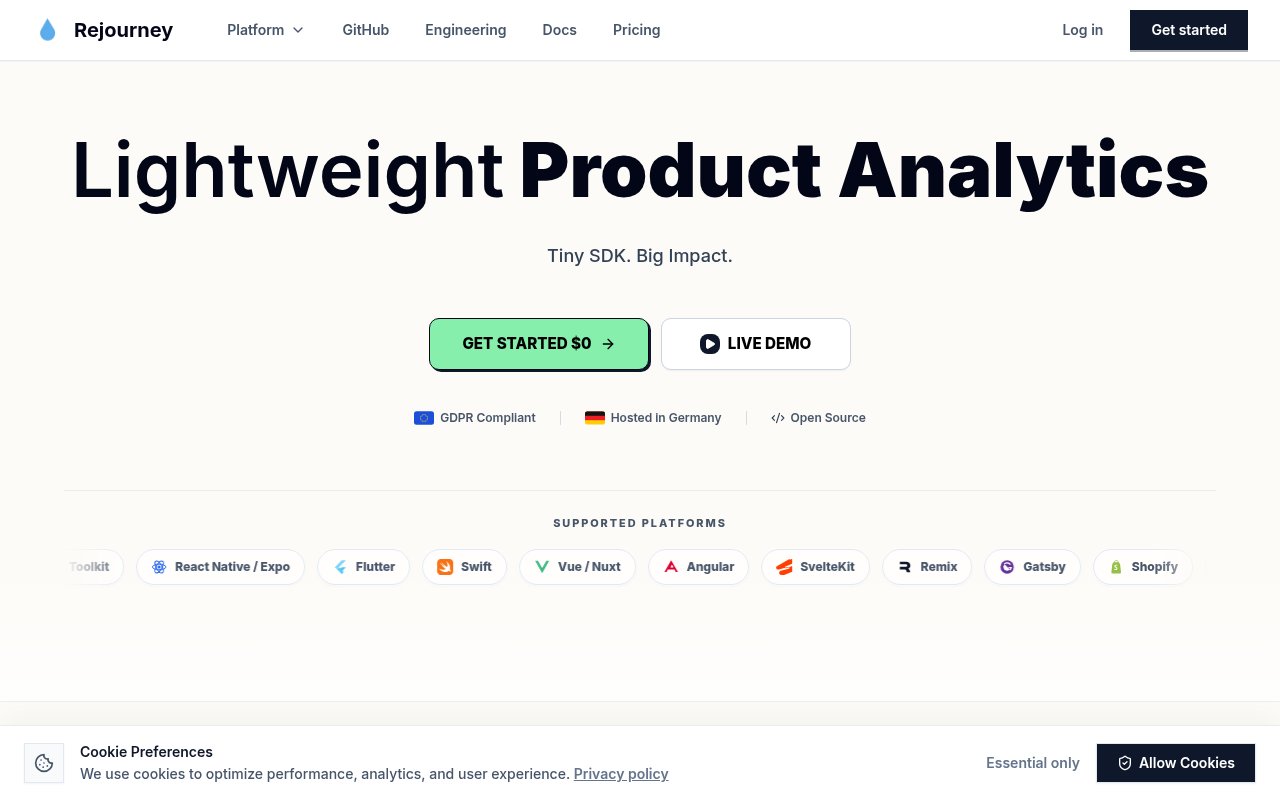
Rejourney is a product analytics platform that keeps session replay, funnels, heatmaps, crash reporting and API monitoring in one place, and does it with an SDK small enough not to slow down the product it's watching. The idea is that a chart telling you 40 percent of users drop off at checkout is only half an answer. Rejourney connects that signal to the actual sessions behind it, so you can watch what those users did, see the console errors and network requests that fired, and fix the cause instead of guessing. Everything ships in one SDK, so there's a single script to add and a single bill to argue about.
The problem it's built around is bloat. The site puts its own web SDK at 61.2 kB against competitors at 238 kB and up, and for a mobile app or a marketing site that difference shows up in load times and battery. Teams often end up with one tool for analytics, one for replay and one for crashes, each with its own script and its own bill, and none of them agreeing on which user did what. Rejourney folds those into one SDK and one dashboard.
Integration is a lightweight SDK that captures browser or app activity along with API performance, crashes and errors. Supported frameworks span Next.js, React, Vue, Angular, SvelteKit, Remix, Gatsby and Shopify on the web, and React Native, Expo, Flutter and Swift on mobile. Once data flows, the platform links behaviour signals to recordings, so a funnel step, a rage click or a crash opens straight into the sessions where it happened. There's also an automation called Leaks, which surfaces places users are being lost and ranks the signals by the estimated number of affected users, so the inbox starts with the problems that cost the most.
The platform splits into website analytics and app analytics. On the web side that means traffic, funnels, errors and the sessions behind each drop-off, while the app side covers the same for mobile with crash and ANR reports attached. The demo dashboard on the site, set up for a fictional store, shows the layout, with growth analytics, developer tools, workspace management and an automations area where the Leaks inbox lives alongside run history and settings. The repository describes the leak side as revenue leak prediction, which is the ambition, though the demo we saw was still loading its signals, so judge it on your own data.
It fits product teams and engineers who want evidence rather than aggregates, and mobile developers in particular, since crash, ANR and error reporting sit beside the behavioural data instead of in a separate tool. The site carries a customer case study with Burst Creatine and comparison pages against the established analytics and replay vendors, which is a reasonable place to start if you're weighing a switch.
What makes it different is the metering model as much as the feature set. Rejourney charges on captured session volume, and analytics events, daily active users and monthly active users are unlimited on every plan, including the free one. That removes the usual game of sampling events to stay under a quota. The source is on GitHub, and a self-hosted deployment via Docker or K3s is offered alongside the cloud service, so teams with data residency requirements can keep recordings on their own infrastructure.
Getting started is installing the SDK for your framework, letting sessions accumulate on the free plan, and then opening a funnel or an error to find the recordings behind it. Because DAU, MAU and events aren't metered, you can instrument generously from day one and only think about volume when replays approach the plan limit.
The honest caveats are that it's a younger product than the incumbents it compares itself with, the free plan's seven day retention is short for anyone investigating slow-moving problems, and the self-hosting path assumes you're comfortable running containers. Session replay of any kind also needs a privacy review, because you're recording what users do, and a replay tool is only as useful as the coverage you give it, so the SDK needs to be on every page or screen where the funnel actually runs.
Access is freemium. The Free plan is $0 forever with no credit card, 5,000 session replays a month and seven days of retention. Growth is $15 a month for 100,000 replays and 30 days of retention. Enterprise is custom priced with custom volume and retention, dedicated hardware, a custom storage bucket and a dedicated support team. Every tier includes replay, funnels, heatmaps, crash diagnostics and API insights.
Key Features
- Session replay linked to product signals
- Funnels, heatmaps and drop-off analysis
- Crash, ANR and error reporting
- Leaks automation ranked by affected users
- Web and mobile SDKs for major frameworks
- Self-hosted deployment via Docker or K3s
Pros & Cons
What we like
- Free plan with 5,000 replays a month and unlimited events
- Small SDK compared with the incumbents it benchmarks against
- Replay, analytics and crash data in one dashboard
- Self-hosting option for data residency
Room for improvement
- Seven day retention on the free plan
- Younger product than the vendors it compares itself with
- Self-hosting requires running containers yourself
- Session recording needs a privacy review before rollout
Frequently Asked Questions
What is Rejourney?
Is Rejourney free?
Can I self-host Rejourney?
Which platforms does it support?
Best For
Featured in
Alternatives to Rejourney
View allNotionlytics
Page-view analytics and reader feedback widgets for public Notion pages

Cometly
Marketing attribution for B2B SaaS that ties ad spend to pipeline and closed-won revenue

Amplitude
Digital analytics platform for product, growth, and marketing teams to analyze user behavior across web and mobile.

Simple Analytics
Cookieless, GDPR-friendly web analytics that needs no consent banner
Our take
Tool Index Editorial · Sep 2026· 4.0/5
Rejourney combines product analytics, session replay, funnels, heatmaps, crash diagnostics, and API context for web and mobile teams. It is for product and engineering groups that want to move from a dropoff metric directly to the sessions and errors behind it. The free plan includes 5,000 monthly replays with 7 days of retention. Growth is $15 a month for 100,000 replays and 30 days, while Enterprise is custom.
We like the single SDK approach, unlimited events and active users, and links between behavioral evidence and stability problems. Support for major web and mobile frameworks is broad, and self hosting is available. Rejourney is younger than the established alternatives, however, and its package size comparisons are its own benchmark. Any session replay rollout also needs deliberate masking, consent, retention, and access controls before real user data is recorded.
Editorial opinion from the Tool Index team, written from the public product pages. Not a user review.
Reviews (0)
Badge builder
Add Rejourney to your website
Choose a badge style and size, preview it here, then copy the generated HTML. Badge images are self-contained SVGs and do not require an external script.

<a href="https://toolindex.net/tools/rejourney?ref=badge" target="_blank" rel="noopener">
  <img src="https://toolindex.net/badge/rejourney/medium.svg" alt="Rejourney - Listed on Tool Index" width="180" height="50" />
</a>How to use the badge
- 1. Pick the style, size, and theme that fit your layout.
- 2. Copy the generated HTML from the code block.
- 3. Paste it into your footer, homepage, or press page.
Standard badge available
The standard listing badge is available now. Score and circle badges are limited to tools currently ranked in the top 10 of a category.
Badge clicks return visitors to this profile with a referral tag so the source remains identifiable.
Related Tools

Sleep Suivour
Track your sleep, improve your rest
Notionlytics
Page-view analytics and reader feedback widgets for public Notion pages
Mixpanel
Product analytics tool for tracking user events, funnels, retention, and cohorts to understand how people use your app.

Simple Analytics
Privacy-friendly web analytics with a clean dashboard, event tracking, and a strong stance against personal data collection.
Work on Rejourney? Request listing access or correction