
Replay
Find silent prompt cache breaks and explain what coding agent sessions cost
Gallery
About Replay
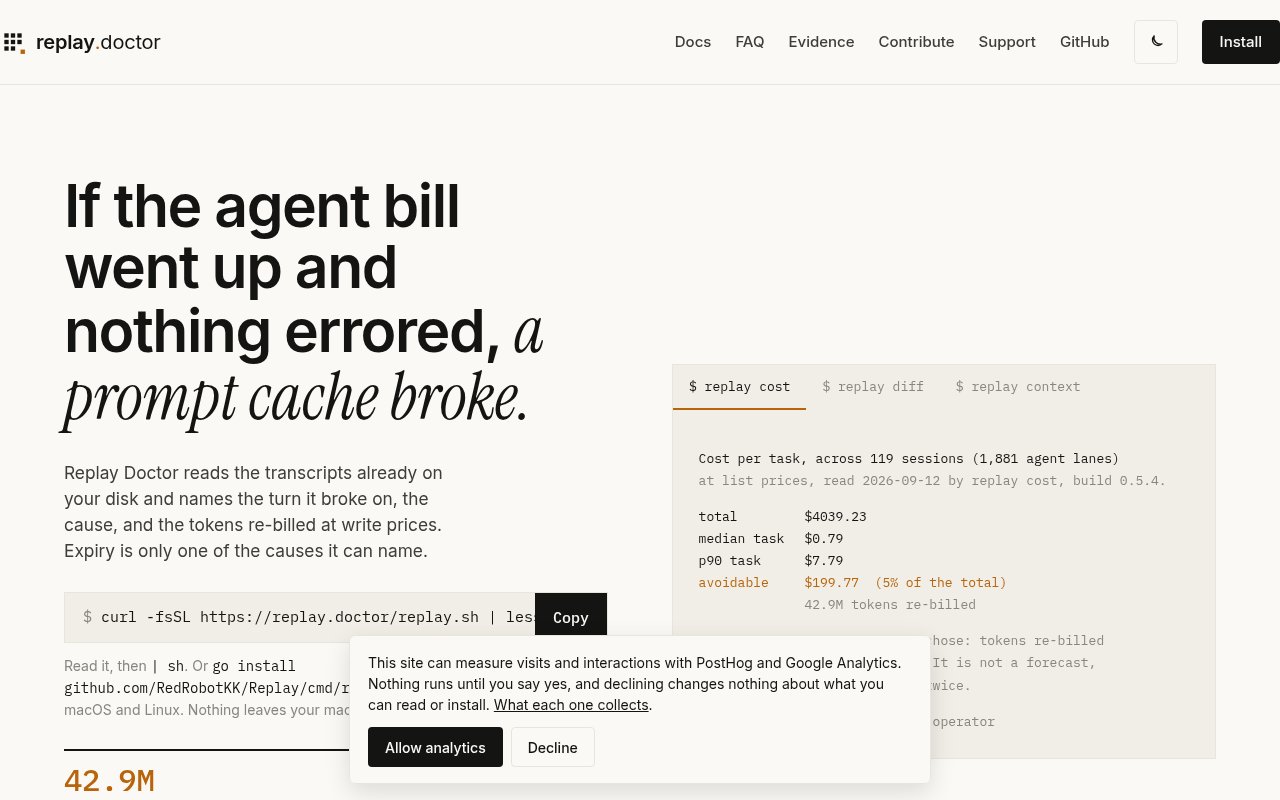
Replay is a local command line tool for understanding the cost and prompt cache behavior of coding agents. It reads transcripts that Claude Code and Codex already store on disk, reconstructs how the provider's caching rules applied, and identifies the turn where a cache stopped matching. That matters because a broken prompt cache doesn't necessarily produce an error. A timestamp, reordered tool list, or re-rendered history can change a previously stable prefix, causing later turns to be charged at write prices while the session continues normally. A monthly provider dashboard can show that spend increased, but it usually can't connect the increase to a specific task or explain the change inside the conversation. Replay works at that lower level, reporting total spend, median and high-percentile task cost, avoidable cost, the affected turn, and a proposed cause.
The simplest mode needs no new instrumentation. A user points the replay command at a transcript directory and it analyzes sessions that have already happened. The doctor command checks which supported transcripts are present and suggests what to run, while the cost command prices sessions at list rates. The diff command locates the point where a cache prefix diverged and describes what changed. The context command scores alternative layouts against the same recorded session, so a team can compare a longer cache lifetime or a history editing policy with the way the task actually ran. Replay puts a calibration result before its recommendations. It first checks whether its model reproduces the cache reads reported by the provider, and it says when that comparison isn't reliable instead of silently treating an estimate as a measurement.
An optional local proxy adds information that transcripts alone can't provide. Transcript analysis can estimate charges from recorded token counts, while the proxy can observe what was sent and what the provider billed on the wire. It forwards the user's own requests, binds to loopback, and records a ledger of block kinds, sizes, timings, and usage instead of storing message text. The product site says file paths and MCP server names are hashed and ledger files are owner-only. Replay also includes opt-in guards for controlling a running agent. A spend cap can refuse the next request after a session or daily limit, loop detection can catch repeated identical calls in the current run, and an error budget can stop a session that is spending most of its activity on failures. Those controls are off until the operator enables them.
Replay is most useful for developers and engineering teams running long, expensive agent sessions. It helps someone answer whether a higher bill came from more productive work, a cache expiration, a changed prompt prefix, or parallel agent lanes writing the same shared context again. Cost per task is especially useful when a team needs to forecast unattended work or price an agent-backed feature, since a monthly total hides the spread between ordinary and unusually expensive sessions. The tool also suits people experimenting with context management. Instead of changing a policy based on a general rule of thumb, they can score the proposed layout against their own recorded work. The data remains local for normal analysis, which is a good fit for transcripts that may contain private code, tool results, and operational details.
The product is unusually explicit about the boundary between evidence and inference. It labels transcript-derived figures as estimated, reserves measured language for observations made through the proxy, and publishes a calibration corpus and dated corrections. It also documents limits that affect a buying decision. The main verified path models Anthropic caching and reads coding agent transcripts. The site says the OpenAI-compatible proxy path has been tested against a stub rather than a live provider, and Cursor's stored conversations don't include the cache accounting needed for transcript analysis. Secret masking is presented as a second layer that can't recognize every possible secret shape. Replay is therefore best treated as a diagnostic instrument whose calibration line and scope notes should be read, not as an automatic promise that every reported saving is achievable.
Replay itself is free, open source under Apache 2.0, and requires no account or entitlement check. The full source is available on GitHub, and the local tool has no hosted account to authenticate against. Signed binaries are available for macOS and Linux on amd64 and arm64, and the Go program has no external runtime dependencies. Windows isn't supported. Installation and operation are aimed at users comfortable with a terminal and local transcript paths, so it isn't a consumer dashboard with a hosted account. For its intended technical audience, the free local workflow makes it practical to inspect existing sessions before deciding whether the optional proxy or guards are worth adding. Teams can also review and adapt the implementation for their own environment under its permissive license.
Key Features
- Local transcript cost analysis
- Prompt cache break detection
- Per-task cost distribution
- Alternative context policy scoring
- Optional loopback measurement proxy
- Opt-in spend and loop guards
Pros & Cons
What we like
- Analyzes coding sessions already stored on disk
- Separates estimated figures from measured results
- Names the turn and likely cache break cause
- Runs locally without an account or telemetry
Room for improvement
- Requires command line setup
- Windows isn't supported
- Cursor transcripts lack required cache fields
- OpenAI-compatible proxy testing remains limited
Frequently Asked Questions
What is Replay?
Does Replay require a proxy?
Is Replay free and open source?
Which systems does Replay support?
Best For
Featured in
Alternatives to Replay

Kevin Gabeci
Solo developer building web apps, cozy browser games, and AI creator toolkits.

SoloDevStack
A solo developer blog built on head-to-head tool comparisons, 580+ posts deep.

Codedex
A gamified, story-driven platform that teaches Python, web dev, and more like an RPG quest

Vibe Built
Building real apps with agentic AI. What worked, what broke, what shipped.
Reviews (0)
Badge builder
Add Replay to your website
Choose a badge style and size, preview it here, then copy the generated HTML. Badge images are self-contained SVGs and do not require an external script.

<a href="https://toolindex.net/tools/replay?ref=badge" target="_blank" rel="noopener">
  <img src="https://toolindex.net/badge/replay/medium.svg" alt="Replay - Listed on Tool Index" width="180" height="50" />
</a>How to use the badge
- 1. Pick the style, size, and theme that fit your layout.
- 2. Copy the generated HTML from the code block.
- 3. Paste it into your footer, homepage, or press page.
Standard badge available
The standard listing badge is available now. Score and circle badges are limited to tools currently ranked in the top 10 of a category.
Badge clicks return visitors to this profile with a referral tag so the source remains identifiable.
Related Tools
Kevin Gabeci
Solo developer building web apps, cozy browser games, and AI creator toolkits.

Coolify
Self-hostable, open source alternative to Heroku and Netlify

Warp
The modern terminal reimagined with AI and collaboration

Bolt.new
Prompt-to-deployed full-stack app inside the browser
Work on Replay? Request listing access or correction