Review Assist
Free open-source MCP server and GitHub App that turns a coding agent's session into a guided PR review
Gallery
About Review Assist
Review Assist is a free, open-source MCP server and GitHub App that turns a coding agent's working session into a guided, verifiable pull request review. Agents now write more code than any team can read by hand, and the context that makes review fast, what was asked, what was tried, and what was actually verified, disappears the moment the pull request opens. Review Assist captures that context as the agent commits and puts it in front of the reviewer, anchored to the diff.
There are two one-time installs. The MCP server runs on the developer's machine and is registered with Claude Code, Codex, or Claude Desktop with a single npx command. As the agent commits, it distils the session into an Intent Document, a JSON file committed alongside the code that explains what changed, why, what was assumed, and which parts were tested. The server never calls a model itself. It supplies ground truth and enforces a role split, where one subagent holds the transcript and can't submit while another reads the diff cold, and it runs five deterministic checks, covering schema, staleness, cross-references, redaction, and coverage, before anything is written. The transcript never leaves the machine. A note on the install page warns that an editor launched from the Dock won't have the same PATH as a terminal, with a README form for that case, which is the kind of detail you only write down after someone hits it.
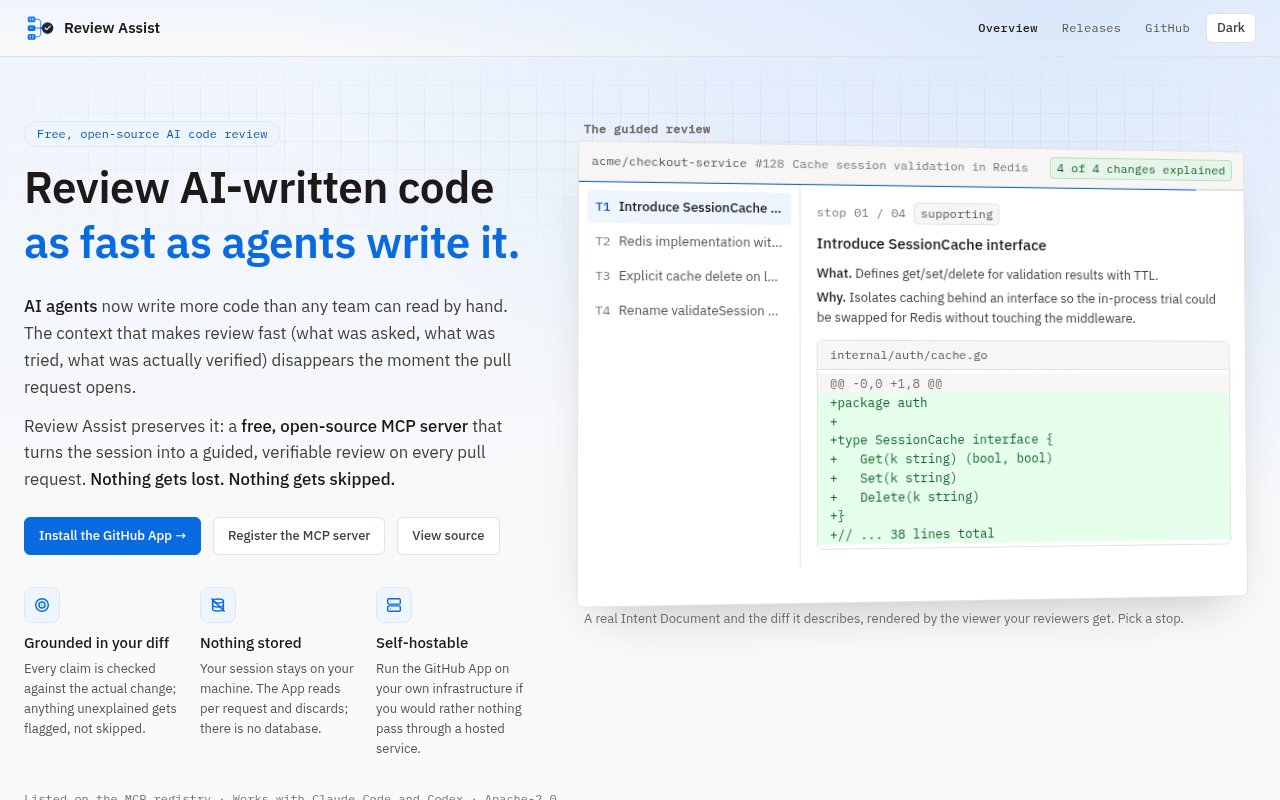
The GitHub App is installed on the repository. On every push it checks the Intent Document against the diff, posts a non-blocking check with the coverage result, adds a summary comment that links to the guided review, and fills in the pull request description from the document. It's an App rather than an Action, so there's no workflow file and no runner minutes. The guided review itself opens in the browser with the assumptions first, then a walkthrough anchored to the hunks, and comments and the verdict post back to the pull request as the reviewer. The demo on the homepage shows a real Intent Document rendered by that viewer, with numbered stops such as introducing a session cache interface and a Redis implementation with a sixty second TTL, each carrying a what and a why, so a reviewer walks the change in the order the agent reasoned about it rather than in file order.
It's for teams reviewing agent-written code on GitHub who want the agent's reasoning in the review rather than reconstructing it from the diff. Repository-specific verification rules go in a committed .reviewer folder, and organisations that don't want anything passing through a hosted service can self-host the App on their own infrastructure. The Intent Document format is deliberately frozen so that validators and viewers stay consistent, which also means the document is a stable artifact in the repository rather than something only the hosted app can read.
What makes it different from AI review bots is that it doesn't generate opinions about your code. It structures what the agent already knows and checks that the explanation covers the change, flagging anything unexplained instead of skipping it. The privacy posture is equally specific. The App has no database, reads the document and diff from GitHub per request with the reviewer's own token, keeps them in memory only for that request, and serves the viewer with private, no-store headers, so nothing about your code is retained. Reviewers sign in with GitHub once, and documents and diffs are read live from GitHub in the browser.
The release notes give a feel for how it has been hardened. Version 0.2.11 in late July 2026 made the role definitions install at the MCP handshake, after the team found that definitions written during a tool call couldn't be dispatched until the next session, so agents were simulating the split without the allowlist that enforces it. Version 0.3.1 in early August introduced paged diffs, hunk-id anchors, and a run handle that survives a restart, because the flow had been failing on exactly the changes large enough to deserve a document. Version 1.0.0 on 13 August added a paged session spine and an interview the server can attest from both sides, along with a schema fix that had been making every submission fail. Small version numbers, but the notes read like a maintainer who ships fixes for real failures.
It's a young project, with a 1.0 release in August 2026 and a small community, it's GitHub only, and it works with the agents that speak MCP, which today means Claude Code, Codex, and Claude Desktop. It's Apache-2.0 licensed, listed on the MCP registry, and free, with no paid tier of any kind. Source, release notes, and architecture documentation are on GitHub under uditk2/review-assist.
Key Features
- MCP server that captures agent intent at commit
- Committed Intent Document in a frozen JSON schema
- GitHub App check and summary on every push
- Guided browser review anchored to diff hunks
- Five deterministic validation checks
- Self-hostable with nothing stored
Pros & Cons
What we like
- Reviewers see what the agent asked, tried, and verified
- No database and no code retained
- No workflow file or runner minutes needed
- Apache-2.0 and free to self-host
Room for improvement
- GitHub only
- Needs an MCP-capable agent, Claude Code or Codex today
- Young project with a very small community
- Adds an Intent Document step to every agent commit
Frequently Asked Questions
What is Review Assist?
Is Review Assist free?
Does it store my code?
Which agents does it work with?
Best For
Featured in
Alternatives to Review Assist

Kevin Gabeci
Solo developer building web apps, cozy browser games, and AI creator toolkits.

SoloDevStack
A solo developer blog built on head-to-head tool comparisons, 580+ posts deep.

Codedex
A gamified, story-driven platform that teaches Python, web dev, and more like an RPG quest

Vibe Built
Building real apps with agentic AI. What worked, what broke, what shipped.
Reviews (0)
Badge builder
Add Review Assist to your website
Choose a badge style and size, preview it here, then copy the generated HTML. Badge images are self-contained SVGs and do not require an external script.

<a href="https://toolindex.net/tools/reviewassist?ref=badge" target="_blank" rel="noopener">
  <img src="https://toolindex.net/badge/reviewassist/medium.svg" alt="Review Assist - Listed on Tool Index" width="180" height="50" />
</a>How to use the badge
- 1. Pick the style, size, and theme that fit your layout.
- 2. Copy the generated HTML from the code block.
- 3. Paste it into your footer, homepage, or press page.
Standard badge available
The standard listing badge is available now. Score and circle badges are limited to tools currently ranked in the top 10 of a category.
Badge clicks return visitors to this profile with a referral tag so the source remains identifiable.
Related Tools
Kevin Gabeci
Solo developer building web apps, cozy browser games, and AI creator toolkits.

Coolify
Self-hostable, open source alternative to Heroku and Netlify

Warp
The modern terminal reimagined with AI and collaboration

Bolt.new
Prompt-to-deployed full-stack app inside the browser
Work on Review Assist? Request listing access or correction