
ScoutLayer
An API, playground and MCP server that pull public contacts and company details from any domain
Gallery
About ScoutLayer
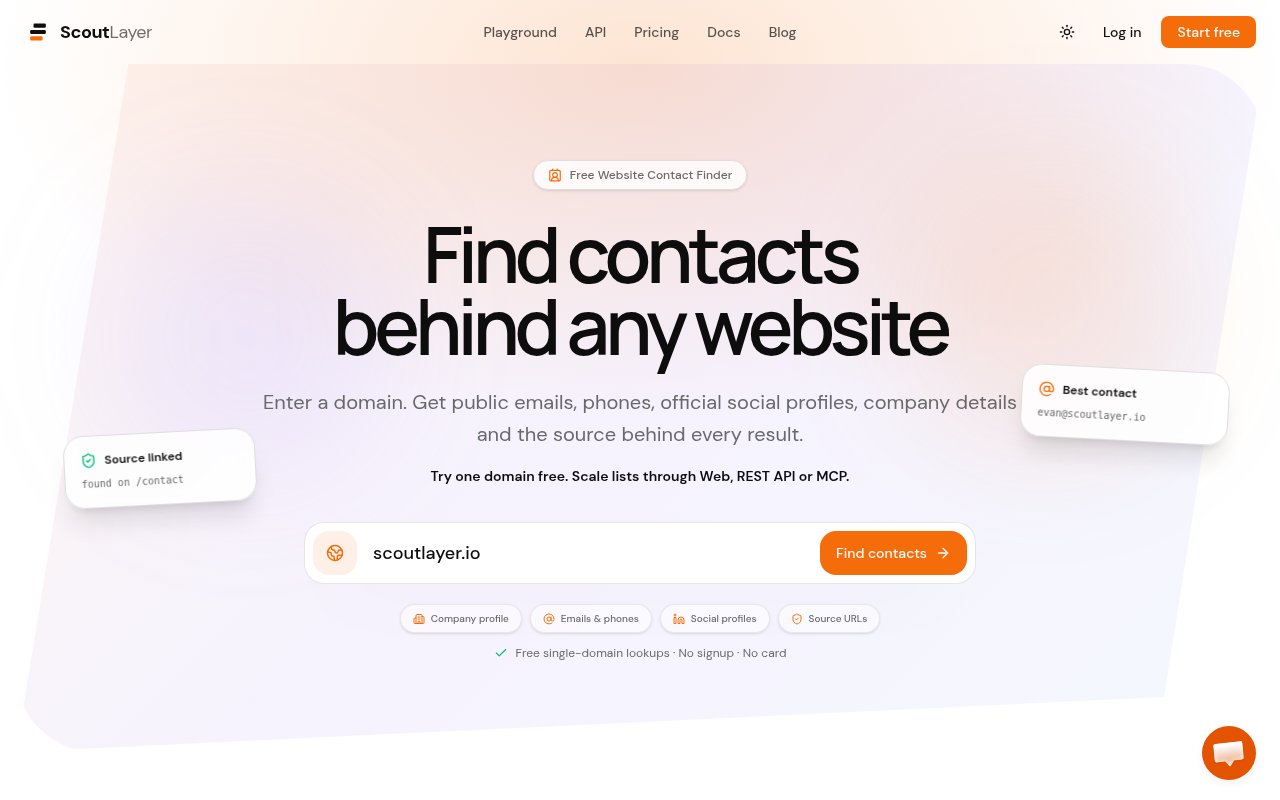
ScoutLayer is a contact discovery API that takes a domain and returns the public contact details a company publishes about itself, in a structured JSON shape. Give it a website and it comes back with emails, phone numbers, social profiles, the company's name and legal entity, logo, brand colours and postal address, each with a confidence score and the URL it was found on. The problem it goes after is the long tail. Contact databases cover the companies everyone already knows, and a newly launched SaaS or a small independent business is usually missing, so the person building a list ends up reading the site by hand.
It works by reading the site rather than buying data. A lookup fetches the company's public pages and the official profiles linked from them, matches and clusters what it finds with LLM assistance, and normalises the result into one schema. Emails are classified as personal, role-based or generic, so a sales tool can prefer a named founder over an info address, and a best_contact field picks the strongest option. The response is designed to be read by software. Alongside the email, phone and social arrays there's an information block with the company's name, legal entity, logo, brand colours and postal address, a people array for the individuals it identified, a pages list showing which URLs were read, a summary, and a meta block with the credits consumed on that call. Confidence scores and source URLs sit on each item, so a downstream tool can filter to high-confidence role addresses or route personal ones past a human first.
There are three ways in, all returning the same object. The web playground does a single domain lookup free with no account. The REST API is one endpoint, GET /api/v1/domain/{domain}, for bulk or in-app use. And there's an MCP server at scoutlayer.io/mcp that lets an AI agent in an OAuth-capable client run the same lookup, sharing one account and one credit balance with the API. That last option is what makes it fit agent workflows where a model needs to work out who to contact and then keep going.
It's aimed at teams enriching contact lists, founders doing outbound to companies that aren't in the big databases yet, and developers who'd rather call an endpoint than maintain a scraper. Because the source is only what a company publishes, it's also a reasonable fit for anyone who wants provenance on every contact, since each entry links back to the page it came from and can be checked in seconds. Getting started doesn't need a card. The playground takes a domain and shows the full response, which is the fastest way to see whether the companies you care about publish enough for it to work, and an account adds 50 credits and an API key so the same request runs from a script or a CRM integration.
Where it stands apart from the enrichment incumbents is the sourcing and the billing. There's no third-party data, which means fewer stale records but also nothing for a company that publishes no contact details at all, and pricing is per contact found, so a domain with no valid contact costs nothing. Compared with an established database, the trade is freshness and provenance against coverage. A database returns a record for almost any domain, but it may be years old and it can't tell you where it came from. ScoutLayer returns only what the company says about itself today, with the page it said it on, and returns nothing rather than a guess when there's nothing to find. For a list of new SaaS launches or independent shops that's the better bargain. For a list of large firms with a switchboard and no public email, a database still wins.
The limits follow from that. Coverage depends on what's on the site, results still need a human sanity check before a campaign goes out, rate limits and authentication aren't spelled out on the API page, and it's a young product from a small team rather than an established data vendor. Enterprise terms aren't listed either, so anyone needing volume beyond the largest pack will have to ask.
Access is freemium with one-time credit packs rather than subscriptions. A single web lookup is free forever, and a new account gets 50 credits to try the API. Starter is $19 for 2,500 credits, Pro is $49 for 10,000, and Scale is $199 for 50,000, which works out to $3.98 per thousand contacts at the top pack. Credits never expire, and one credit buys one contact with its company identity, public emails and phones, social profiles and sources. The API documentation sits at scoutlayer.io/website-contact-api, and support is reachable at hello@scoutlayer.io.
Key Features
- Domain to contact lookup API
- Email classification as personal, role or generic
- Confidence scores and source URLs per contact
- Company identity, logo, colours and address
- MCP server sharing the API's credit balance
- Free single-domain web playground
Pros & Cons
What we like
- Every contact links back to the page it came from
- No charge when a domain has no valid contact
- Credits never expire and there's no subscription
- Same schema across web, REST and MCP
Room for improvement
- Only finds what a company publishes itself
- Results still need a human check before outreach
- Rate limits aren't published
- Young product from a small team
Frequently Asked Questions
What is ScoutLayer?
Is ScoutLayer free?
Where does the data come from?
Can I use it from an AI agent?
Best For
Featured in
Alternatives to ScoutLayer
View all
Close
Inside-sales CRM with calling and email built in
HubSpot
All-in-one CRM and growth platform for marketing, sales, and service teams

Upscale B2B
Done-for-you cold email and AI outreach agency that books qualified B2B meetings on your calendar

Prosp
AI LinkedIn outbound that personalizes messages, voice notes, and multi-account campaigns at scale
Our take
Tool Index Editorial · Oct 2026· 3.5/5
ScoutLayer reads a live company website and returns public emails, phones, social profiles, company details, confidence, and a source URL in one structured record. We like that the web playground, REST API, and MCP server share the same schema, and that every fact can be checked against its source. One domain lookup is free without signup, and new accounts receive 50 credits.
This is provenance-first enrichment, not a replacement for a large contact database. It finds only what a business publishes, and LLM-assisted matching still deserves a human check before outreach. Credit packs start at $19 for 2,500 and never expire, with no charge when no working email is found. That pricing is attractive for long-tail domain lists, but rate limits and larger enterprise terms are not prominent on the public pages.
Editorial opinion from the Tool Index team, written from the public product pages. Not a user review.
Reviews (0)
Badge builder
Add ScoutLayer to your website
Choose a badge style and size, preview it here, then copy the generated HTML. Badge images are self-contained SVGs and do not require an external script.

<a href="https://toolindex.net/tools/scoutlayer?ref=badge" target="_blank" rel="noopener">
  <img src="https://toolindex.net/badge/scoutlayer/medium.svg" alt="ScoutLayer - Listed on Tool Index" width="180" height="50" />
</a>How to use the badge
- 1. Pick the style, size, and theme that fit your layout.
- 2. Copy the generated HTML from the code block.
- 3. Paste it into your footer, homepage, or press page.
Standard badge available
The standard listing badge is available now. Score and circle badges are limited to tools currently ranked in the top 10 of a category.
Badge clicks return visitors to this profile with a referral tag so the source remains identifiable.
Related Tools

Boilerroom
An all-in-one outbound sales platform for dialing, sequencing, and follow-up
Close
Inside-sales CRM with calling and email built in
Apollo.io
B2B prospecting database fused with a sales engagement platform
lemlist
Cold email and multichannel outreach with personalized images and video
Work on ScoutLayer? Request a listing correction