SenseCollect
An HTTP API that returns enriched local business leads, Amazon reviews, and TikTok posts, priced per row
Gallery
About SenseCollect
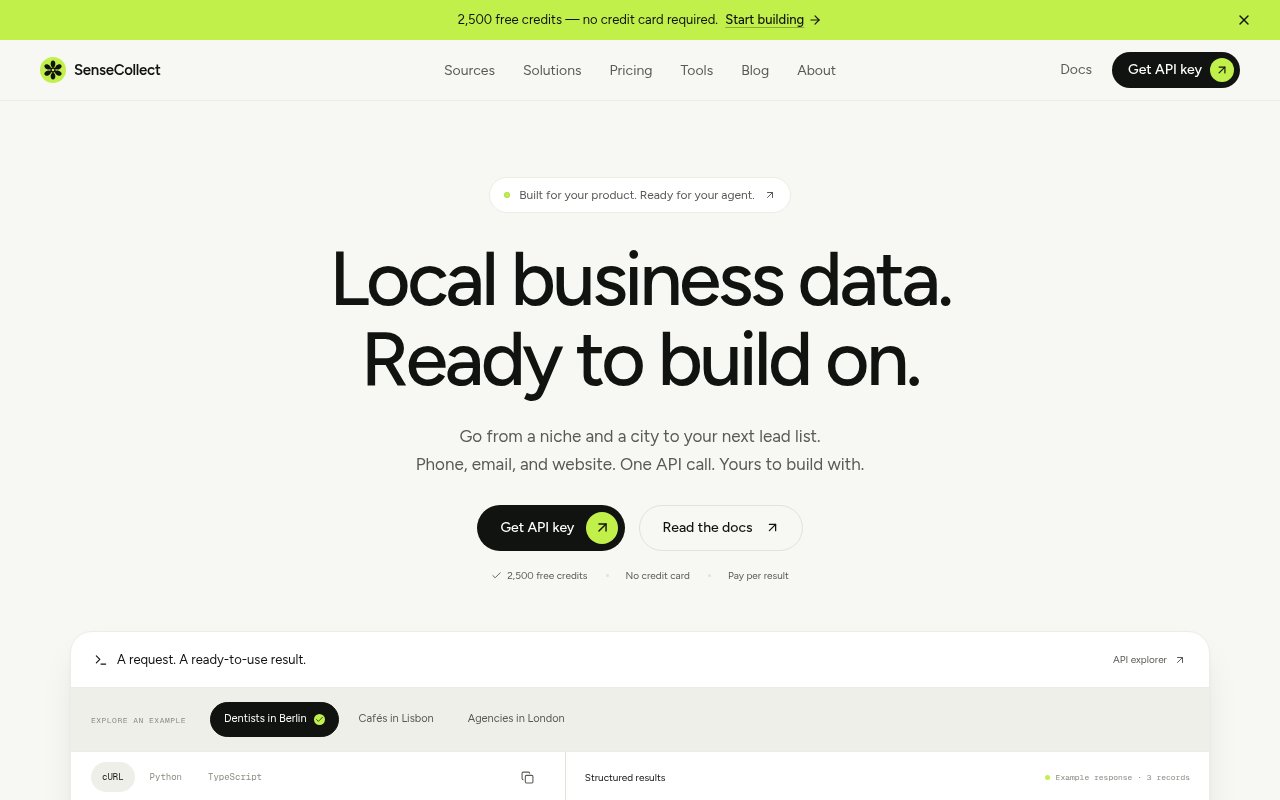
SenseCollect is an HTTP API for pulling lead and market data out of public sources without running your own scrapers. One call returns the businesses a Google Maps search would show for a niche and a place, enriched with phone, email, website, rating, and review count. Other endpoints return Amazon product reviews, including a complaints-only variant, and TikTok posts for a hashtag or topic with creator and engagement counts. Every result comes back in the same record shape, and you pay per row returned. The catalog currently lists sixteen endpoints across the three sources plus the housekeeping calls, all reachable with a single key from the dashboard.
The problem it solves is the gap between wanting a list of every plumber in a city with no website and actually having one. Scraping Maps yourself means proxies, breakage, and a parser to maintain. Buying a lead list means stale data and a minimum order. SenseCollect sits in between, an API with a catalog of sources, a dashboard to mint a key, and a bill that's proportional to what you actually got back. It also removes the guesswork about cost, since credits used and credits remaining come back in every response and the catalog publishes what each row costs before you call it.
Using it is deliberately plain. You create an API key, send GET requests with an x-api-key header, and read the records from the data field of the response. Every record carries the same fields, an id, type, source, title, url, content, and published date, an author with name and handle, a contact block with phone, email, and website, a location with the address, metrics for rating and review count, and a raw block holding the original source fields for anything the schema flattened. Requests can ask for enrichment and verification as parameters and cap how many rows come back, so a test doesn't turn into a bill. Long runs can be started with an async flag, which returns a job id immediately for polling. Watches re-run a search on a schedule and only charge when you fetch the changes, which is how you notice new businesses appearing in an area. Claim and release endpoints let you mark leads you've already worked so they don't come back in the next pull. For AI agents there's an MCP server at the same endpoint family with the same pricing and authentication, so an assistant can run the same queries a script would.
It's for anyone building an outbound pipeline, a local-services product, a market research tool, or an agent that needs fresh business data. Agencies prospecting for clients without a website, founders validating a niche, and developers who'd rather call an endpoint than babysit a scraper are the obvious fits. The businesses-without-a-website endpoint is the one built for web designers and agencies, since it filters the Maps results down to the companies most likely to need what they sell. The Amazon and TikTok sources widen that to product researchers and anyone doing social listening around a hashtag.
The differences that matter are in the billing and the schema. Pricing is per row with no per-call minimum, so a query that matches nothing costs nothing and failed runs are refunded automatically. There's no subscription and credits never expire, which suits the bursty way lead generation actually happens. Watches are free to run and charge only when you retrieve the changes, so monitoring a hundred searches for new arrivals costs nothing until something appears. The uniform record shape means fields a source can't fill come back empty rather than missing, so the code that handles a Maps result handles a TikTok post too. Verified contacts, which cost more per row, aren't charged when the address turns out to be undeliverable, and a personal_only filter drops shared inboxes.
It's narrow by design. Three sources is a short list next to the big data vendors, there's no CRM integration beyond what you build, and per-row credits mean a broad, careless query can burn through a pack quickly. The docs mention no SDK, only the HTTP interface and the MCP server, so you're writing the client yourself, and the record schema, while consistent, is shallow next to a dedicated review analytics product. Data quality is whatever the public source holds on the day, and the site doesn't publish a support address, only a contact page.
Access is freemium. New accounts get 2,500 free credits with no card required, which is enough for a real test. After that credits come in one-time packs, 10,000 for $19, 30,000 for $49, and 80,000 for $99, which the pricing page frames as roughly 588, 1,764, and 4,705 Maps leads respectively, and because credits don't expire an agency can buy the large pack and draw it down over a year. Costs per row are published in the source catalog, at 17 credits for a Maps search, 19 for Maps businesses without a website, 7 for Amazon reviews, 10 for TikTok posts, and 45 for a verified contact, while watches, claimed leads, account, and job endpoints are free.
Key Features
- Google Maps business search with contact enrichment
- Businesses without a website endpoint
- Amazon reviews and complaints-only endpoint
- TikTok posts by hashtag or topic
- Uniform record schema across sources
- MCP server for AI agents
Pros & Cons
What we like
- Pay per row returned with no subscription
- Credits never expire and failed runs refund
- Watches monitor searches for new results
- 2,500 free credits with no card
Room for improvement
- Only three data sources so far
- No published support email
- Careless broad queries burn credits quickly
- No built-in CRM integration
Frequently Asked Questions
What is SenseCollect?
Is SenseCollect free?
How much does a row cost?
Can AI agents use it?
Best For
Featured in
Alternatives to SenseCollect

Close
Inside-sales CRM with calling and email built in
HubSpot
All-in-one CRM and growth platform for marketing, sales, and service teams

Upscale B2B
Done-for-you cold email and AI outreach agency that books qualified B2B meetings on your calendar

Prosp
AI LinkedIn outbound that personalizes messages, voice notes, and multi-account campaigns at scale
Reviews (0)
Badge builder
Add SenseCollect to your website
Choose a badge style and size, preview it here, then copy the generated HTML. Badge images are self-contained SVGs and do not require an external script.

<a href="https://toolindex.net/tools/sensecollect?ref=badge" target="_blank" rel="noopener">
  <img src="https://toolindex.net/badge/sensecollect/medium.svg" alt="SenseCollect - Listed on Tool Index" width="180" height="50" />
</a>How to use the badge
- 1. Pick the style, size, and theme that fit your layout.
- 2. Copy the generated HTML from the code block.
- 3. Paste it into your footer, homepage, or press page.
Standard badge available
The standard listing badge is available now. Score and circle badges are limited to tools currently ranked in the top 10 of a category.
Badge clicks return visitors to this profile with a referral tag so the source remains identifiable.
Related Tools

Boilerroom
An all-in-one outbound sales platform for dialing, sequencing, and follow-up
Close
Inside-sales CRM with calling and email built in
Apollo.io
B2B prospecting database fused with a sales engagement platform
lemlist
Cold email and multichannel outreach with personalized images and video
Work on SenseCollect? Request listing access or correction